
Lieferung heute & morgen

Qualitätsgarantie

Willkommens-Angebote freischalten: KOSTENLOSE Lieferung | Bis zu 80 % RABATT | Kostenlose 30-Tage-JoyPlus-Testphase
App herunterladen
A 230V LED recessed spotlight can be connected directly to the mains in many areas of your home. Even so, choosing the wrong one is easy: a spotlight may not fit the existing ceiling cut-out, its colour temperature may not suit the room, or its stated IP rating may be misunderstood.
Here are the main pitfalls to watch out for:
First, measure the existing cut-out. It may be possible to enlarge an opening in a plasterboard or stretch ceiling, but reducing its size is much more difficult. You’ll also need enough space above the ceiling for the light, connection cable and, if required, a driver.
Flat LED recessed spotlights can have recessed depths of around 25.5 to 34 millimetres. A model with an outer diameter of 145 millimetres may need a cut-out of 115–135 millimetres, while a smaller spotlight measuring 118 millimetres across may be designed for a cut-out of 95–110 millimetres.
Luminous flux, measured in lumens, tells you how much light a spotlight produces. Wattage alone isn’t enough to compare products. For example, a 9-watt spotlight may produce 690, 720 or 780 lumens, depending on the model.
3CCT LED recessed spotlights usually offer a choice of 3000, 4000 and 6500 Kelvin. Check whether you can select the colour temperature using a switch on the housing or only through an app. A high CRI value, such as CRI 80, also indicates how accurately colours are rendered, but it can’t replace judging the light for yourself.
With dimmable LED spotlights, the light and dimmer need to be compatible. Some models require a compatible trailing-edge dimmer, while others can only be controlled via an app. A non-dimmable model must not be connected to an external dimmer.
The IP rating matters in bathrooms, kitchens and utility rooms. IP44 may be suitable for areas where splashing is possible, provided the installation and the relevant bathroom zones are taken into account. IP65 offers greater protection against dust and water jets. A qualified electrician should assess the specific installation.
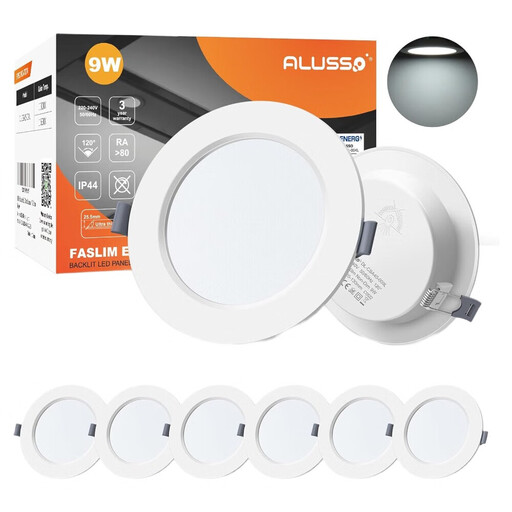
Why it suits this profile: This set includes six spotlights for consistent ceiling lighting and is designed for 220–240V direct connection, with no separate transformer required. Its recessed depth of 25.5 millimetres makes it suitable for ceilings with limited space.
The stated diameter of 145 millimetres, ceiling cut-out of 115–135 millimetres and direct mains connection make it easier to plan the installation in advance.
9 watts, 720 lumens, 6500 Kelvin, IP44 and a stated lifespan of over 30,000 hours.
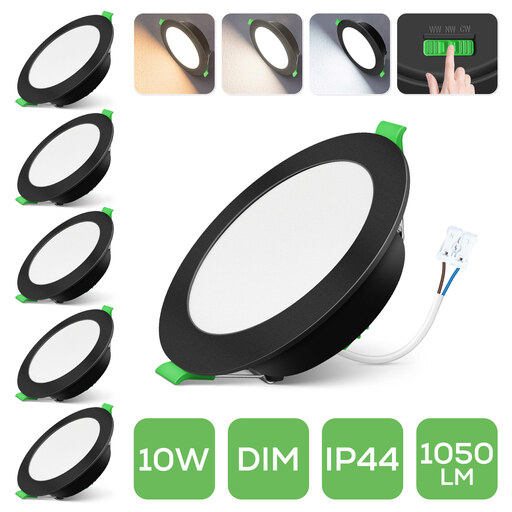
Why it suits this profile: This model combines a 230V connection with three selectable colour temperatures and a stated dimming function. That gives you more flexibility when planning the lighting for a kitchen, living room or bathroom.
Check compatibility with a suitable dimmer before installation. You can select one of the three colour temperatures using the built-in switch.
10 watts, 1050 lumens, 3000/4000/6500 Kelvin, a 90–100 millimetre cut-out and IP44.
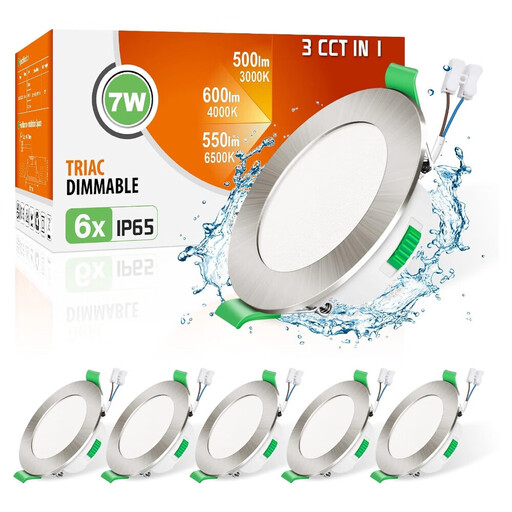
Why it suits this profile: With IP65, a 230V direct connection, a dimming function and six lights, this set is designed for rooms where moisture protection and flexible use are important.
The IP65 rating is clearly stated. Even so, you’ll need to check the permitted installation areas and dimmer compatibility on site.
7 watts, 3CCT with 3000/4000/6500 Kelvin, a dimming range of 10–100 per cent and a ceiling cut-out of 67–75 millimetres.
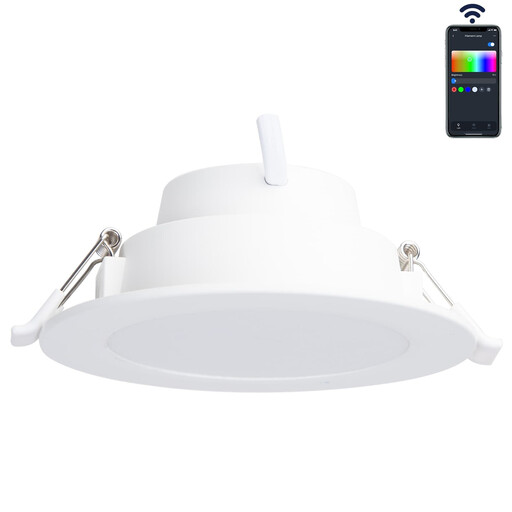
Why it suits this profile: This 220–240V model supports Bluetooth Mesh, app control, RGB colours and a colour temperature range of 2700 to 6500 Kelvin.
With an IP20 rating, this light is specifically intended for dry indoor areas. It is therefore not suitable for bathrooms or damp zones.
9 watts, 780 lumens, a 120-degree beam angle, plus app-controlled dimming and colour selection.
We’ve put together a complete, regularly updated list of products that meet these strict selection criteria and fully comply with the safety regulations in force in the EU.
Before installation, check that the circuit is switched off and that there is no voltage present. A proper connection is especially important when wiring directly to 230V. The ceiling cut-out must be within the range specified by the manufacturer so that the spring clips can hold the light securely.
For running costs, look at the power consumption in watts. This simple calculation is a useful guide:
Power in kW × operating hours × electricity price = electricity costs
A 9-watt spotlight uses 9 kilowatt-hours over 1,000 hours of operation. The actual cost depends on your electricity tariff and how long you use the light. You should also check the energy efficiency class on the product label.
A qualified electrician is required for work on fixed electrical installations. This applies even when a product without a transformer is connected directly to 220–240V.
It depends on the exact installation location and the bathroom’s electrical zones. IP44 may be suitable for protection against splashing water, but it does not protect against direct water jets or immersion. The installation should be assessed by a qualified professional.
The product information for this selection gives lifespans ranging from around 25,000 to over 30,000 hours, depending on the model. These are manufacturer figures and can be affected by heat, switching frequency, mains conditions and installation. Adequate heat dissipation is therefore still important.