
Lieferung heute & morgen

Qualitätsgarantie

Willkommens-Angebote freischalten: KOSTENLOSE Lieferung | Bis zu 80 % RABATT | Kostenlose 30-Tage-JoyPlus-Testphase
App herunterladen
230V LED recessed spotlights are suitable for bathrooms, kitchens, hallways, living areas and covered outdoor spaces. They connect directly to 220–240 V AC and generally do not require an additional transformer. However, LED recessed spotlights vary considerably in brightness, cut-out size, colour temperature, dimmability and moisture protection.
If you focus only on wattage or a low price, it is easy to end up buying an unsuitable model. The following points will help you avoid common mistakes and choose a light that is right for the room.
Wattage initially describes energy consumption. The key factor for actual brightness is the luminous flux in lumens. A 10W LED recessed spotlight producing 1,050 lumens will therefore not automatically be as bright as another 10W model with significantly fewer lumens.
When planning your lighting, you should also check whether the stated lumen figure applies to each light or to the complete set. With a six-pack of recessed spotlights, the luminous flux is normally specified per spotlight.
An IP44 LED recessed light is protected against solid foreign objects and splashing water from various directions. This makes it suitable for many bathroom areas and kitchens, but not for direct water jets, permanently wet locations or immersion.
For more humid environments, an IP65 LED recessed spotlight offers greater protection against dust and water jets. However, the IP rating does not replace correct installation. Connection points, the ceiling structure and the specific installation location must also be taken into account.
Dimmable LED recessed spotlights do not automatically work with every existing wall dimmer. A compatible trailing-edge dimmer is often required. Specifications such as ‘10–100% dimmable’ refer to use with a suitable control device.
If you want to continue using an existing dimmer, check that it is compatible with LED lights. A dimmer must not be connected upstream of non-dimmable models.
Slim LED recessed lights are particularly practical for low ceilings or suspended structures. What matters is not just the visible height, but the actual installation depth, including the terminal block and cable.
Before buying, measure the existing ceiling cut-out. Examples from the selection include:
The visible diameter alone is therefore not enough to make the right choice. The cut-out, installation depth and available connection space must all be compatible.
A 3CCT LED spotlight offers several selectable colour temperatures. Common values include:
With some lights, the colour temperature is selected before installation using a switch on the housing. This is useful if the room design may still change. With LED ceiling spotlights permanently set to 6,500 Kelvin, on the other hand, the colour of the light is fixed from the outset.
For dry indoor spaces, a light with a lower IP rating is often sufficient. In bathrooms, kitchens or on a covered balcony, you should check the installation zone. IP44 is intended for areas exposed to splashing water, while IP65 provides greater protection.
For garden paths, flowerbeds or fully exposed outdoor areas, conventional 230V recessed spotlights are not always the most suitable choice. Solar ground spotlights with a separate solar panel can be an alternative. For products with Bluetooth Mesh and RGBCCT functionality, smart garden lighting can be controlled via an app, depending on the model. Before buying, check the weather resistance, charging conditions and position of the solar panel.
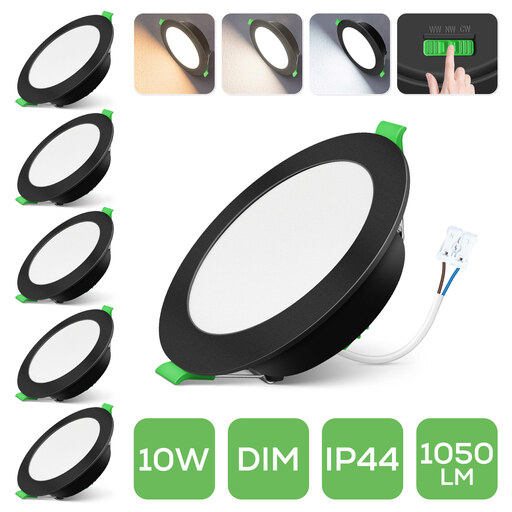
Why this product suits this profile: The six-pack combines three selectable colour temperatures with a stated brightness of 1,050 lumens per spotlight. This allows the lighting effect to be adapted to different living spaces.
Choosing by lumens rather than wattage alone is made easier. In addition, the dimmability is explicitly linked to a compatible dimmer and is not presented as a universal feature.
10W, 1,050 lm, 3CCT with 3,000/4,000/6,500 K, IP44 and direct connection to 220–240 V.
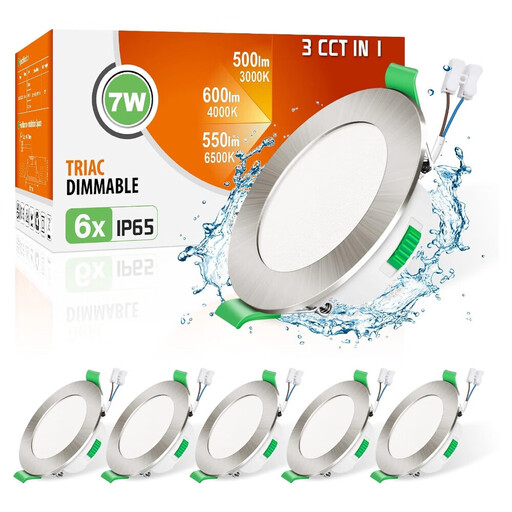
Why this product suits this profile: This compact spotlight is designed for damp areas and selected covered outdoor spaces. The choice of colour temperature and dimming function provide additional flexibility when planning your lighting.
The IP65 rating is clearly distinguished from IP44. The cut-out and installation depth are also specified precisely as 67–75 mm and 29 mm respectively.
IP65, 7W, up to 600 lm according to the product specification, 3CCT and 10–100% dimmability with a compatible dimmer.
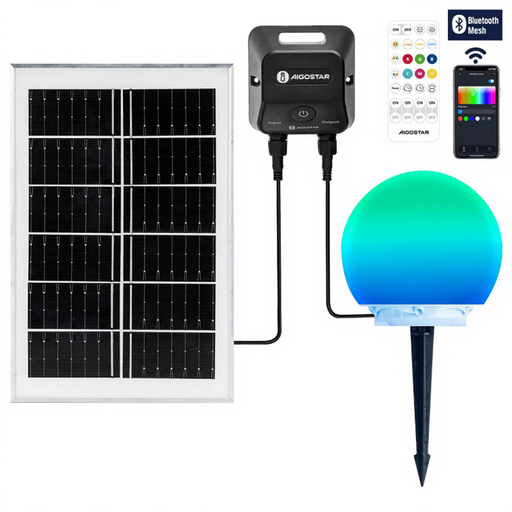
Why this product suits this profile: A solar-powered solution is ideal for garden paths, patios and flowerbeds if you do not want to install a 230V power supply. Bluetooth Mesh control supports central operation of multiple lights.
The light is not classified as a 230V recessed spotlight for indoor use, but as a standalone outdoor solution with a solar panel, battery and IP67 rating.
RGB+CCT with 2,700–6,500 K, Bluetooth Mesh, separate 5W solar panel and a 4,000-mAh battery according to the product description.
With 230V lights, the power supply must be switched off before installation. The connection should be carried out by a qualified person in accordance with the applicable installation regulations. Check the following in advance:
Power consumption is relevant when calculating electricity costs. A 10W spotlight used for four hours a day consumes 0.04 kWh per day in theory. With several lights, consumption increases according to the number of spotlights and the actual operating time. You should also check the energy efficiency class on the product label, as this varies from model to model.
We have put together a complete, regularly updated list of products that fully meet these strict selection criteria and the safety regulations applicable in the EU.
Direct connection to 220–240 V is possible without a transformer. However, as mains voltage can be life-threatening, installation should be carried out by a qualified electrician. Before any work, the relevant circuit must be switched off and secured against being switched on again.
Several of the models mentioned specify an average lifespan of 30,000 hours. Actual service life depends, among other things, on operating hours, heat dissipation, mains conditions and correct installation. A stated lifespan is therefore a product specification, not a guarantee that the light will operate for exactly that long in every household.
This depends on the exact installation location and the relevant installation zone. IP44 LED recessed lights are protected against splashing water and are often offered for suitable areas in bathrooms and kitchens. For more demanding damp areas, IP65 may provide greater protection. However, the IP rating alone does not determine whether installation is permitted; electrical installation regulations and the distance from water sources must also be observed.