
Lieferung heute & morgen

Qualitätsgarantie

Willkommens-Angebote freischalten: KOSTENLOSE Lieferung | Bis zu 80 % RABATT | Kostenlose 30-Tage-JoyPlus-Testphase
App herunterladen
In an era where laptops, tablets, and smartphones are constant companions in our professional and personal lives, a reliable mobile power supply is essential. A 25000mAh laptop power bank promises to fill this gap. However, the market is flooded with products whose specifications often create more confusion than clarity. As your Joybuy Product Recommendation Officer, I'm here to help you identify the crucial features and avoid common purchasing pitfalls.
Many users invest in a high-capacity power bank only to be disappointed by its charging performance. This is often due to overlooked details that manufacturers don't always highlight.
To make an informed decision, focus on these three technical specifications.
Think of capacity in milliamp-hours (mAh) as the size of the fuel tank. 25000mAh provides enough energy to charge a modern laptop once and a smartphone multiple times. Total output in watts (W), on the other hand, is the engine's power—it determines how quickly that energy can be delivered. A 165W power bank can distribute its high output across multiple devices simultaneously, which is ideal if you need a power bank for multiple devices. For demanding laptops, an output of at least 100W per port is a key benchmark.
Modern power banks should offer at least two, and ideally three, USB-C ports that support the Power Delivery (PD) 3.0 or 3.1 standard. This is the only way to ensure that devices like laptops, tablets, and smartphones can all charge simultaneously at their optimal speeds. Pay attention to the maximum output per port, not just the total output.
Additional features can significantly enhance practical usability. A power bank with a built-in cable reduces the need to carry separate accessories and minimises cable clutter. Another useful feature is a power bank with a display. This not only shows the remaining battery percentage but often also the current charging output in watts for each port, giving you complete control over the charging process.
Here are some product recommendations tailored to specific user profiles that meet the criteria mentioned above.
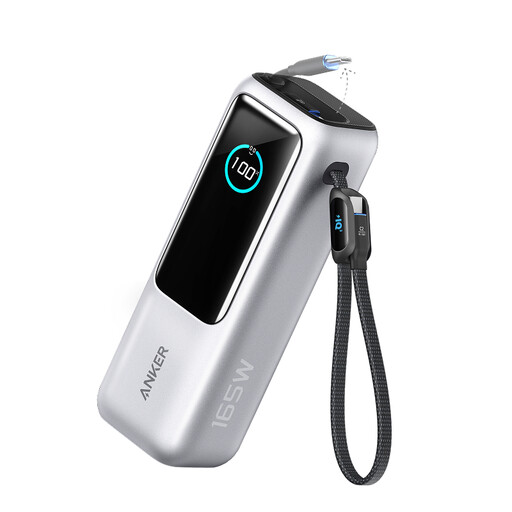
Why This Fits Their Persona: Ideal for digital nomads and professionals who need to charge multiple high-power devices—like a MacBook Pro, a tablet, and a smartphone—simultaneously without sacrificing speed. The combination of high capacity, high output, and integrated cables offers maximum on-the-go efficiency.
This model bypasses the misleading charging-speed trap with three USB-C ports offering up to 100W single-port output and a total output of 165W. The display shows the precise power delivery, and the integrated cables are rated for high performance.
High Charging Power: Charges up to four devices simultaneously, including demanding laptops. Integrated Cables: Two built-in USB-C cables (one retractable, one lanyard-style) for maximum convenience.
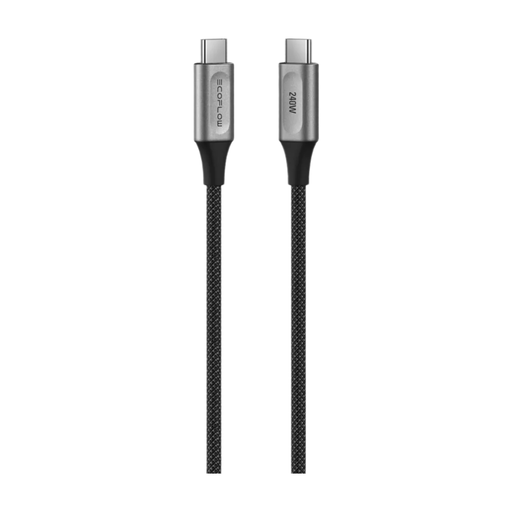
Why This Fits Their Persona: For users who already own a high-output power bank or wall charger but want to ensure not a single watt of power is lost to a subpar cable. Perfect for unlocking the full potential of their charging infrastructure.
This cable directly solves the "performance bottleneck" trap. By supporting up to 240W via the PD 3.1 standard, it ensures that even the most demanding devices can charge at maximum speed without creating a bottleneck.
Future-Proof: Supports the latest USB Power Delivery 3.1 standard for charging speeds up to 240W. Durability: The nylon braiding and reinforced connectors are designed for longevity and heavy use.
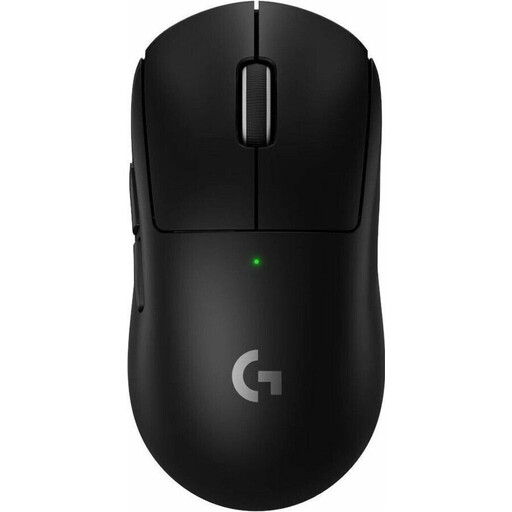
Why This Fits Their Persona: For users who demand efficiency and performance not just from their power supply, but from their entire mobile setup. This mouse complements a high-performance kit with its light weight, long battery life, and precise control—all chargeable via the same USB-C standard as their laptop and power bank.
This product avoids the "cable chaos" trap by relying on a universal USB-C charging port. It can be charged with the same cable and power bank as your laptop, reducing the number of accessories you need and simplifying your mobile setup.
Efficiency: Extremely lightweight (60g) with a battery life of up to 95 hours to maximize mobile productivity. Unified Standard: Charges via USB-C, ensuring compatibility with modern charging infrastructure.
We have compiled a complete, real-time updated list of products that fully meet these strict selection criteria and rigorous safety standards.
Yes, this is generally possible. The International Air Transport Association (IATA) limits lithium-ion batteries in carry-on luggage to 100 watt-hours (Wh). A 25000mAh power bank with a typical cell voltage of 3.7 volts has an energy rating of 92.5 Wh (25 Ah × 3.7 V), which is below the limit. It is recommended to check the specific regulations of your airline before travelling.
The most reliable method is to check the charging information directly on your device. Many laptops will indicate whether they are charging at full speed or if a slower power source is connected. A power bank with a display that shows the current wattage output offers the greatest transparency. Also, ensure you are using a USB-C cable rated for high-power delivery.
No, this is not the case when using high-quality, certified products. Modern devices and power banks communicate via protocols like USB Power Delivery (PD) to negotiate the optimal charging speed. The Battery Management System (BMS) in your laptop protects the battery from overcharging and excessive current. Therefore, charging with a powerful power bank is no more harmful than charging with the original power adapter.