
Lieferung heute & morgen

Qualitätsgarantie

Willkommens-Angebote freischalten: KOSTENLOSE Lieferung | Bis zu 80 % RABATT | Kostenlose 30-Tage-JoyPlus-Testphase
App herunterladen
For professionals and travelers whose productivity depends on charged devices, a dead battery is more than an inconvenience—it's a work-stopper. A high-capacity 25000mAh power bank seems like the logical solution, but the market is flooded with models whose advertised features often fail to deliver in practice. Before you invest, it's crucial to understand the common pitfalls that can lead to a bad purchase.
Many users discover after buying that their new power bank either can't charge their laptop, does so painfully slowly, or that the advertised capacity provides surprisingly few charge cycles. These issues often stem from three common but rarely discussed flaws:
To make an informed decision, you should focus on measurable technical specifications rather than marketing promises. The following three criteria are decisive for performance and usability.
Instead of the raw mAh figure, the rating in watt-hours (Wh) is a more accurate metric for stored energy. It is calculated by multiplying the nominal capacity (in amp-hours) by the nominal voltage of the battery cells (usually 3.7V).
This value is especially important for air travel. International aviation authorities limit lithium-ion batteries in carry-on luggage to 100 Wh. At 92.5 Wh, a 25000mAh power bank is safely within this limit, making it an ideal companion for frequent flyers.
The charging power determines how quickly your devices will charge. For demanding devices like a portable charger for a MacBook or other laptops, a high wattage is essential.
Look for support for the Power Delivery (PD) standard. This protocol enables intelligent communication between the power bank and the end device to deliver the maximum possible charging power safely and efficiently. A fast-charging power bank with PD 3.0 or PD 3.1 is future-proof.
The best power banks are designed for maximum efficiency. This means being able to charge multiple devices simultaneously without sacrificing speed.
Based on these objective criteria, we have identified a few models that represent a fitting solution for specific user groups.
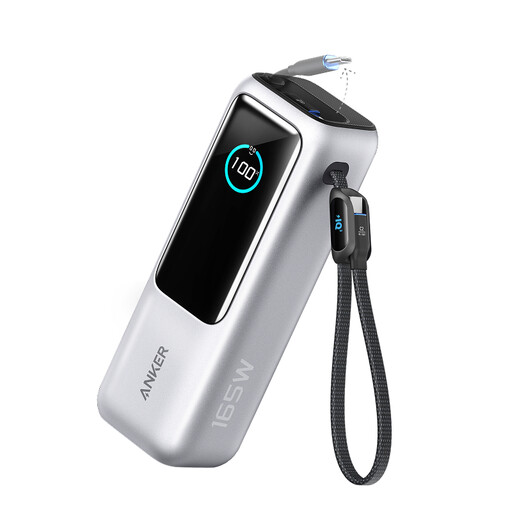
Why This Fits Their Persona: Ideal for users who need to power a complete mobile workstation on the go. With 165W of total output, it can charge a MacBook Pro, a tablet, and a smartphone simultaneously at high speed. The integrated cables make for a hassle-free setup.
Solves the slow-charging problem with a high total output of 165W and three powerful USB-C ports. The two built-in USB-C cables eliminate the need to carry extra cords.
Enables charging for up to four devices at once. One retractable and one fixed USB-C cable offer maximum flexibility.
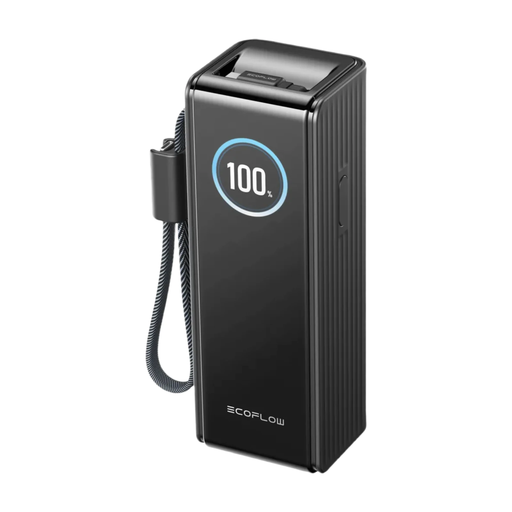
Why This Fits Their Persona: Perfect for tech-savvy users who demand full control and transparency. The high total output of 170W and two 140W-capable USB-C ports can power even the most demanding setups. The TFT display provides precise, real-time performance data.
The smart TFT display shows the actual power output, remaining capacity, and battery health. This creates transparency and exposes misleading capacity claims.
Two USB-C ports, each with up to 140W output. The power bank itself can be recharged at up to 140W, minimizing downtime.
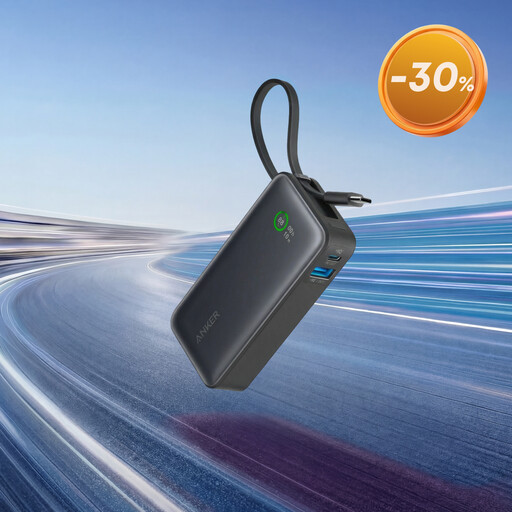
Why This Fits Their Persona: A compact and lightweight solution for the daily commute. It offers enough energy to charge a smartphone multiple times, and the built-in cable ensures maximum convenience with no cable clutter in your bag.
Solves the impractical design problem by directly integrating a powerful 30W charging cable. It helps avoid buying an oversized power bank for daily needs.
Combines 30W two-way fast charging with an extremely compact form factor. Ideal for quickly charging smartphones and tablets on the go.
We've compiled a complete, up-to-date list of products that fully meet these strict selection criteria and relevant safety regulations.
The number of charge cycles depends on the battery capacity of the device being charged and the power bank's efficiency. As a rough guideline, accounting for energy loss during conversion:
Yes, usually. The decisive metric is the capacity in watt-hours (Wh), which must not exceed 100 Wh. A 25000mAh power bank typically has 92.5 Wh (25 Ah × 3.7V), placing it under the limit. It is important that the power bank must be carried in carry-on luggage, not in checked baggage.
The nominal capacity (e.g., 25,000 mAh) refers to the sum of the internal battery cells at their native voltage (approx. 3.7V). During charging, this voltage is stepped up to the 5V, 9V, or higher required by the USB standard. This conversion process results in energy loss. Therefore, the actual capacity your device receives is lower. As a rule of thumb, you can expect an efficiency of 60–70%, which for a 25,000 mAh model corresponds to a real usable capacity of about 15,000–17,500 mAh at 5V.