
Lieferung heute & morgen

Qualitätsgarantie

Willkommens-Angebote freischalten: KOSTENLOSE Lieferung | Bis zu 80 % RABATT | Kostenlose 30-Tage-JoyPlus-Testphase
App herunterladen
A 28 cm deep frying pan with lid can combine the functions of a frying pan, sauté pan and braiser in one piece of cookware. That’s handy for families, keen home cooks and households short on storage space: you can fry vegetables, braise meat and finish a one-pot meal in the same pan.
However, product descriptions aren’t always clear. Terms such as ‘non-stick’, ‘suitable for all hob types’ and ‘scratch-resistant’ need careful consideration before you buy. Otherwise, three common pitfalls could leave you with a pan that doesn’t suit your kitchen or everyday needs.
A pan for all hob types needs a suitable base for induction. Many materials work on gas, ceramic and electric hobs, but induction hobs require a magnetic base. So look for an explicit statement that the pan is suitable for induction, rather than relying on a general marketing claim.
The contact area matters too: on a 28 cm pan, the actual base can be considerably smaller. The base diameter, not the width of the rim, is what matters for heat transfer.
A 28 cm coated pan makes frying and cleaning easier. Even so, any coating can be damaged by overheating, heating the pan while empty, harsh cleaning products or metal utensils. For a coated sauté pan, wooden, silicone or suitable plastic utensils are a sensible choice.
Claims such as ‘PFAS-free’, ‘PFOA-free’ or ‘PTFE-free’ refer to the product description. They shouldn’t automatically be taken to mean the coating will last longer or have a particular effect on your health.
A well-fitting lid is useful for braising, steaming and keeping food warm. However, the oven temperature limits are often different from those for the pan itself. Glass lids, plastic handles and silicone components can limit the maximum temperature. Before using the pan in the oven, check the manufacturer’s instructions for the pan and lid separately.
The 28 cm diameter usually refers to the top rim. A body height of around 7 to 8 cm gives you plenty of room for sauces, vegetables, pasta and braised dishes, without food spilling out as you stir. Weight also matters for everyday use: cast iron retains heat well, but it’s considerably heavier than aluminium.
Before you buy, check:
Aluminium heats up relatively quickly and is often paired with a non-stick coating in deep pans. Stainless steel is hard-wearing and suitable for searing, but it calls for a different approach to temperature and the use of oil or fat. Multi-layer bases with an aluminium core can improve heat distribution.
With a 28 cm non-stick pan, you should also check the care instructions. ‘Dishwasher-safe’ doesn’t necessarily mean the coating will remain unchanged over time. Many manufacturers recommend washing by hand with a soft sponge, even when the pan is technically dishwasher-safe.
An induction pan with lid should be clearly labelled as suitable for induction. Clear information about gas, electric and ceramic hobs is useful too. If you plan to use the pan in the oven, check the temperature limits and whether the lid is suitable. A handle that stays cool on the hob can still get hot in the oven.
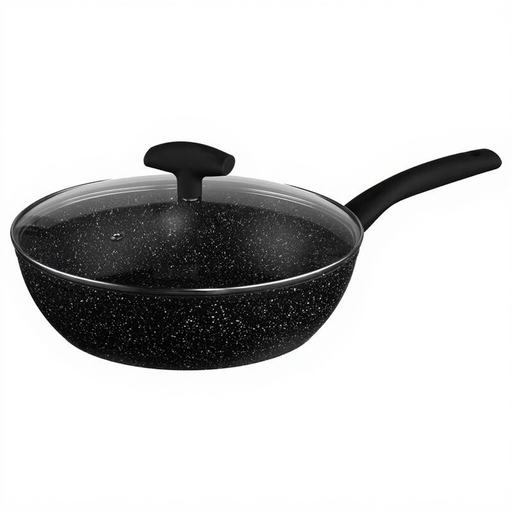
Why this product suits this profile: Forged aluminium, a non-stick coating, a glass lid and a stainless steel induction base make this pan well suited to everyday household cooking.
The stainless steel base is explicitly stated to be suitable for all common hob types. The manufacturer recommends washing by hand, making the care requirements clear.
28 cm size, glass lid, soft ergonomic handles and stated compatibility with induction, gas, electric and ceramic hobs.
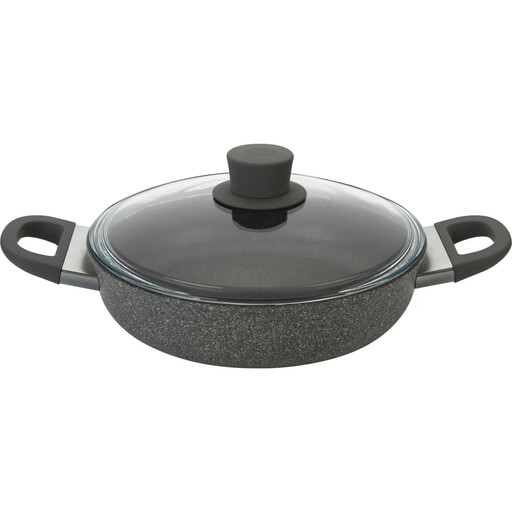
Why this product suits this profile: This forged aluminium pan has a five-layer GRANITIUM Extreme coating, two handles and a glass lid.
The product details specify the material, coating construction, lid material and compatible hob types. Based on the available product information, oven use isn’t guaranteed across the board.
Suitable for induction, with two carry handles, a glass lid and stated dishwasher suitability; handwashing is still recommended.
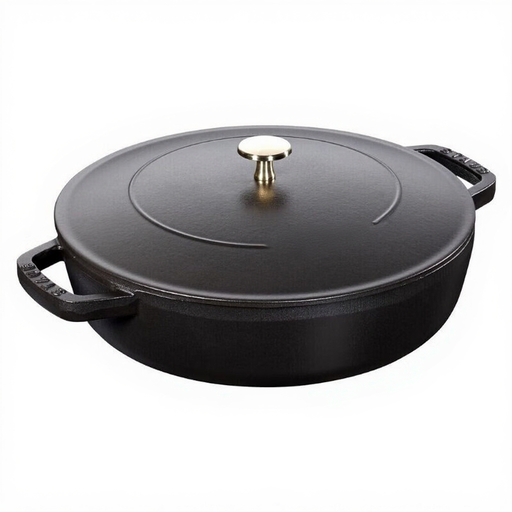
Why this product suits this profile: This enamelled cast iron pot is designed for braising, slow cooking and excellent heat retention.
Its substantial weight of 5.4 kg and the recommendation to wash it by hand are important to bear in mind. In return, the product details state that the pot is suitable for all hob types, the oven and the grill.
3.7 l capacity, enamelled cast iron, a lid and a stated temperature resistance of up to 260 °C.
We’ve put together a comprehensive, regularly updated list of products that meet these strict selection criteria and fully comply with the safety regulations in force in the EU.
Whatever the material, everyday use affects how long a pan lasts. Let your cookware cool down after use before cleaning it. Don’t use metal utensils or scouring pads with coated models. Avoid heating the pan on a high setting while it’s empty.
With a stainless steel pan, you can deal with significant temperature changes and stuck-on food differently than you would with a 28 cm coated pan. So follow the instructions for your particular pan. Don’t continue using a pan if its coating is damaged or peeling.
Not necessarily. Gas, electric and ceramic hobs are usually straightforward, while induction hobs need a magnetic base. Also check that the actual base of the pan is a suitable size for your cooking zone.
That depends on the model. The pan, handle and lid may all have different temperature limits. Some lids need to be removed before oven use; other models aren’t designed for use in the oven.
There’s no reliable one-size-fits-all answer. It depends on factors such as heat, utensils, cleaning and how often you use the pan. Low to medium temperatures, soft utensils and gentle cleaning can help preserve the coating.