
Lieferung heute & morgen

Qualitätsgarantie

Willkommens-Angebote freischalten: KOSTENLOSE Lieferung | Bis zu 80 % RABATT | Kostenlose 30-Tage-JoyPlus-Testphase
App herunterladen
A 28 cm stainless steel frying pan provides enough space for several portions, vegetables, meat, fish or one-pan dishes. At the same time, it will usually still fit on standard hob rings. To ensure your purchase performs well in everyday use, however, home cooks should look beyond shiny surfaces and terms such as “premium”. The key factors are the construction, hob compatibility, care instructions and the actual contents of the package.
A coating-free stainless steel frying pan is not automatically non-stick. Delicate foods can stick if the temperature is too low or too high. This is especially important when cooking eggs, fish or pancakes: preheating, using enough fat and turning the food at the right time all make a difference.
The advantage of an uncoated frying pan lies in its durable, direct-contact cooking surface. Nevertheless, you should follow the manufacturer's instructions for cleaning and using metal utensils. “Scratch-resistant” is a product characteristic, not a licence for rough handling.
An induction-compatible frying pan requires a magnetic base. With gas, ceramic, electric and halogen hobs, a flat underside and even heat distribution are also important. A multi-layer construction with an aluminium core can distribute heat more quickly than a simple stainless steel body.
Before buying, you should therefore check whether gas, induction, ceramic and electric are actually listed. The size of the hob ring also matters: a large 28 cm frying pan may heat unevenly on a small induction zone.
A stainless steel frying pan with a lid is practical for braising, reducing sauces and keeping food warm. However, the lid may be made of glass and have different temperature limits from the pan. The PURECOOK frying pan with lid is specified as oven-safe up to 220 °F, which is approximately 104 °C. This is considerably lower than the temperatures commonly used for many oven dishes.
“Dishwasher-safe” also does not mean that the surface will remain unchanged after every cycle. For a longer service life, mild washing-up liquid, a soft sponge and thorough drying are often the gentler choice.
With a 304 stainless steel frying pan, “304” refers to a commonly used stainless steel alloy with good corrosion resistance. However, the steel designation is not the only relevant factor when choosing a pan. You should also consider:
In a Tri-Ply frying pan, two stainless steel layers typically surround an aluminium core. Aluminium is a good heat conductor, while stainless steel forms the contact surfaces and outer areas. The PURECOOK models are described as having a Tri-Ply construction made from 304 stainless steel and an aluminium core. The information on GB 4806.9 and US FDA requirements comes from the respective product details; it should not be treated as an individual health or performance guarantee.
28 cm generally refers to the upper rim of the pan, not necessarily the actual heated surface. This diameter can be suitable for two to four portions. A high rim increases the capacity and makes braising easier, but it often also makes the pan heavier.
You should also look at:
A shallow pan is better suited to searing and turning food. A deeper model is more practical for sauces, vegetable dishes and recipes containing liquid.
Stainless steel reacts to sudden changes in temperature. An empty pan should not be left on a high heat setting for longer than necessary. After cooking, it is advisable to let the pan cool before cleaning, unless the manufacturer's instructions state otherwise. Water marks or slight discolouration are often purely cosmetic and, on their own, say nothing about the pan's performance.
When using acidic ingredients such as tomatoes or wine, follow the relevant material guidance. Rust-resistant properties reduce the amount of care required, but they do not replace drying the pan after washing.
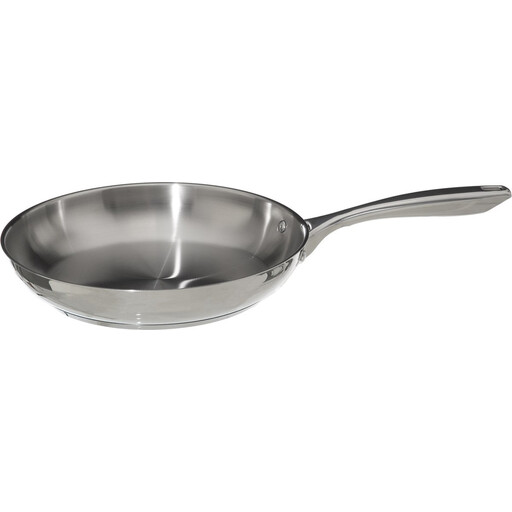
Why this product suits this profile: This 28 cm pan is aimed at households looking for straightforward everyday cookware suitable for gas, induction, ceramic or electric hobs.
The product details explicitly state the 28 cm size, compatibility with all common hob types and dishwasher suitability. This allows important compatibility questions to be checked before purchase.
28 cm diameter, 8.5 cm height, 2.2 l capacity and, according to the product description, suitability for all the hob types listed.
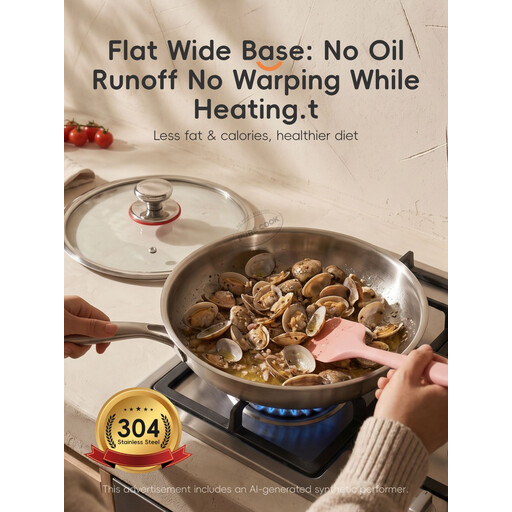
Why this product suits this profile: The multi-layer construction and included glass lid are ideal for households that want to cover frying, sautéing and braising with one utensil.
The product page specifies the Tri-Ply construction, 304 stainless steel, lid and use on gas, induction, ceramic and halogen hobs. The stated oven limit of 220 °F should be taken into account.
Sandwich base made from stainless steel and aluminium, glass lid with a silicone section and, according to the product description, dishwasher-safe cleaning.
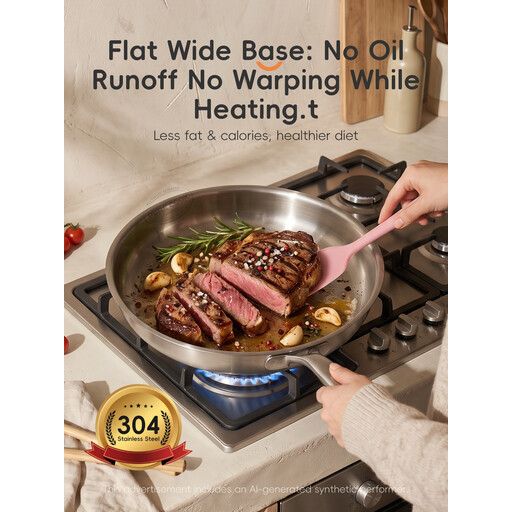
Why this product suits this profile: The lid-free model is ideal for frequent cooks who prefer a clear view of the food and already have a suitable lid.
The package contents are clearly specified as a single frying pan without a lid. This avoids misunderstandings about accessories or assumed all-in-one equipment.
Tri-Ply construction, 28 cm format and, according to the product details, suitability for gas, induction, ceramic and halogen hobs.
We have put together a complete, regularly updated list of products that fully meet these strict selection criteria and the safety regulations applicable in the EU.
Stainless steel requires different temperature control from many coated frying pans:
With induction, the pan responds particularly quickly. For this reason, start at a medium setting and increase the power only when necessary. Stainless steel handles can become hot; heat-resistant gloves are advisable during prolonged use or when using the pan in the oven.
That depends on the base. A frying pan is suitable for induction if the manufacturer expressly states this. According to the product details, the PURECOOK and Résilience models featured here are suitable for induction and other hob types.
The pan should be preheated before adding oil. Dry food, enough fat and the right temperature help to reduce sticking. If the food is moved too early, it may not release from the surface as easily.
It is not possible to give a reliable fixed service life. This depends on the material thickness, layer construction, temperature control, cleaning and frequency of use. A stainless steel frying pan used and cared for correctly can last for many years; visible discolouration or scratches do not automatically mean that it has lost its functionality.