
Lieferung heute & morgen

Qualitätsgarantie

Willkommens-Angebote freischalten: KOSTENLOSE Lieferung | Bis zu 80 % RABATT | Kostenlose 30-Tage-JoyPlus-Testphase
App herunterladen
A 28-inch trekking e-bike needs to handle several different tasks: it should feel controlled in urban traffic, offer sufficient range for the daily commute and remain comfortable on longer leisure rides. At the same time, unclear range specifications, unsuitable frame sizes and incomplete equipment frequently lead to disappointing purchases.
Author: Joybuy Product Recommendation Officer
Specifications such as “up to 100 km” or “up to 120 km” generally refer to favourable conditions, such as a low assistance level, flat terrain, moderate rider weight and suitable temperatures. Headwinds, hills, frequent stops and starts, luggage and cold German winter days can significantly affect the actual range.
For this reason, do not compare only the stated kilometres. Also consider the battery capacity in watt-hours (Wh). A 400-Wh battery provides a more meaningful basis for comparison than a marketing claim based solely on range.
An e-bike with 70 Nm of torque can provide strong support on hills. However, it is equally important to consider whether the motor is mounted at the crank, rear wheel or front wheel. A mid-drive trekking e-bike generally uses the bicycle’s gearing system, allowing it to adapt to different gradients. A front motor is often sufficient for flat urban routes, but it can feel different on loose surfaces or steep climbs.
The legally permitted motor output is also relevant: in Germany, pedelecs with a rated continuous power of up to 250 W and motor assistance up to 25 km/h are generally treated in the same way as conventional bicycles. Nevertheless, you should always check the specific equipment and conformity details in the product information.
A suspension fork or suspension seat post can soften uneven surfaces, but it does not automatically make a bicycle a good fit. Before buying, check the frame size, top-tube design, handlebar position and available saddle-height adjustment.
A step-through e-bike or wave frame makes mounting and dismounting easier. A trapezoidal frame also offers relatively comfortable access and can be an excellent compromise for commuters.
For frequent hills, longer rides or heavier loads, a mid-drive motor with a torque sensor is an appealing option. It responds to pedal pressure and can therefore adapt directly to the rider’s input. Front and rear hub motors are often mechanically simpler and may be sufficient for flat urban routes.
Pay attention to the following specifications:
An e-bike with a removable battery is easier to charge at home, in a cellar or at the workplace. With fully integrated batteries, you should also check whether they can actually be removed and how the removal process works.
As a general guide:
A 9-speed drivetrain offers more ratios than a 3-speed hub gear and is practical for changing gradients and longer rides. A hub gear such as the Shimano Nexus Inter7, on the other hand, is designed for frequent urban riding and low-maintenance operation.
Hydraulic disc brakes are included on many trekking and city models. Even so, check before buying whether replacement pads are readily available and whether the braking system can be serviced regularly.
A StVZO-compliant e-bike should include functioning front and rear lights, reflectors, a bell and suitable rear reflectors, among other features. When shopping online, it is advisable to read the precise model description and included accessories. On pre-assembled bicycles, check the pedals, handlebar, brakes, gears and all screw connections before the first ride. Depending on the model, final assembly by a qualified bicycle workshop may be advisable.
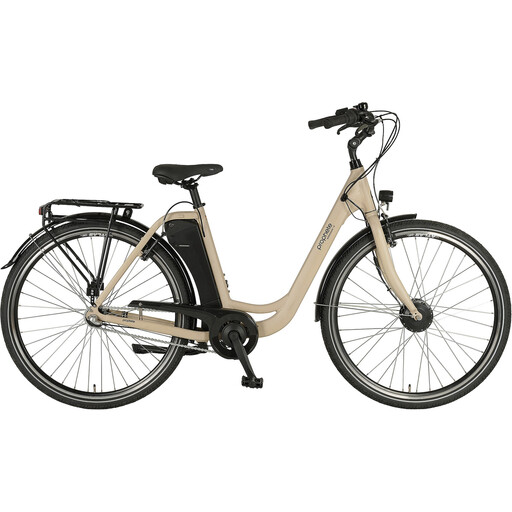
Why it suits this profile: This city e-bike is designed for adults who mainly ride on flat urban routes, run errands and enjoy relaxed journeys. The 49 cm wave frame makes mounting easier.
The product specifications state 374 Wh, a range of up to 100 km and five assistance levels. This makes it easier to assess the battery and intended use realistically.
28-inch wheels, 40 Nm front motor, Shimano Nexus 3-speed hub gear, luggage rack and LED lighting.
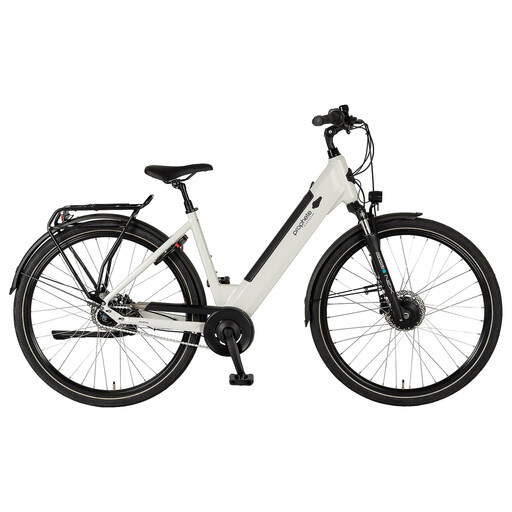
Why it suits this profile: For daily rides, commutes and frequent stops, the low wave frame provides easy, hassle-free access.
The removable 399.9-Wh battery can be charged either on the bike or separately. This reduces the hassle when there is no parking space with access to a power outlet.
Shimano Nexus Inter7 hub gear, hydraulic disc brakes, suspension fork, suspension seat post and a stated range of up to 100 km.
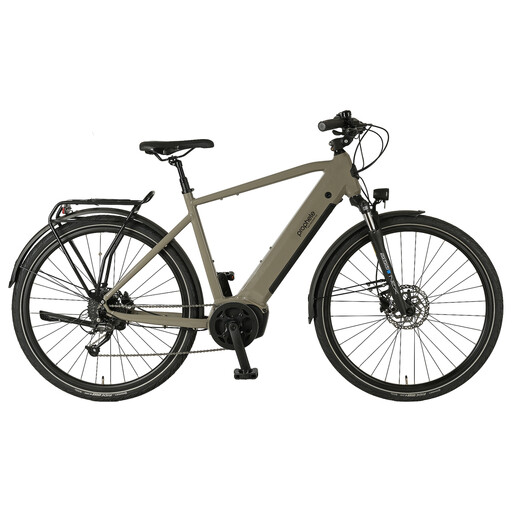
Why it suits this profile: This model is designed for everyday journeys and longer tours. Its 54 cm diamond frame is ideal for riders who prefer a classic frame design.
The AEG mid-drive motor is specified with up to 70 Nm of torque, a 400-Wh battery and a torque sensor. For touring, these details are more informative than motor power alone.
Shimano Altus 9-speed drivetrain, hydraulic Shimano MT200 disc brakes, 28-inch Continental tyres and a permitted maximum gross weight of up to 150 kg.
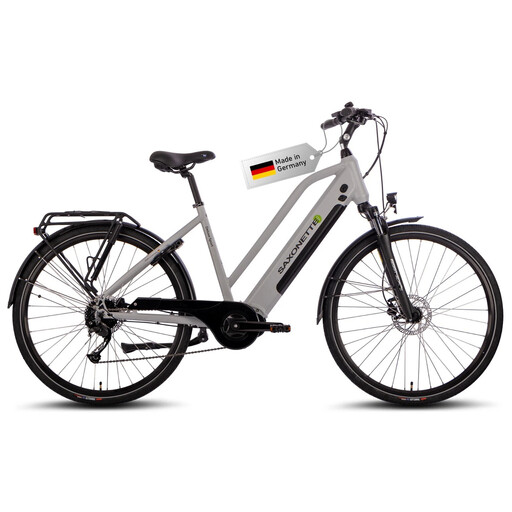
Why it suits this profile: The 50 cm trapezoidal frame, 70 Nm mid-drive motor and 9-speed drivetrain appeal to riders who want to combine everyday cycling with touring.
The product description states 418 Wh, a removable battery and a range of up to 120 km. These figures should be understood as manufacturer specifications under specific conditions.
Shimano Alivio 9-speed drivetrain, hydraulic disc brakes, front suspension fork, luggage rack and, according to the product specifications, StVZO-compliant lighting and reflectors.
Our complete selection includes additional e-bikes with 28-inch wheels for urban riding, commuting and trekking tours. Before buying, check the technical specifications and included accessories for each model.
Battery life depends on charging cycles, temperature, usage and storage conditions. Charge the battery with the supplied charger, protect it from extreme heat and cold, and store it in a dry place at a moderate charge level if the bike will not be used for an extended period. Its actual capacity will decline over time; check the relevant provider’s warranty and replacement-part terms for specific details.
Electricity costs depend on battery capacity, the price of electricity and energy consumption. A battery with around 400 Wh theoretically requires approximately 0.4 kWh for a full charge. Charging losses and actual usage will add to this figure. You should also budget for tyres, brake pads, the chain, servicing and, where applicable, replacement batteries.
For commuting, 28-inch wheels, mudguards, a luggage rack, lighting and a suitable riding position are particularly practical. If you regularly encounter hills, a mid-drive motor with higher torque may be a sensible choice. On a step-through e-bike, the frame design makes mounting and dismounting easier. Before every ride, check the brakes, tyre pressure, lighting system and battery level.