
Lieferung heute & morgen

Qualitätsgarantie

Willkommens-Angebote freischalten: KOSTENLOSE Lieferung | Bis zu 80 % RABATT | Kostenlose 30-Tage-JoyPlus-Testphase
App herunterladen
A 28 cm ceramic induction frying pan is suitable for many households in Germany: its diameter provides room for several portions, while the pan can respond quickly on an induction hob. However, models vary considerably in terms of base construction, coating, side height, cleaning and hob compatibility.
Anyone who only looks for terms such as “scratch-resistant”, “healthy” or “suitable for all hob types” may overlook important details. Three common buying pitfalls are particularly relevant:
A coated induction frying pan needs a magnetically suitable base. Look for the explicit statement “induction-compatible” in the product specifications. For a versatile household, approval for gas, electric and ceramic hobs is also useful.
A multi-layer stainless steel body with an aluminium core can distribute heat across the base. With aluminium pans, however, it is crucial to check whether a suitable induction base has been integrated. A pan for gas and electric hobs will not automatically work on induction.
With a ceramic non-stick frying pan, the description should clearly state what the main body and surface structure are made of. Terms such as “Diamond”, “Titanium” or “Hybrid” are not, on their own, a measurable guarantee of quality. More useful details include:
If a product is advertised as PTFE-, PFOA- or PFAS-free, this statement should be understood as information provided by the manufacturer. It is not general proof that a pan is completely “free from harmful substances”. When choosing, transparent information about materials and safety is therefore important.
28 cm generally refers to the pan’s upper diameter. The actual usable base may be smaller. This is particularly relevant on an induction hob, as the heating zone should match the pan base.
A shallow 28 cm coated frying pan is suitable for eggs, vegetables, fish or searing meat. A deep-sided version with a body height of 7.5 to 8 cm is better suited to casseroles, sauces and one-pot recipes. A pan with a lid retains liquid and heat in the cookware, but is often heavier and requires more storage space.
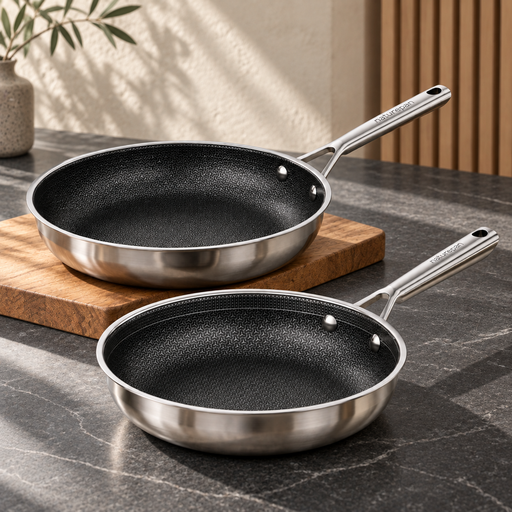
Why this product suits this profile: With 24 and 28 cm pans, this two-piece set covers typical sizes for everyday household cooking and is specified as suitable for induction, gas, electric and ceramic hobs.
The hob types and measurements are listed clearly. The hybrid, textured surface is described as suitable for frying and searing; metal utensils are nevertheless not recommended.
24 and 28 cm pans, multi-layer stainless steel body with aluminium core, oven use up to 230 °C according to the product information.
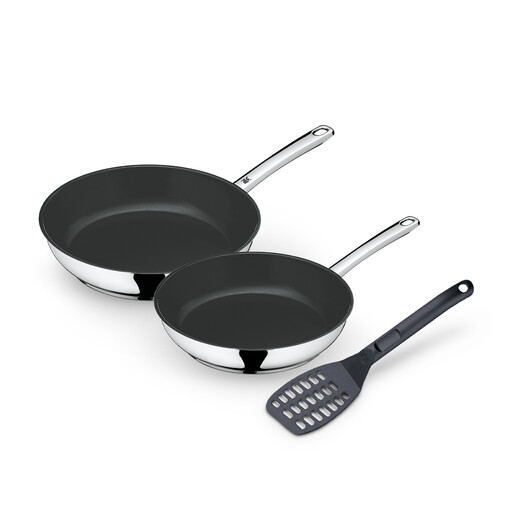
Why this product suits this profile: The set combines two coated stainless steel pans with a matching turner, making it suitable for households that prioritise equipment and clearly specified materials.
The product details specify the coating, Cromargan stainless steel 18/10, TransTherm base, hob types and temperature limits. This makes it easier to assess the equipment before buying.
Two sizes, ceramic coating, induction compatibility and a dishwasher-safe turner; according to the product information, the pans are oven-safe up to 250 °C.
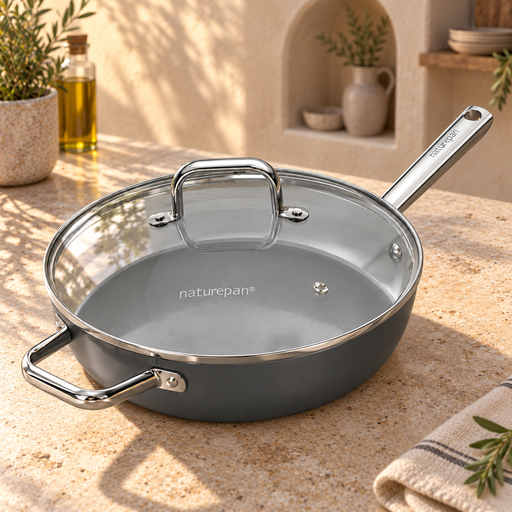
Why this product suits this profile: The tall 7.5 cm sides and included glass lid are ideal for casseroles, sauces, ragouts and one-pan meals.
The pan is explicitly listed as suitable for induction, gas, electric and ceramic hobs. For oven use, the lid must be removed; use in a microwave is not permitted.
28 cm diameter, ceramic coating with Diamond-Titanium reinforcement, lid and oven suitability up to 260 °C according to the product information.
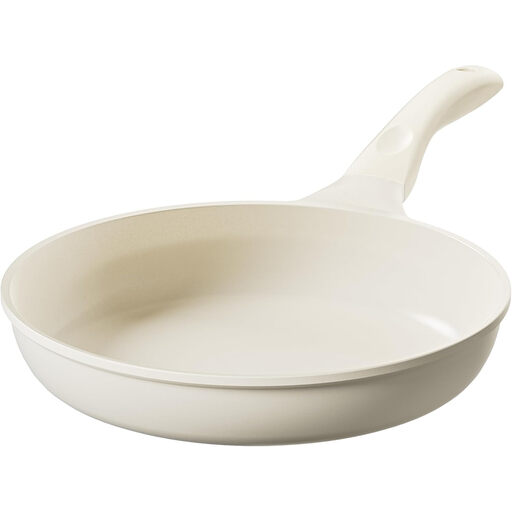
Why this product suits this profile: This individual 28 cm pan is designed for everyday dishes and is described as featuring aluminium, ceramic and stainless steel components, along with a Bakelite handle.
The specifications explicitly mention induction, gas and electric hobs. They also recommend wooden, silicone or nylon utensils to help protect the coating from scratches.
28 cm format, ergonomic Bakelite handle, ceramic non-stick surface and stated dishwasher suitability.
Even a dishwasher-safe pan should, where possible, be cleaned by hand. Allow the cookware to cool naturally first. Use warm water, a mild washing-up liquid and a soft sponge. Abrasive cleaners, scourers and sharp objects can damage the surface.
For everyday use, follow these guidelines:
The service life cannot be predicted from the coating name alone. Frequent exposure to high temperatures, unsuitable utensils and aggressive cleaning have a greater impact on how long the pan lasts than the marketing claim on the packaging.
We have put together a complete, regularly updated list of products that fully meet these strict selection criteria and the safety regulations applicable in the EU.
No. A ceramic coating says nothing about the type of hob. What matters is a magnetic, induction-compatible base. Also check whether gas, electric and ceramic hobs are approved for use.
There is no standard service life. How long it lasts depends on heat, cleaning, the utensils used and how often you cook with it. Low to medium temperatures and hand washing can help protect the coating.
For two people, a 28 cm pan usually provides enough room for vegetables, fish, eggs or smaller portions of meat. However, check the base diameter: it can be considerably smaller than the upper diameter and should match the induction zone.