
Lieferung heute & morgen

Qualitätsgarantie

Willkommens-Angebote freischalten: KOSTENLOSE Lieferung | Bis zu 80 % RABATT | Kostenlose 30-Tage-JoyPlus-Testphase
App herunterladen
A 28 cm frying pan is a practical choice for many kitchens: it offers enough cooking space for several portions while remaining more manageable than an oversized pan. The selection ranges from non-stick frying pans and stainless-steel pans to 28 cm grill pans and deep sauté pans with lids.
However, marketing terms such as “non-stick”, “suitable for all hob types” or “dishwasher-safe” reveal little about real-world use on their own. What matters are specific details regarding hob compatibility, temperature limits, coating, care and included accessories.
An induction pan requires a magnetic base. Many models explicitly state that they are induction-compatible, while others are suitable only for gas, electric or ceramic hobs. Halogen and infrared hobs are not always supported automatically either.
Before buying, compare the product description carefully with the hob you have at home. If you move or replace your cooker later, choosing a model explicitly designated as an induction pan can offer greater flexibility.
A non-stick pan is not automatically suitable for very high temperatures or oven use. Coated models often require low to medium heat. The handle may also limit the maximum permissible oven temperature.
Examples from the product specifications: The ZWILLING Shine grill pan is rated for a maximum temperature of 150 °C and is not oven-safe. By contrast, the ZWILLING Pro pan and several Naturepan models are described as oven-safe up to 230 °C. Specific figures like these are more meaningful than general claims such as “heat-resistant”.
A dishwasher-safe pan can be cleaned in the dishwasher, but hand-washing is often recommended for coated surfaces to preserve their performance for longer. Stainless steel is generally less sensitive, but incorrect cleaning can still cause stains or discolouration.
It is worth checking the care instructions before buying. The product specifications reviewed here generally recommend a mild detergent, a soft sponge and thorough drying before storage.
A coated frying pan makes it easier to release delicate foods and is often well suited to controlled cooking at low to medium temperatures. Wooden, silicone or plastic utensils are generally the safest choice. Metal utensils can damage the surface unless the manufacturer expressly permits their use.
A stainless-steel pan does not rely on a conventional non-stick coating and is designed for long-term use when handled correctly. Food may initially stick more readily. Preheating the pan, adding oil afterwards and selecting the right temperature can help reduce sticking. Discolouration and limescale residue are not unusual with stainless steel and can often be removed with suitable cleaning products.
According to the respective product descriptions, multi-layer constructions made from stainless steel and aluminium combine a robust outer surface with a heat-conducting aluminium layer. Their practical performance still depends on the base thickness, hob power and cooking technique.
Look for a clear list of compatible heat sources:
The stated diameter of 28 cm does not always correspond to the genuinely usable cooking surface. With a pan featuring sloped sides or a smaller base, the effective cooking area is reduced. For induction, the pan base should ideally match the size of the cooking zone.
A shallow frying pan is well suited to steaks, vegetables, eggs and one-pan dishes. A taller deep sauté pan with lid is the better choice when reducing liquids, cooking vegetables or continuing to cook a covered dish.
Before using a pan in the oven, check three points: the maximum temperature, whether the pan body is oven-safe and the handle’s temperature resistance. With models featuring glass lids, the lid may have a lower temperature limit or need to be removed before placing the pan in the oven. A metal pan must never be used in a microwave.
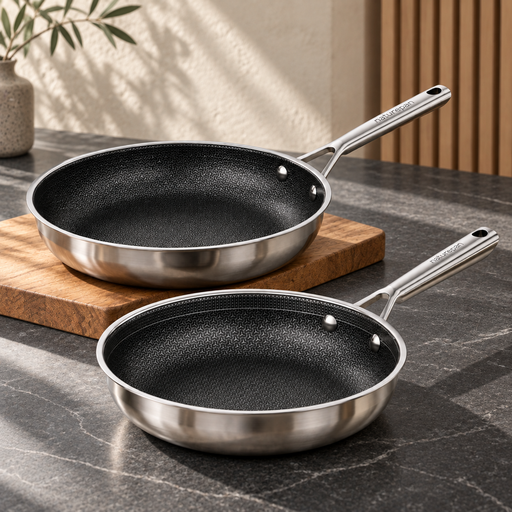
Why is this model a good fit? Two sizes cover the most common everyday cooking tasks, from individual portions to family meals. According to the product specifications, both pans are suitable for induction, gas, electric and ceramic hobs.
Hob compatibility and the included contents are clearly specified. The coated surface should be used with low to medium heat and soft kitchen utensils.
24 cm and 28 cm pans in one set; ceramic coating; listed as dishwasher-safe and oven-safe up to 230 °C without the lid.
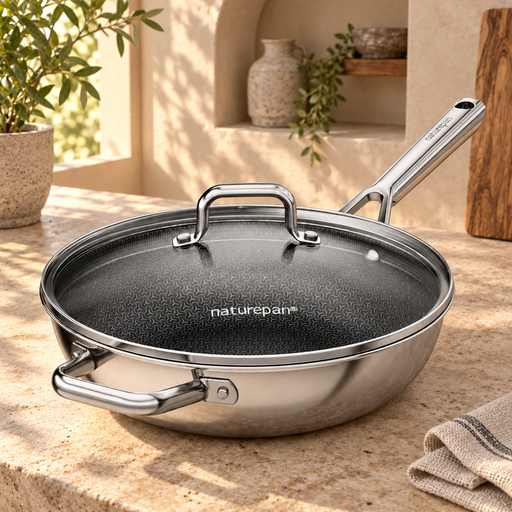
Why is this model a good fit? The taller shape and included lid are ideal for braising, sauces and larger portions. Its hybrid construction combines stainless steel, an aluminium core and ceramic-coated areas.
The maximum oven temperature of 230 °C is specified; the lid must be removed before oven use. It is approved for induction and three other hob types.
28 cm diameter; lid included; listed as dishwasher-safe in the product data; designed for frying, sautéing and braising.
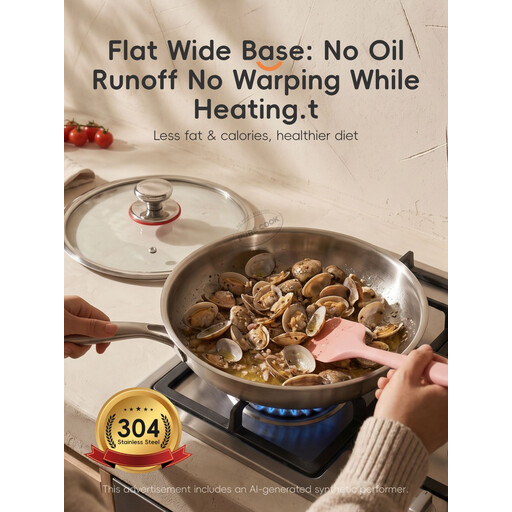
Why is this model a good fit? This pan is aimed at households that value a cooking surface without a non-stick coating and a glass lid. Its three-layer construction includes stainless steel and an aluminium core.
This model does not depend on a non-stick coating. Cooking without a coating requires preheating, the right amount of oil and carefully controlled heat.
304 stainless steel with aluminium core; glass lid; listed as suitable for gas, induction, ceramic and halogen hobs, as well as dishwasher-safe.
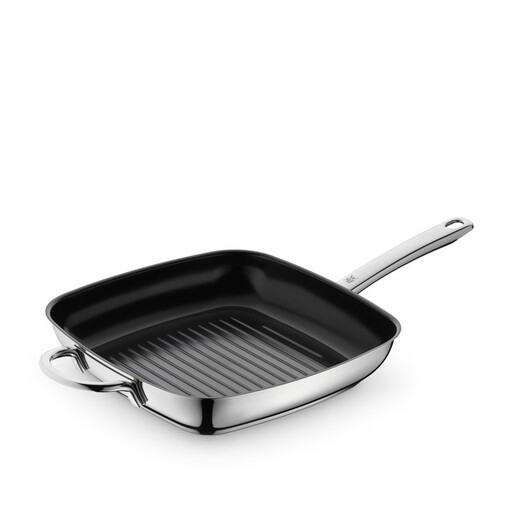
Why is this model a good fit? The square grill pan is designed for vegetables, fish and meat, with raised grill ridges for characteristic searing. Its shape distributes the usable surface differently from a round pan.
The product specifications state compatibility with induction, gas, electric and ceramic hobs, as well as an oven limit of up to 260 °C. Hand-washing is recommended to protect the coating.
Square 28×28 cm design; ceramic coating; grill ridges; specified for several common hob types and oven use.
Our selection of 28 cm stainless-steel frying pans can be compared by material, hob type, lid, coating and care instructions. Check the current product specifications before buying.
With a coated frying pan, avoid heating it empty at a high setting for extended periods. Low to medium heat is sufficient for many everyday dishes. Allow the cookware to cool before cleaning and avoid sudden temperature changes, such as running cold water over a very hot surface.
A stainless-steel pan can generally be treated with a suitable stainless-steel cleaner, provided the manufacturer permits this. With both material types, regularly check that the handles, fittings and pan base remain secure and free from deformation.
That depends on the dish and the pan’s design. A 28 cm frying pan may be sufficient for vegetables, fried potatoes or several smaller pieces of food. For large portions or many ingredients, a taller deep sauté pan with a lid is more practical. The usable cooking surface is also smaller than the outside diameter when the sides are strongly sloped.
Only a model explicitly stated to be induction-compatible is suitable. Stainless steel alone is not sufficient proof. Also ensure that the base sits flat and is approximately the same size as the induction zone.
There is no reliable one-size-fits-all service-life estimate. Longevity depends on heat, cleaning methods, utensils and frequency of use. Gentle hand-washing, soft kitchen tools and avoiding empty heating can help keep the surface in good condition for longer.