
Lieferung heute & morgen

Qualitätsgarantie

Willkommens-Angebote freischalten: KOSTENLOSE Lieferung | Bis zu 80 % RABATT | Kostenlose 30-Tage-JoyPlus-Testphase
App herunterladen
A 28 cm frying pan with lid is a versatile addition to the cookware of many households. Its size provides enough surface area for several portions while generally remaining more manageable than a large sauté pan. Whether you are frying, sautéing, stir-frying or slow-cooking, the diameter is not the only deciding factor. The combination of material, coating, hob compatibility and care is equally important.
Many products are promoted with terms such as “non-stick”, “suitable for all hob types” or “dishwasher-safe”. Buyers should examine these claims more closely. Not every coated frying pan can withstand high temperatures, and not every glass lid is suitable for use in the oven.
The stated 28 cm diameter often refers to the upper rim. The actual base of the pan may be considerably smaller. This makes the base diameter particularly important for induction hobs, as it affects the area over which heat can be transferred. When choosing a pan, look for details such as “base diameter”, “contact area” or “induction base”.
A pan may be suitable for gas, electric, ceramic and induction hobs, while the handle or lid is not approved for use in the oven. Check the following separately:
For example, the Naturepan version with ceramic coating is stated to be suitable for oven use up to 230 °C without the lid. The same applies to the hybrid version: the lid must be removed before using the pan in the oven.
A dishwasher-safe pan may officially be suitable for cleaning in a dishwasher, but many manufacturers still recommend washing it by hand. Detergent, high temperatures and mechanical stress can gradually affect the surface. With a ceramic pan or a traditional non-stick pan, a soft sponge and mild washing-up liquid are generally the gentler option.
An aluminium pan is relatively lightweight and transfers heat quickly. Many models also feature a magnetic stainless steel base so that they can be used as an induction pan. A coating makes cleaning easier and can support cooking with less oil. However, this does not guarantee a particular cooking result, which also depends on the temperature, ingredients and utensils used.
An uncoated stainless steel pan is less susceptible to scratches and can be used with stainless steel, wooden or silicone turners. However, it requires careful temperature control. With coated stainless steel or a hybrid surface, you should follow the relevant care instructions.
Multi-layer constructions such as Tri-Ply combine stainless steel with an aluminium core. According to the respective suppliers’ product information, this construction is designed to improve heat distribution. Such pans are often heavier, but can provide a robust alternative for regular use.
A ceramic pan generally has a ceramic coating on a metal body. The SENSARTE and Naturepan models featured here are stated to have a PTFE-free or PFAS-free coating. These claims refer to the respective product descriptions and should be checked against the latest manufacturer information.
The following applies to all coated frying pans:
A deep frying pan or 28 cm sauté pan holds more liquid and helps reduce splashing. A well-fitting glass lid lets you monitor your food without constantly removing the lid. For sauces, vegetable dishes and slow-cooked meals, a high rim is often more practical than a traditional shallow frying pan.
Also consider the weight, handle design and available cupboard space. Two side handles may offer greater stability when carrying heavy dishes, but require more storage space. A long handle makes tossing easier, but takes up more room on the hob.
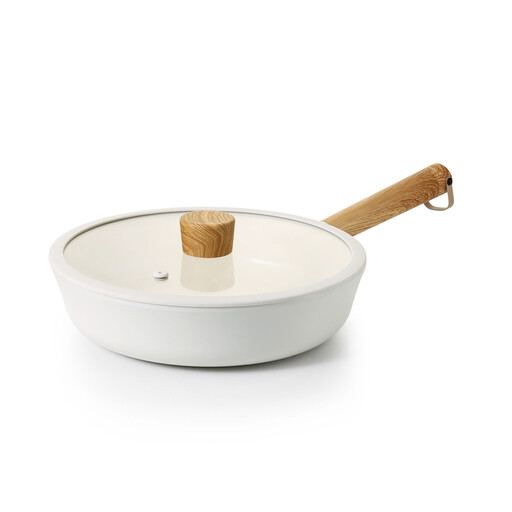
Why this product suits this profile: According to the product information, this deep aluminium pan with ceramic coating and glass lid is suitable for gas, induction, ceramic, electric and halogen hobs.
The hob compatibility and 28 cm diameter are clearly stated. Hand washing is also recommended to help protect the coating.
Ceramic coating, magnetic stainless steel base, glass lid and versatile compatibility with various hob types.
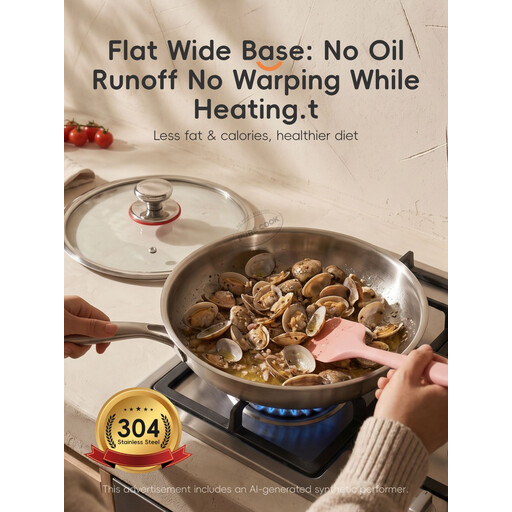
Why this product suits this profile: The three-layer construction of stainless steel, an aluminium core and stainless steel is aimed at households looking for an uncoated, versatile pan.
The product information explicitly lists gas, induction, ceramic and halogen hobs, as well as dishwasher suitability. The precise temperature rating should be checked before using it in the oven.
Uncoated 304 stainless steel construction, multi-layer base, glass lid and, according to the supplier, a scratch-resistant surface.
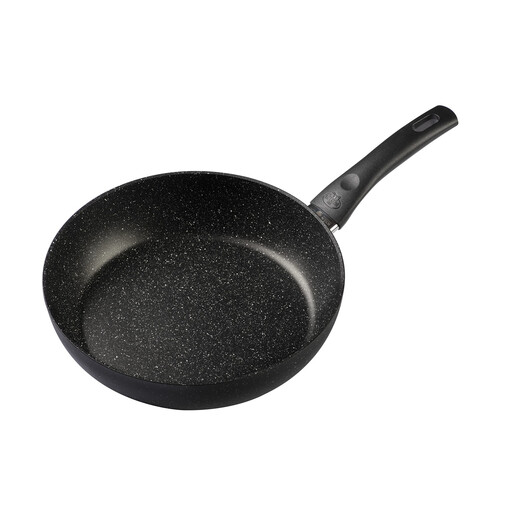
Why this product suits this profile: The high rim and stated 6-litre capacity make it suitable for larger quantities, sauces and slow-cooked dishes.
The product description states a maximum oven temperature of 160 °C and suitability for all common hob types. This makes it easier to assess important usage limits before buying.
Four-layer Nerolite coating, glass lid, dishwasher-suitable design and high rim for sautéing and slow cooking.
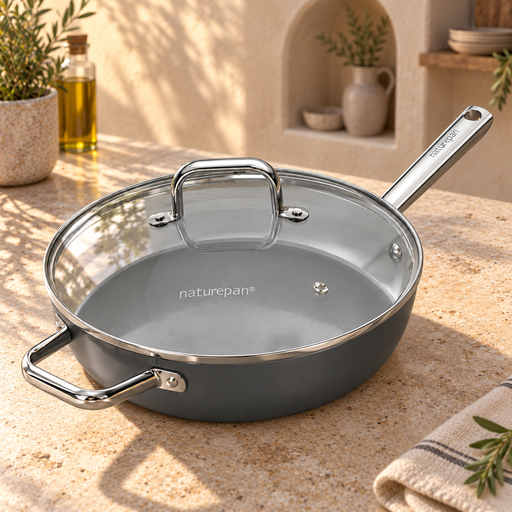
Why this product suits this profile: This deep sauté pan with ceramic coating, glass lid and dishwasher suitability is designed for regular one-pan meals.
The specifications state a body height of 7.5 cm, a diameter of 28 cm, compatibility with induction, gas, electric and ceramic hobs, as well as an oven limit of 260 °C without the lid.
Diamond- and titanium-reinforced ceramic coating, high rim, glass lid and, according to the product information, dishwasher suitability.
We have put together a complete, regularly updated list of products that fully meet these strict selection criteria and the safety regulations applicable in the EU.
The service life of a 28 cm frying pan with lid depends greatly on how it is used. Coated models should be used at low to medium heat. An empty pan should not be heated intensely for extended periods. Allow the cookware to cool before washing it to avoid sudden temperature changes.
With stainless steel, controlled preheating often helps prevent ingredients from sticking immediately. The precise technique depends on the dish and the hob. With coated surfaces, however, soft kitchen utensils and gentle cleaning are preferable to high heat or abrasive tools.
A 28 cm pan is a practical size for many family meals. However, the usable base area, rim height and capacity are also important. For very large portions or substantial slow-cooked dishes, a model with a high rim may be more suitable.
A pan for all hob types needs a magnetic base or explicit approval from the manufacturer. Aluminium alone is not automatically suitable for induction. Look for a specific statement regarding induction compatibility and, if in doubt, check the product details for the model in question.
Wait until the pan has cooled, then use warm water, mild washing-up liquid and a soft sponge. Even if a pan is described as dishwasher-safe, washing it by hand can help protect the coating. Metal turners, abrasive cleaners and metal scouring pads should be avoided with coated models.