
Lieferung heute & morgen

Qualitätsgarantie

Willkommens-Angebote freischalten: KOSTENLOSE Lieferung | Bis zu 80 % RABATT | Kostenlose 30-Tage-JoyPlus-Testphase
App herunterladen
A 28 cm honeycomb pan is a great fit for many British households: the diameter offers plenty of space for two to three portions, yet it’s generally more manageable than a large wok. If you want to fry with less oil, cook vegetables, or combine meat and sides in one pan, you shouldn’t just focus on the honeycomb pattern.
What really matters are the material, coating, base construction, hob compatibility and care. Our selection highlights what to look for in a scratch-resistant frying pan, a stainless steel pan or a ceramic pan with a glass lid.
A textured surface can reduce direct contact between your utensils and the coating. However, it doesn’t automatically replace a classic non-stick pan. Depending on the model, the honeycomb structure may be made of stainless steel, sit over a ceramic coating, or form part of the inner surface.
So before you buy, you should check:
With coated models, you should avoid heating them strongly without oil or ingredients. For the COOKER KING Lingbai Honeycomb Ceramic Wok 30cm, it is explicitly stated that a coated pan should not be preheated when empty.
A pan for all hob types should have a suitable base that sits as flat as possible. For induction, a magnetic base is essential. With gas hobs, you also need a stable stand and a handle that isn’t too close to the flame.
Look for specific details regarding:
The label “All Cooktops Compatible” is helpful, but it doesn’t replace checking the full product description. The diameter of the pan’s base can also be smaller than the top rim. This affects the usable surface area on an induction zone.
A honeycomb pan with a lid is ideal for braised dishes, keeping food warm, and cooking with less risk of splashing. Even so, lids differ in material and handling. A transparent glass lid makes it easier to monitor the cooking process without losing heat by lifting it too often.
Check whether the lid is actually included in the delivery and whether the handle is heat-insulated. At high temperatures, handle the lid with care, as glass can be sensitive to sudden temperature changes.
A pan made from 304 stainless steel is often searched for because of its material name. With multi-layer pans, the layered construction can help with heat distribution. The name 304 describes the type of stainless steel used; it isn’t a guarantee of any other product feature on its own.
Ceramic models can combine a smooth, coated inner surface with a honeycomb structure. According to the product details, the MAXCOOK pan features a food-safe ceramic non-stick coating and a three-layer stainless steel construction. You should always verify such claims in the individual product listing.
A 28 cm pan is a versatile standard size. It offers more surface area than smaller models and is suitable for everyday portions. For a single person, a 24 to 26 cm pan may be easier to handle. If you often cook for several people or fry large quantities, you might benefit from a 30 or 32 cm pan.
It’s important not just to look at the top diameter. What also matters are:
A scratch-resistant frying pan isn’t automatically immune to every kind of misuse. Sharp edges, knocks and extreme temperature changes can damage the surface. With coated pans, wooden or silicone spatulas are usually a gentler choice. The MAXCOOK description lists stainless steel, wooden and silicone spatulas as suitable, but advises against sharp-edged metal utensils.
Hand washing with a soft sponge extends the lifespan of many coated models. For the MAXCOOK pan, hand washing is recommended, as high temperatures and harsh detergents can affect the surface and the handle.
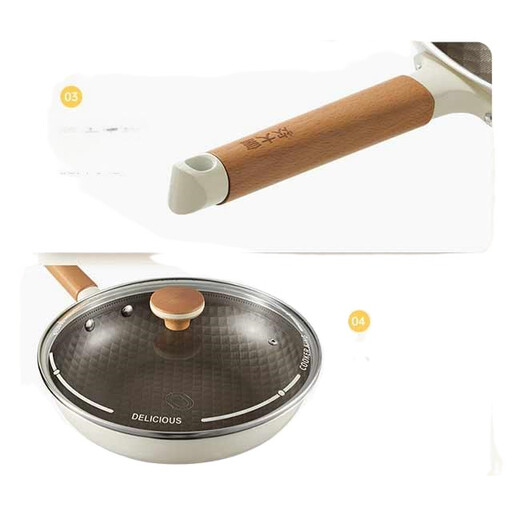
Why this product fits the profile: The more compact 26 cm size is ideal for smaller households and everyday portions when you’re looking for a handy ceramic pan.
The product name clearly indicates a ceramic honeycomb pan. This allows buyers to check the coating and size before purchasing.
Compact diameter and ceramic honeycomb design as stated in the product name.
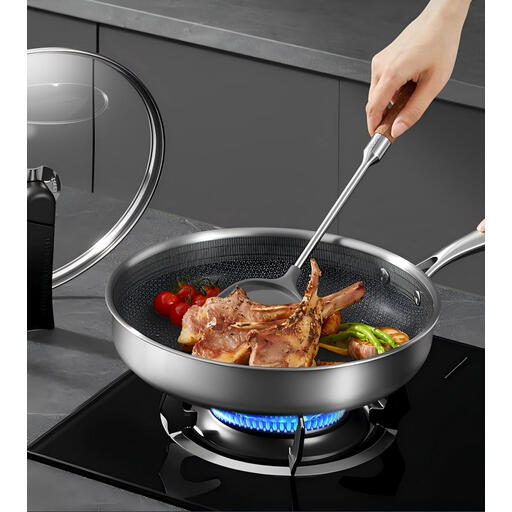
Why this product fits the profile: The 28 cm size matches the everyday format you’re looking for. The product name mentions 304 stainless steel, a glass lid and suitability for all hobs.
The key buying criteria are already visible in the product name: diameter, material, lid and hob compatibility.
28 cm, 304 stainless steel construction, glass lid and all-hob compatibility according to product details.
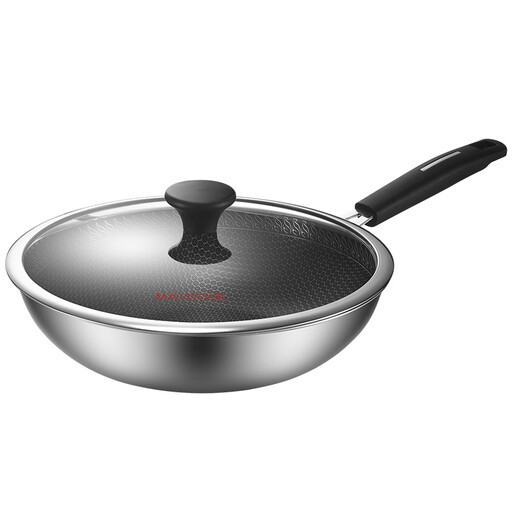
Why this product fits the profile: The 30 cm wok is aimed at households that want to fry, braise, boil or deep-fry larger quantities.
The product description mentions three-layer stainless steel, a flat magnetic base, ceramic coating, glass lid and hand washing as the care instruction.
30 cm, three-layer 304 stainless steel, ceramic inner coating, glass lid and suitability for induction, gas, electric and ceramic hobs according to product details.
We’ve put together a full, regularly updated list of products that fully meet these strict selection criteria and the safety regulations in force in the EU.
That depends on the base construction. An induction pan needs a magnetic, flat base. Look for an explicit mention of induction compatibility and also consider the usable base surface area.
It’s impossible to give a reliable lifespan. It depends on the material, coating, temperature, tools and cleaning. Avoid preheating coated models when empty, sudden temperature changes and sharp-edged kitchen tools. Hand washing can help protect the surface.
No. The honeycomb pattern describes the structure of the inner surface. A non-stick effect can come from a coating or from the specific surface construction. So check the exact details about coating, care and permitted kitchen utensils in the product listing.