
Lieferung heute & morgen

Qualitätsgarantie

Willkommens-Angebote freischalten: KOSTENLOSE Lieferung | Bis zu 80 % RABATT | Kostenlose 30-Tage-JoyPlus-Testphase
App herunterladen
A 28 cm stainless steel frying pan suits many British households: the surface area is enough for several portions without taking up unnecessary space on a standard hob. At the same time, stainless steel pans differ significantly in construction, heat retention, weight and features.
If you only look at the material label "stainless steel" or terms like "scratch-resistant", you risk missing important details. Three typical buying mistakes often lead to disappointment:
A three-layer stainless steel frying pan typically consists of stainless steel, an aluminium core and another layer of stainless steel. Aluminium distributes heat more quickly, while stainless steel can provide a robust, corrosion-resistant cooking surface.
With the PURECOOK Tri-Ply 304 Stainless Steel, the product description states a construction of 304 stainless steel, aluminium and stainless steel. This design appeals to those looking for an uncoated stainless steel frying pan with more even heat distribution. However, its everyday suitability still depends on hob power, base contact and temperature control.
The term 304 stainless steel pan describes a commonly used grade of stainless steel. But it is not a guarantee of every desired property on its own. Buyers should also check the actual layer construction, base shape, handle and care instructions.
An induction-compatible pan needs a magnetic base. For a model suitable for all hob types, the product description should explicitly mention gas, induction, ceramic or electric, and halogen.
For oven use, the maximum permitted temperature is crucial. An oven-safe pan can be practical when you want to sear a dish first and then finish cooking it in the oven. You need to distinguish between the pan body, handle and lid. A glass lid or silicone element may have a lower temperature limit than the stainless steel body.
With the PURECOOK pan with lid, an oven safety rating of up to 220 °F is stated. That equates to roughly 104 °C and should not be confused with an oven safety rating of up to 220 °C. So before using it in the oven, it is wise to check the original specification carefully.
"28 cm" usually refers to the top rim diameter, not necessarily the actual heated surface area. A smaller base diameter can lead to uneven use on a large induction zone. For a hob zone around 21 to 22 cm in diameter, a suitably sized base area is often more practical.
The height of the rim also matters:
A stainless steel pan with lid expands your cooking options, but adds weight and storage requirements. If you cook regularly for several people, this compromise can be worthwhile.
The selection below groups different 28 cm models by usage profile. What matters are the stated product specifications, not general marketing claims.
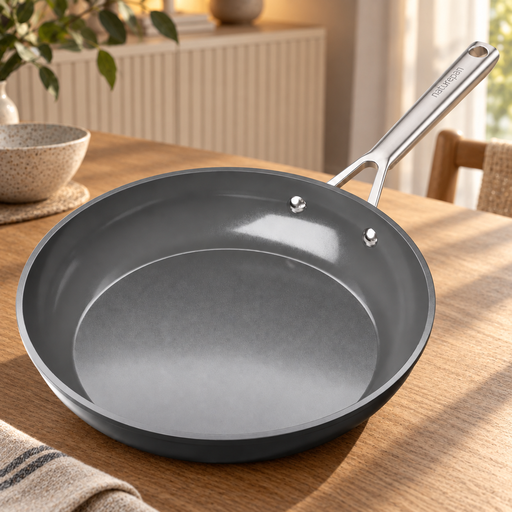
Why this product fits the profile: The aluminium construction with a ceramic non-stick coating is designed for straightforward everyday frying and is stated as suitable for induction, gas, electric and ceramic hobs.
The product data lists the compatible hob types and recommends low to medium heat along with suitable utensils, rather than suggesting unrestricted use.
28 cm diameter, ceramic coating and stated dishwasher suitability; hand washing is recommended to protect the surface.
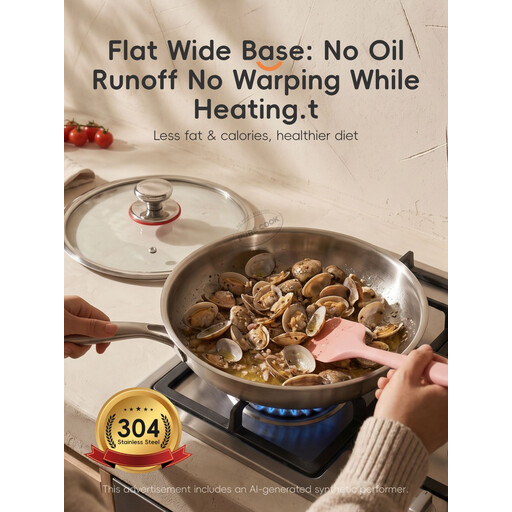
Why this product fits the profile: The three-layer construction of 304 stainless steel and aluminium, plus the glass lid, appeals to households that want to fry, sauté and braise.
The product description clearly states the layer construction and hob compatibility. The oven limit of the lid and pan should be checked before use.
Uncoated stainless steel surface, aluminium core, glass lid and suitability for gas, induction, ceramic and halogen hobs according to product specifications.
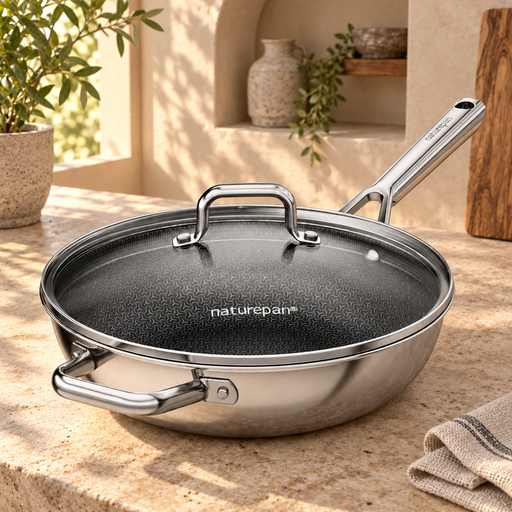
Why this product fits the profile: The higher rim, the lid and the combination of a stainless steel body, aluminium core and ceramic areas make it suitable for one-pan meals and braised dishes.
The product data distinguishes the coated area from the stainless steel body and provides clear care instructions: moderate heat, gentle cleaning and no metal utensils.
High rim of 7.8 cm, matching lid, suitability for induction, gas, electric and ceramic hobs, and oven use up to 230 °C without the lid according to product specifications.
We have put together a complete, regularly updated list of products that fully meet these strict selection criteria and the safety regulations in force in the EU.
A stainless steel frying pan usually needs a bit more attention to temperature control than a non-stick pan. For good everyday results, these steps help:
A dishwasher-safe stainless steel pan can make cleaning easier. However, with coated models, frequent washing can affect the lifespan of the surface. Uncoated stainless steel is less sensitive in this respect, but may show water spots or heat discolouration. Abrasive cleaners and steel wool should generally be avoided on delicate surfaces.
That depends on the base. A pan is suitable for induction if the manufacturer explicitly states this hob type and a magnetic base is present. With a pan for all hob types, gas, induction, ceramic, electric and, where applicable, halogen should each be listed individually.
The pan should be preheated over a medium heat. Then add a little oil before placing the food in the pan. Excessively high temperatures, moist food and frequent turning can encourage sticking. An uncoated frying pan is especially suitable for those who want to use this temperature technique regularly.
The lifespan depends on material thickness, layer construction, hob use and care. An uncoated stainless steel pan can last a long time with proper handling because there is no non-stick layer to wear out. With coated versions, the surface is the main area of wear. Product claims about durability or guarantees should therefore always be read alongside the specific care conditions.