
Lieferung heute & morgen

Qualitätsgarantie

Willkommens-Angebote freischalten: KOSTENLOSE Lieferung | Bis zu 80 % RABATT | Kostenlose 30-Tage-JoyPlus-Testphase
App herunterladen
A 28 cm stainless steel frying pan with lid provides plenty of space for family portions, vegetables, meat or slow-cooked dishes. However, a large size, shiny surface and claims such as ‘rapid heating’ do not automatically make a pan the right choice. The key factors are its construction, hob compatibility, lid quality and care instructions.
Stainless steel is robust and corrosion-resistant, but on its own it conducts heat far less efficiently than aluminium. With a simple, single-layer construction, hot spots can therefore develop. This increases the risk of delicate foods sticking while other areas have not yet heated sufficiently.
A tri-ply stainless steel frying pan usually has a layered construction of stainless steel, aluminium and stainless steel. The aluminium core supports heat distribution, while the stainless steel surfaces provide stability and are designed for contact with food. The specific construction and thickness of the layers should be clearly stated in the product description.
An induction-compatible frying pan needs a magnetic or induction-ready base. Gas, ceramic, electric and halogen hobs have different requirements. Buyers should therefore check that all the hob types they need are actually listed.
The same applies to an oven-safe frying pan: the maximum temperature may differ for the pan body, handle and lid. The PURECOOK model featured here is stated to be oven-safe up to 220 °F, which is approximately 104 °C. Before using it in the oven, check the latest manufacturer’s information and the lid’s temperature limit.
A glass lid makes it easier to monitor food while slow-cooking or reducing sauces. Nevertheless, it should not be placed on a hot surface or exposed to sudden changes in temperature. Details about the rim, handle, seal and maximum temperature are all part of a complete product description.
A 304 stainless steel frying pan is often associated with good resistance to many everyday foods. However, this does not mean it is suitable for every cleaning method or temperature. Acidic foods should not be left in the pan unnecessarily long, and harsh scouring agents can alter the surface.
The PURECOOK model is described as having a 304 stainless steel body with an aluminium core and an outer stainless steel layer. According to the manufacturer’s information, the material complies, among other things, with the Chinese GB 4806.9 standard and US FDA requirements. These details refer to the manufacturer’s product information and should not be construed as a medical or therapeutic claim.
28 cm generally refers to the top diameter. The actual usable cooking surface may be smaller if the sides are strongly curved. For four portions, a large frying pan with a flat inner base is often more practical. A flared rim can make it easier to pour out sauces.
Also check:
An uncoated frying pan does not have a conventional non-stick coating that can come away through overheating or the use of unsuitable utensils. However, stainless steel requires careful temperature control: preheat the pan, add the oil afterwards and do not move the food too soon. Sticking can often be controlled more effectively at low to medium heat than at maximum power.
Coated models can be more convenient for delicate foods, but they generally require gentler cleaning and suitable utensils. ‘PFAS-free’ or ‘PTFE-free’ should only be used where this is expressly stated in the product information.
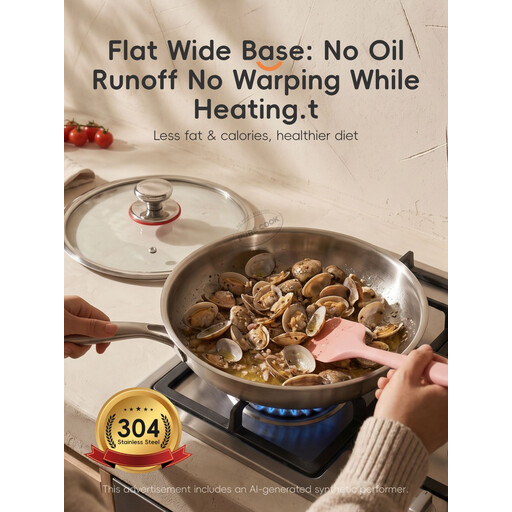
Why this product suits this profile: The combination of a 28 cm diameter, glass lid and uncoated stainless steel cooking surface covers typical tasks in a family kitchen.
The stated sandwich base with aluminium core avoids the typical limitation of a purely single-layer pan. Its suitability for gas, induction, ceramic and halogen hobs is listed in the product data.
304 stainless steel, tri-ply construction, glass lid and, according to the product information, dishwasher-safe cleaning.
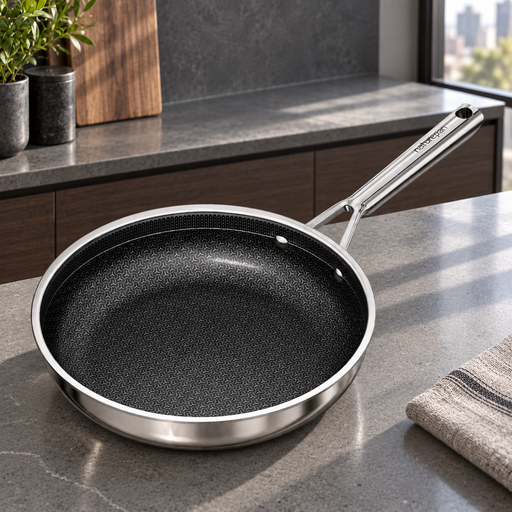
Why this product suits this profile: The hybrid structure combines a multi-layer stainless steel body with an aluminium core and a textured ceramic coating.
The information explicitly lists the compatible hob types, dishwasher suitability and an oven limit of up to 230 °C with the lid removed. This makes it possible to check important usage limits before buying.
28 cm diameter, aluminium heat core and stated compatibility with induction, gas, electric and ceramic hobs.
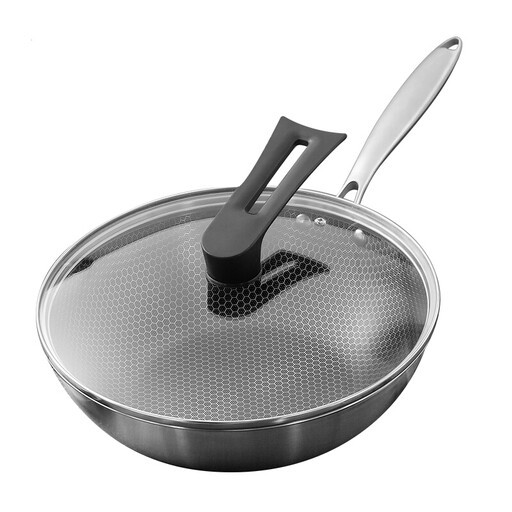
Why this product suits this profile: The slightly larger wok shape is suitable for stir-frying, sautéing and dishes with greater volume.
The product description lists a stainless steel body, a lid and several possible uses. However, specific details about the base construction, oven suitability and cleaning should be checked before buying.
30 cm diameter, lid and, according to the product information, suitability for gas, induction and electric hobs.
We have put together a complete, regularly updated list of products that fully meet these strict selection criteria and the safety regulations applicable in the EU.
A stainless steel frying pan should first be cleaned with warm water and a mild washing-up liquid. When cooking, follow this order: preheat, reduce the temperature, add oil, add the food. Very high temperatures are often unnecessary, particularly on induction hobs.
For a long service life, please note:
That depends on the base construction. An induction-compatible frying pan should be explicitly approved for induction use. On tri-ply models, the outer stainless steel layer is often magnetic; however, the information provided by the relevant manufacturer is definitive.
Stainless steel does not have a non-stick coating. Common causes include a base that has not been preheated, too little fat or turning the food too soon. Medium heat and brief searing can generally be controlled more effectively than a consistently high temperature.
There is no reliable, universal service-life estimate. It depends on the material thickness, multi-layer construction, handle attachment, changes in temperature and cleaning. A rust-resistant stainless steel frying pan will usually remain functional for longer when stored dry and cared for appropriately than a model whose coating has been damaged through incorrect use. The specific manufacturer’s information and proper use are the decisive factors.