
Lieferung heute & morgen

Qualitätsgarantie

Willkommens-Angebote freischalten: KOSTENLOSE Lieferung | Bis zu 80 % RABATT | Kostenlose 30-Tage-JoyPlus-Testphase
App herunterladen
A high-quality tabletop, whether it's solid wood, fine veneer, or a modern designer material, is an investment. You want to preserve its aesthetic appeal without compromising on daily use. A 2mm clear table protector seems like the ideal solution: invisible protection against scratches, stains, and wear. However, the market is flooded with products that don't live up to their promises.
As your Joybuy Product Recommendation Officer, I'll help you navigate the common pitfalls and make an informed decision. We'll focus on the facts so you can find a durable and suitable protector for your table.
Many buyers are disappointed shortly after their purchase because the product shows flaws that weren't apparent beforehand. Pay special attention to these three points:
To avoid these problems, you should check three core features before buying. These define the quality and suitability of a transparent table film.
The choice of material is crucial. Most high-quality protective films are made of Polyvinyl Chloride (PVC). This material is flexible, robust, and easy to clean. A wipeable PVC tablecloth can be effortlessly cleaned of liquids, grease, or crumbs with a damp cloth.
The material thickness of 2 mm offers a good compromise between protection and subtlety. It's thick enough to protect the tabletop from accidentally dropped cutlery or the pressure of writing, but not so bulky that it disrupts the aesthetic. Such a clear table cover also serves as an effective transparent desk pad, ensuring a smooth and stable work surface.
This is the most critical point. Check the texture of your tabletop:
A good transparent table protector should have a certain level of heat resistance. Most PVC films are designed for temperatures up to approx. 60–80°C. This means warm plates or cups are not a problem. However, hot pots or pans straight from the stove must never be placed on it, as this can cause permanent deformation or discolouration.
Pay attention to the dimensions when purchasing. Some manufacturers supply the film with a slight surplus (e.g., 0.5–2 cm) to compensate for any potential material shrinkage. A high-quality protective film for tables can be precisely cut to the desired size with a sharp utility knife and a straight edge (e.g., a metal ruler) if needed.
Here are some product recommendations tailored to different user profiles and the criteria mentioned above.

Why This Fits Their Persona: Ideal for protecting standard dining or kitchen tables with matte or wood surfaces. It offers solid, straightforward protection for daily use at a reasonable price-performance ratio.
The robust 2 mm thickness prevents premature wrinkling and provides reliable protection. The material is designed for matte surfaces, thus avoiding the typical bubble formation.
Completely waterproof and oil-proof for extremely easy cleaning. Can be trimmed to size if needed, with the manufacturer accounting for a length tolerance for potential shrinkage.
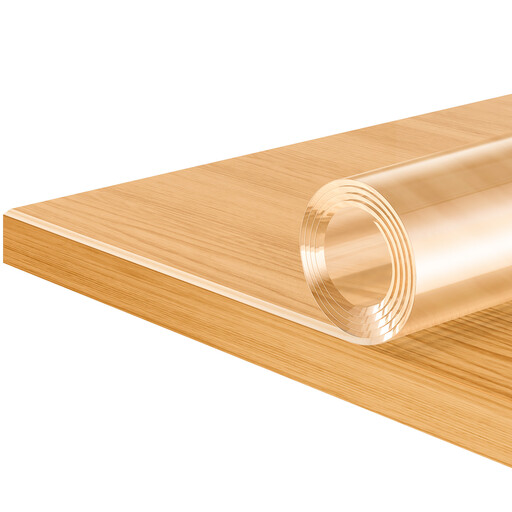
Why This Fits Their Persona: Perfect for the heavily used dining table in a family household. The bevelled edges enhance comfort and safety, as there are no sharp 90-degree angles for children to bump into.
The high-quality, 2 mm thick PVC is dimensionally stable and designed for continuous use. Its clear suitability for matte tables prevents the bubble problem from the outset.
The 45° bevelled V-edge is the standout feature. It provides a comfortable feel when arms rest on the table and minimises the risk of injury.
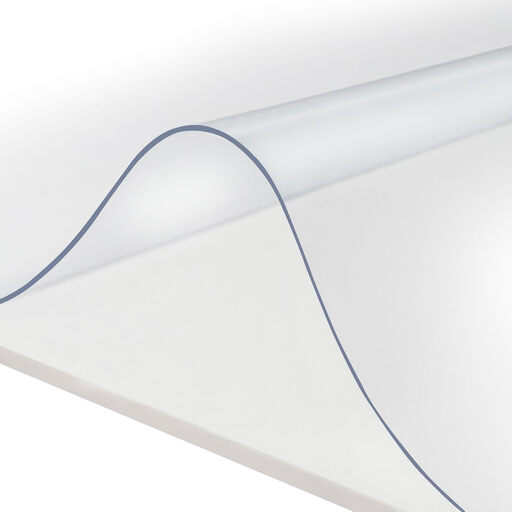
Why This Fits Their Persona: An excellent choice as a transparent desk pad. The robust surface protects the desk from scratches from keyboards, pressure marks from writing, or paint stains during creative projects.
The high material density and 2 mm thickness ensure a flat, stable work surface. According to the manufacturer, the film is low-odour and dimensionally stable, minimising problems with shrinkage and smell.
The non-slip property ensures that the pad stays in place even during intensive use. Its heat resistance up to 80°C protects the desk from warm laptops or coffee cups.
We have compiled a complete, up-to-date list of products that fully meet these strict selection criteria and UK safety regulations.
The film is delivered rolled for transport reasons. After unrolling, it may be wavy or the corners may curl up. Place the film on the table and let it sit for 24 to 48 hours at room temperature. Its own weight will help it flatten. You can speed up the process by placing heavy books on the edges or by gently warming the film with a hairdryer on a low setting.
This is due to the adhesion between two perfectly smooth surfaces, which traps tiny amounts of air. Standard PVC films are not suitable for this application. Specifically look for films labelled as "suitable for high-gloss surfaces" or "anti-bubble," or choose a slightly frosted version.
Yes, this is usually possible without any problems. Use a sharp utility knife or sturdy scissors and a long metal ruler as a guide. Measure carefully and mark the cutting line discreetly with a pencil. Note that some manufacturers supply the film with a slight surplus to compensate for potential material shrinkage in the first few weeks. It may be advisable to wait one to two weeks before cutting the film to its final size.