
Lieferung heute & morgen

Qualitätsgarantie

Willkommens-Angebote freischalten: KOSTENLOSE Lieferung | Bis zu 80 % RABATT | Kostenlose 30-Tage-JoyPlus-Testphase
App herunterladen
A 2 mm transparent PVC table cover is designed to protect your table without completely hiding the wood grain, colour or design underneath. At the same time, many shoppers expect a waterproof table cover that is easy to clean, sufficiently heat-resistant and stays securely in place. In practice, disappointing purchases are often caused not by the material itself, but by unsuitable dimensions, unclear manufacturer specifications or an unsuitable surface.
This buying guide from the Joybuy Product Recommendation Officer explains the most important criteria objectively and shows which version may suit different needs.
A table cover with exactly the same dimensions as the tabletop may appear too short at the edges. Rolled PVC products may also have slight dimensional variations or shrinkage. Some product descriptions state a tolerance of around 1 to 5 mm.
Before buying, you should check:
A made-to-measure table cover can sometimes be adjusted by trimming it. This requires a sharp cutting tool, a stable surface and careful marking.
A heat-resistant table cover is not automatically suitable for hot pots, pans or baking dishes. According to the product descriptions, several of the models considered here are temperature-resistant up to 80 °C. This may be sufficient for warm plates, cups or serving dishes, but it does not replace a trivet for very hot items.
PVC can deform when exposed to direct or intense heat. Open flames and hot cooking utensils should therefore never be placed directly on the cover.
A smooth, glossy transparent PVC table cover allows the tabletop to remain visible, but air bubbles can form on glass or high-gloss lacquered surfaces. For these types of surface, the product information sometimes recommends placing a thin fabric layer between the table and the cover.
A transparent table protector is often easier to use on matt wooden surfaces. Even so, you should check the manufacturer’s information for the relevant surface before buying.
For this type of product, the focus is on PVC with a thickness of 2 mm. Compared with very thin covers, this material offers greater dimensional stability and can protect the table from liquids, scratches, grease and dirt during everyday use. However, its thickness also makes the cover heavier and less flexible when trimming.
Look for a specific material description such as polyvinyl chloride (PVC), as well as the stated thickness. Vague terms such as “thick protective cover” reveal little about the actual construction.
A waterproof table cover has a non-absorbent surface. Liquids therefore initially remain on the cover and can be wiped away with a damp cloth. For everyday use in families, offices, cafés or nurseries, a washable tablecloth is particularly practical.
Where possible, use:
With intensive use, regular cleaning is recommended so that grease and colour residues do not remain on the surface for extended periods.
A non-slip table cover may sit more securely on matt or textured tabletops. However, its performance can vary depending on the surface. On glass and high-gloss surfaces, air bubbles or stronger adhesion may occur.
For dining tables where arms frequently rest on the edge, a table cover with a bevelled edge may be a sensible choice. The relevant WOLTU models are described as having a 45-degree bevel. This reduces a hard, sharp-feeling edge and may improve comfort. It is a design feature, but it does not replace careful handling of knives or other sharp objects.
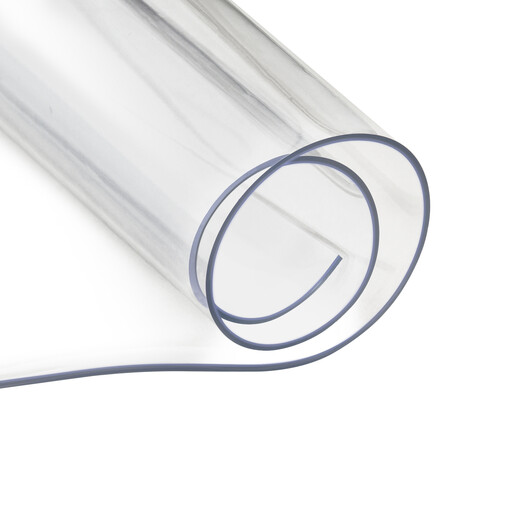
Why this product suits this profile: The compact standard size is suitable for smaller dining tables, desks or side tables. The transparent design leaves the surface underneath visible.
The specific dimensions make it easier to check the fit. According to the product description, the cover is waterproof, washable and heat-resistant up to 80 °C.
2 mm PVC, rectangular dimensions of 70 x 110 cm and a smooth, wipe-clean surface.
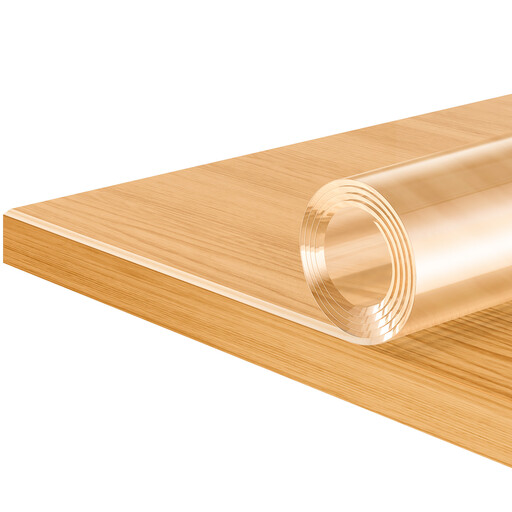
Why this product suits this profile: The bevelled edge is designed for dining tables where the cover is used regularly and where arm support and edge shape matter.
The 45-degree edge avoids a straight, hard finishing edge. The product description also mentions a non-slip texture and protection against water, oil and dirt.
2 mm thickness, 80 x 140 cm, transparent surface and bevelled edge.
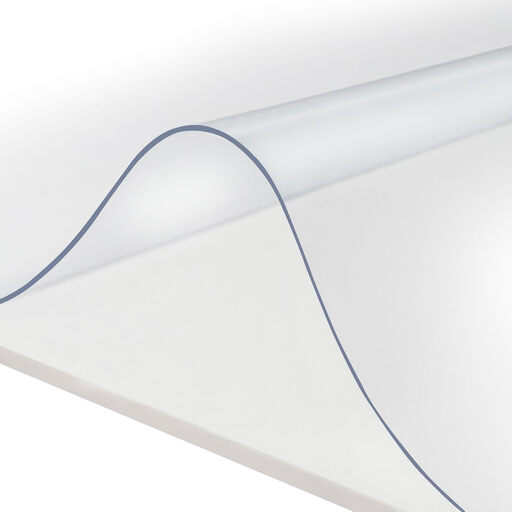
Why this product suits this profile: The combination of 2 mm PVC, a transparent design and a wipe-clean surface is suitable for dining tables, craft areas and desks in family homes.
The product specifications state that it is water-resistant, easy to clean and has a non-slip texture. Suitability for glass and high-gloss surfaces is stated as limited.
Dimensions of 80 x 120 cm, 2 mm material thickness, heat resistance up to 80 °C according to the supplier and a surface that can be wiped clean when damp.
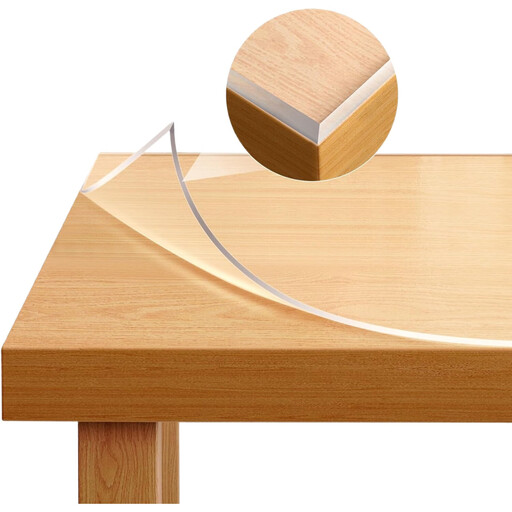
Why this product suits this profile: The longer format is aimed at larger dining tables, conference tables or work surfaces in offices, hospitality venues and educational establishments.
The precise size specification reduces the risk of choosing a cover that is too small. For glass and polished surfaces, the description warns that air bubbles may occur.
90 x 180 cm, 2 mm PVC, bevelled edge and a water- and grease-repellent surface according to the product specifications.
We have put together a complete, regularly updated list of products that fully meet these strict selection criteria and the safety regulations applicable in the EU.
PVC table covers are often delivered rolled up. Place the cover on the table and leave it to lie flat for 24 to 48 hours. Heavy objects placed around the edges can help smooth it out. A hairdryer should only be used carefully and from a distance, as excessive heat can deform the material.
For a made-to-measure table cover, mark the cutting line on the reverse side. After trimming, check the edges carefully. A bevelled edge cannot be added afterwards to every cover; it should already be specified as a product feature when you buy it.
Air bubbles can form more easily on glass or high-gloss surfaces. First, check the manufacturer’s instructions. According to several product descriptions, placing a thin fabric layer between the tabletop and the cover may help. This issue is often less pronounced on matt wooden surfaces, but it cannot be ruled out entirely.
Its lifespan depends on use, exposure to sunlight, cleaning and mechanical stress. A 2 mm-thick cover is designed for everyday protection, but it will not remain completely free from signs of use indefinitely. Knives, rough objects, intense heat and harsh cleaning products can damage the surface.
This depends on the stated temperature limit. The product specifications for the models mentioned state temperatures of up to 80 °C. Hot plates or cups may be below this limit; however, pots, pans and baking dishes should still be placed on a suitable trivet.