
Lieferung heute & morgen

Qualitätsgarantie

Willkommens-Angebote freischalten: KOSTENLOSE Lieferung | Bis zu 80 % RABATT | Kostenlose 30-Tage-JoyPlus-Testphase
App herunterladen
A 2 mm transparent PVC table protector is designed to protect your tabletop without hiding its wood effect, colour or finish. In family homes, kitchens, offices, cafés, schools and nurseries in particular, protection against liquids, stains, scratches and everyday wear is an important buying consideration.
However, not every transparent table cover is suitable for every table. Unclear measurements, unsuitable surfaces or exaggerated heat-resistance claims can often lead to disappointing purchases. The following points will help you assess a suitable table protector objectively.
A 100 x 180 cm table protector may seem unambiguous on paper. Even so, before buying, you should check whether the protector is meant to lie exactly on the tabletop or extend beyond the table edge. An overhanging table protector may develop raised corners. If it is too small, the edges of the tabletop will remain unprotected.
PVC table covers supplied rolled may also have a slight measurement tolerance or shrinkage. Depending on the design, product specifications state a tolerance of around 1 to 5 mm. For a close-fitting transparent table cover, it is advisable to measure the tabletop at several points and follow the guidance provided for the individual product.
Some models are described as being heat-resistant up to 80 °C. This provides a useful indication for warm plates or mugs, but it does not replace a trivet for cookware taken directly from the hob or oven.
For versions with bevelled edges, some product information explicitly states that they should not be used near naked flames or powerful heat sources. The specific manufacturer’s information is therefore more important than a general advertising claim.
A non-slip table protector can lie securely on matt or textured tabletops. However, on glass, high-gloss lacquer or highly polished surfaces, air bubbles, adhesion marks or visual changes may occur. Several product descriptions recommend placing a thin layer of fabric between the tabletop and the protector on such surfaces.
Before laying it out, the surface should be clean, dry and free from dust and sharp particles. Otherwise, pressure marks or trapped bubbles may remain visible.
PVC is waterproof and can be cleaned with a damp cloth. Compared with thinner plastic protectors, a thickness of 2 mm provides greater stability and can help dampen the noise of cutlery on the tabletop. At the same time, the material can still be cut to size, provided the supplier allows this.
A washable PVC tablecloth is suitable for dining rooms, kitchens, desks or craft areas. Where it will come into direct contact with food, buyers should rely solely on the relevant manufacturer’s information. General statements about material suitability should not automatically be applied to every PVC product.
A smooth surface makes it easier to wipe away water, oil, sauces or paint residue. A textured or non-slip underside can help keep the table protector in place. This is particularly relevant in homes with children, busy offices or heavily used communal areas.
“Scratch-resistant” should be understood as protection against normal signs of use, not as permission to use knives, scissors or other sharp objects on it. Even a scratch-resistant table protector can be damaged by hard or pointed objects.
Standard rectangular sizes such as 70 x 110 cm, 80 x 120 cm, 90 x 140 cm or 100 x 180 cm cover many tables. For unusual shapes, a made-to-measure table protector may be a practical option, provided the protector can be cut to size.
Bevelled edges with a 45-degree cut may feel more comfortable against the table edge than a sharp-looking straight edge. However, the shape of the edge does not automatically make the protector suitable for glass or high-gloss surfaces.
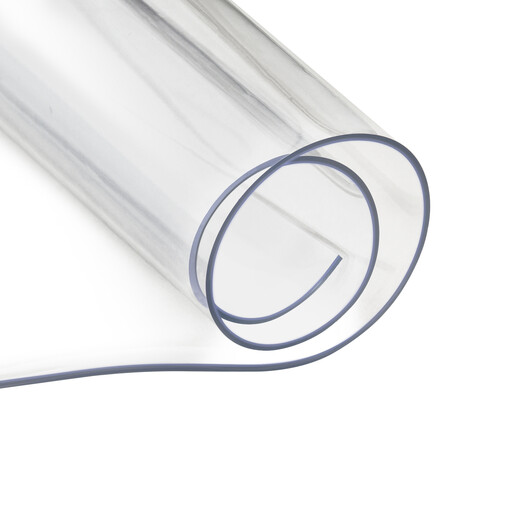
Why this product suits this profile: The compact size is suitable for smaller kitchen tables, side tables or desks. According to the product description, the protector can be cut to size if required.
The clearly stated dimensions make it easier to check suitability before buying. The product information specifies water resistance, a washable surface and heat resistance up to 80 °C.
2 mm PVC, a transparent design and cleaning with a damp cloth according to the product description.
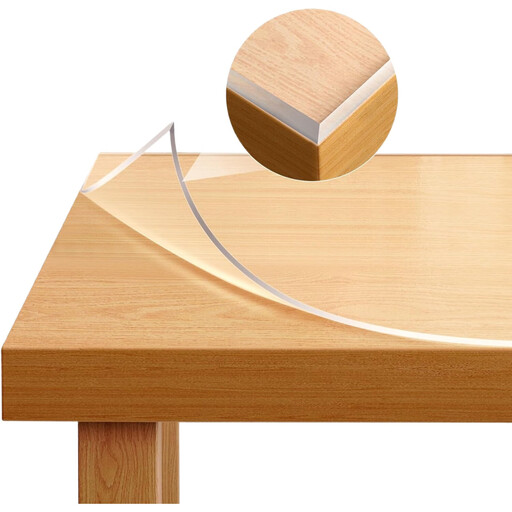
Why this product suits this profile: The elongated size is designed for larger dining tables or work surfaces. The 45-degree edge may feel more comfortable when resting your arms on the table.
The product description explicitly points out that air bubbles may occur on glass or polished surfaces and recommends using a layer of fabric between the surfaces.
2 mm PVC, a water- and grease-resistant surface and a bevelled edge according to the product details.
Why this product suits this profile: The combination of a compact surface, non-slip design and stated heat resistance makes it suitable for kitchens, craft tables, offices or areas used regularly.
The product information states a temperature limit of up to 80 °C. This does not make the protector suitable for naked flames or very hot cookware; a trivet is still required.
Waterproof, wipe-clean surface and a non-slip design according to the product description.
We have put together a complete, regularly updated list of products that fully meet these strict selection criteria and the safety regulations applicable in the EU.
Its lifespan depends on exposure to UV light, friction, cleaning products, temperature and everyday use. A 2 mm-thick PVC protector is designed for regular use, but it will not remain completely free from signs of wear indefinitely. Sharp objects, intense heat and abrasive cleaners can damage the surface prematurely.
According to the product descriptions, many of the variants mentioned can be cut to the desired shape using a suitable cutting tool. Before cutting, you should take the table dimensions, edge shape and possible shrinkage into account. For rounded corners, a template made from paper or card is recommended.
Not in every case. Air bubbles or adhesion marks may occur on glass and high-gloss surfaces. Several models therefore recommend using a layer of fabric between the surfaces. If you have a glass tabletop, check the specific manufacturer’s instructions before buying and before use.