
Lieferung heute & morgen

Qualitätsgarantie

Willkommens-Angebote freischalten: KOSTENLOSE Lieferung | Bis zu 80 % RABATT | Kostenlose 30-Tage-JoyPlus-Testphase
App herunterladen
A 2-zone induction hob is ideal for small kitchens, student flats, holiday homes or as an additional cooking option. Before buying, however, you should distinguish carefully between a portable induction hotplate, a built-in induction hob and an electric ceramic-glass model. Similar product images and marketing claims can otherwise result in dimensions, connections or pan compatibility not matching your kitchen.
A hob described as a 30 cm induction hob is not automatically suitable for every 30 cm cut-out. Three details are crucial:
A model may be 29 cm wide externally but require a cut-out measuring 260 or 265 mm. Before buying, measure your existing worktop and compare the measurements with those in the installation instructions.
A rating such as 3,000 or 3,500 watts describes the maximum total power output. It does not necessarily show the power at which both zones can operate simultaneously. On some appliances, the available power is distributed electronically. If you plan to cook with two larger pans at the same time, pay attention to the specifications for the individual zones and the electrical protection required.
A permanently installed 220–240 V built-in hob with a 3,000-watt rating may have different connection requirements from a portable appliance with a mains plug. Higher-powered models, or models supplied without a plug, must only be connected in accordance with the installation instructions and by a qualified electrician.
Both versions often have a smooth glass surface, but they work differently:
With induction, also make sure the pan has a flat and sufficiently large base. Aluminium, copper and ceramic cookware will only work if the base contains a magnetic layer.
A portable induction hotplate can be used flexibly on a worktop, in an office or in a holiday home. It requires no alterations to the worktop and can be stored away after cooking. A double induction hob with two portable zones is practical when you occasionally need to use two pans at the same time.
A built-in induction hob, on the other hand, creates a permanent integrated look and saves worktop space when the dimensions are suitable. Before ordering, check the installation height, ventilation and connection type. When replacing an existing hob, the cut-out dimensions are more important than the product’s overall width.
A hob with touch controls is easy to clean because there are no rotary knobs protruding from the surface. Look for clear displays and check whether each zone can be controlled separately. Useful everyday features include:
These features do not replace supervision while cooking. Hot surfaces, oil and fat can still cause burns or fires.
Smooth glass and ceramic-glass surfaces can usually be cleaned with a soft, damp cloth and a suitable cleaning product. Only clean the hob once the residual heat indicator has gone out. Abrasive cleaners, hard sponges and using the hob as a storage surface can damage it.
Also compare the recommended pan diameter with your existing cookware. For example, the TOPWISH 30cm 2-Zone Built-In Induction Hob specifies zones measuring 160 and 180 mm. The pan sizes stated by the manufacturer should be used as a guide.

Why this product suits this profile: This compact double induction hob is designed for small worktops and offers two zones, touch controls and nine power levels.
The stated external dimensions of 290 × 520 × 64 mm and cut-out dimensions of 265 × 495 mm make it easier to check the fit before installation.
3,500 watts maximum power, a timer of up to 99 minutes, pan detection, child lock and residual heat indicator.
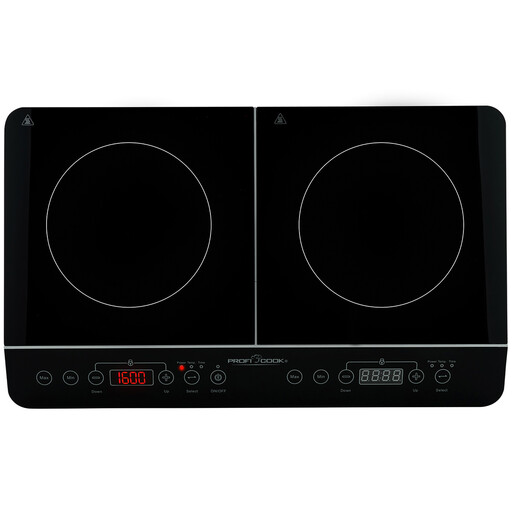
Why this product suits this profile: This portable induction hotplate offers separate controls and is suitable for households needing a versatile replacement or additional appliance.
The product specifications mention automatic pan detection, switch-off when the pan is removed and overheating protection, rather than relying on general safety claims alone.
Two cooking zones, 16 function levels per zone, a temperature range of 60 to 240 °C and a 180-minute timer.
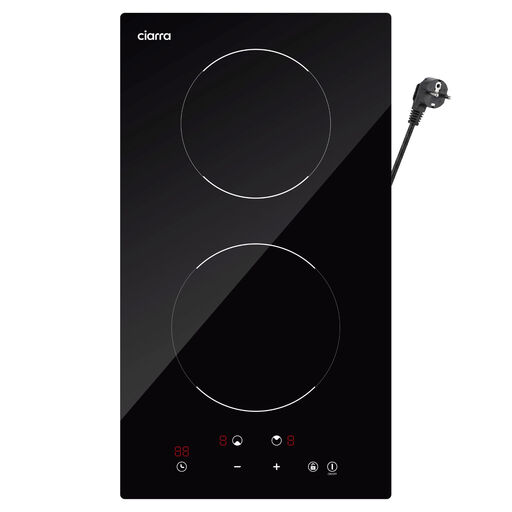
Why this product suits this profile: This permanently installable 2-zone model is suitable for small kitchens when you are looking for an integrated solution with clearly defined installation dimensions.
The specifications list the external dimensions of 290 × 520 × 62 mm, the cut-out dimensions of 270 × 490 mm and the 220–240-V connection separately.
3,000 watts, nine power levels, an individual timer of up to 99 minutes, plus child lock and automatic pan detection.

Why this product suits this profile: This single portable induction hotplate requires no installation and can be used in small cooking areas, offices or as an additional cooking zone.
The specifications explicitly state that magnetic cookware is required, ventilation openings must remain clear and the appliance is limited to one cooking zone.
2,000 watts, ten power levels, touch controls, six pre-set functions and child lock.
We have put together a complete, regularly updated list of products that fully meet these strict selection criteria and the safety regulations applicable in the EU.
Many compact built-in models are around 29 cm wide and 52 cm deep. However, whether the appliance fits depends on the cut-out dimensions, installation height and ventilation. With portable appliances, there is no cut-out to make; instead, you need a stable, dry and sufficiently large surface on which to place it.
Pans and frying pans with a magnetic, preferably flat base are suitable. Hold a magnet against the underside: if it sticks firmly, the cookware is generally suitable for induction cooking. Also check the recommended diameter for the individual cooking zone.
Running costs depend on the power output, usage time and electricity tariff. An appliance rated at 2,000 watts theoretically uses 2 kWh per hour at full power; in practice, the maximum output is not drawn continuously, depending on the temperature control and cooking process. For a realistic estimate, multiply the actual operating time by the maximum power output and your tariff.