
Lieferung heute & morgen

Qualitätsgarantie

Willkommens-Angebote freischalten: KOSTENLOSE Lieferung | Bis zu 80 % RABATT | Kostenlose 30-Tage-JoyPlus-Testphase
App herunterladen
Choosing the first set of baby gear is a decision that requires careful consideration. A 3-in-1 co-sleeper promises flexibility and long-term use, but the market can be overwhelming. Many models advertise multifunctionality, but in practice, they have flaws that only become apparent after purchase. This guide will help you identify the essential features and avoid common buying mistakes.
Not every multifunctional crib delivers on its promises. Pay attention to these three critical points to make a safe and durable choice.
To avoid the issues mentioned above, you should check three core aspects before buying. These form the basis for a safe and functional sleep solution.
The most important feature of a baby crib is its safety. Always look for certification according to the current European safety standard EN 1130:2019. This standard ensures that the product meets strict requirements for stability, materials, and construction. This includes ensuring that no gap can form between the co-sleeper and the parent's mattress and that all materials are free from harmful substances and child-safe. A co-sleeping crib that meets this standard provides a tested foundation for sleeping together safely.
A height-adjustable bedside crib is essential to ensure a seamless, flush fit with the parent's mattress. Check the number of adjustment levels and the overall adjustment range. For box spring beds, models with a particularly high maximum mattress height are required. Measure the height of your mattress top (from the floor) and compare it with the co-sleeper's specifications. A good model offers at least 6-7 levels or stepless adjustment to allow for a precise fit.
A crib with an included mattress is often a smart choice, as it ensures the mattress fits the frame perfectly, leaving no gaps at the edges. A 45x90 cm crib sleeping surface is a common size for the first few months. Look for a breathable mattress, ideally with a washable cover. Concepts like the roba safe asleep system combine an air-permeable mattress with ventilated side panels to promote an optimal sleep climate. The frame should be made of solid wood or high-quality plywood to provide the necessary stability.
Based on these criteria, we have identified models that are well-suited for different needs and living situations.
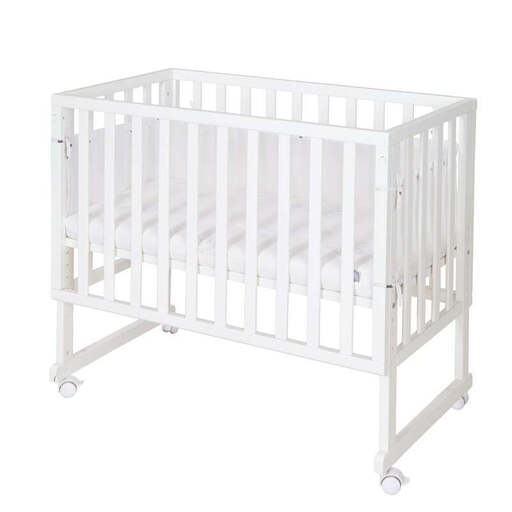
Why This Fits Their Persona: Ideal for parents looking for a safe, space-saving solution for the first 6 to 12 months. The compact 45 x 90 cm sleeping surface fits well in smaller bedrooms, while the 3-in-1 function (co-sleeper, bassinet, bench) allows for practical long-term use.
The crib meets the EN 1130:2019 safety standard. The breathable mesh insert counteracts the risk of poor air circulation. The 7-level height adjustment and the included strap system ensure a stable, gap-free attachment.
The patented 'safe asleep' system, with its air-permeable mattress and mesh surround, is a key safety feature. The included castors add flexibility for daily use.
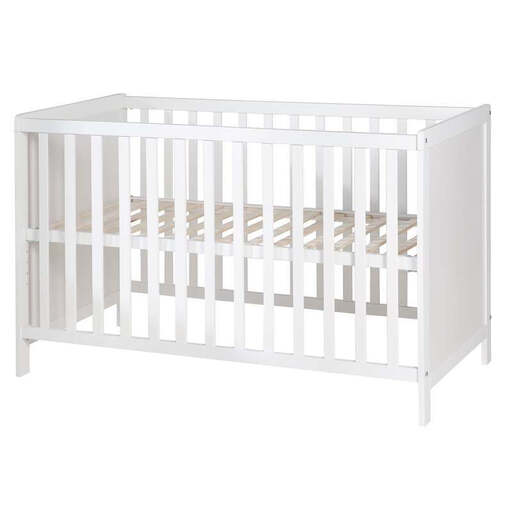
Why This Fits Their Persona: Perfect for forward-thinking parents seeking an investment that grows with their child. With a 60 x 120 cm sleeping surface, it can be converted from a co-sleeper to a standalone cot and later into a toddler bed, making it usable for up to 5 years, according to the manufacturer.
This model avoids the short-lifespan trap through its extended usability and well-designed conversion feature with 5 removable bars. The stepless height adjustment (22–42 cm) ensures compatibility with many parent beds.
Its long-term usability up to a weight of 50 kg offers excellent value for money. Certification according to EN 716–1:2017 + AC:2019 confirms its safety as a child's cot.
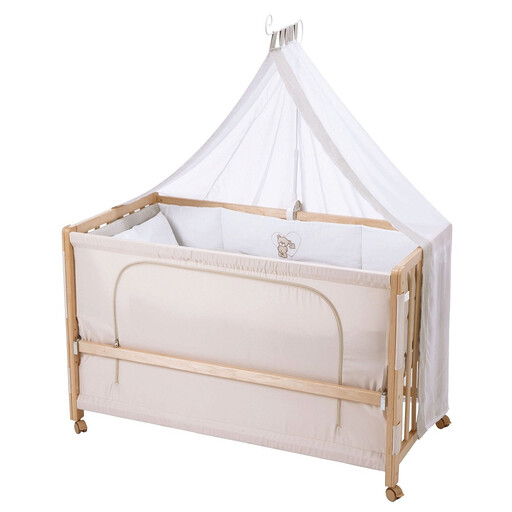
Why This Fits Their Persona: For parents who prefer a hassle-free, all-in-one solution. This set includes everything needed: mattress, bedding, bumper, canopy with rod, and even a set of castors. This saves the time and effort of finding matching accessories.
Since all components are from the same manufacturer, a perfect fit and compatibility are guaranteed. The fabric side with a zip is a practical solution for nighttime access to the child, avoiding the need to lean awkwardly over bars.
The biggest advantage is the all-inclusive set, which is ready to use right away. The 6-level height adjustment and included locking castors also provide a high degree of flexibility and mobility.
We have compiled a complete, real-time list of products that fully satisfy these strict selection criteria and UK safety regulations.
1. How high should a co-sleeper for a box spring bed be? The sleeping surface of the co-sleeper should be perfectly level with the top of the parent's mattress. Since box spring beds often have a mattress height of 60 to 70 cm, you will need a co-sleeper whose sleeping surface can be adjusted to a corresponding height. Pay close attention to the maximum height setting in the product specifications. Some manufacturers also offer special extension kits for extra-tall beds.
2. How long can you use a 3-in-1 co-sleeper? The lifespan depends heavily on the model and its size. Smaller models with a sleeping surface of around 45 x 90 cm are typically suitable as a co-sleeper or bassinet for the first 6 to 12 months, until the child starts to pull themselves up. Larger models (e.g., 60 x 120 cm) can often be used for several years and converted into a toddler bed.
3. Is a mattress always included with a co-sleeper? No, not always. While many models are offered as a complete set including a mattress, there are others where the mattress must be purchased separately. A set is often advantageous because it guarantees the mattress has the correct dimensions, avoiding any safety-critical gaps. Always check the product description carefully to see what is included.