
Lieferung heute & morgen

Qualitätsgarantie

Willkommens-Angebote freischalten: KOSTENLOSE Lieferung | Bis zu 80 % RABATT | Kostenlose 30-Tage-JoyPlus-Testphase
App herunterladen
As an owner of an electric car or plug-in hybrid, you're faced with the question of how to charge your vehicle most efficiently at home. A permanently installed wallbox isn't always an option, especially for renters or those in apartment buildings with underground garages. A 3.6 kW portable EV charger offers a flexible and economical alternative. However, the market is confusing and full of pitfalls that can lead to safety risks or a costly purchasing error. This guide will show you what to look for to find a safe and durable charging solution.
Many buyers focus solely on price, overlooking critical flaws that compromise functionality and safety. Avoid these three common mistakes:
To make an informed decision, you should carefully examine three technical features. These define the safety, compatibility, and real-world usability of your charging cable.
A charging power of 3.6 kW is the standard for single-phase charging from a conventional 230V household socket (Schuko). This power is the result of the voltage (230 V) multiplied by the maximum current (16A). Ensure the charger offers an adjustable current (e.g., 8A, 10A, 13A, 16A). This feature is essential when charging from an older or unknown electrical installation, as it allows you to reduce the load and thus prevent the circuit from being overloaded.
This is the most critical safety parameter. A high-quality EV charging cable for domestic sockets must have an integrated residual current protection mechanism that responds to both AC fault currents (usually 30mA) and DC fault currents (at least 6mA). This combination, often referred to as RCD Type A-EV or RCD DD, reliably protects you and your vehicle. A device without explicitly stated DC protection does not meet the safety standards recommended for charging electric vehicles.
The Type 2 connector (according to IEC 62196-2) is the European standard for AC charging. A Type 2 mobile charging cable is therefore compatible with almost all electric cars and plug-in hybrids sold in Germany and across Europe. Before buying, think carefully about the cable length you need. Measure the distance from the socket to your vehicle's parking spot and allow for some extra length. Lengths between 5 and 10 metres cover most scenarios and offer a good compromise between reach and manageability.
Based on the criteria mentioned, we have identified products suitable for different user groups.
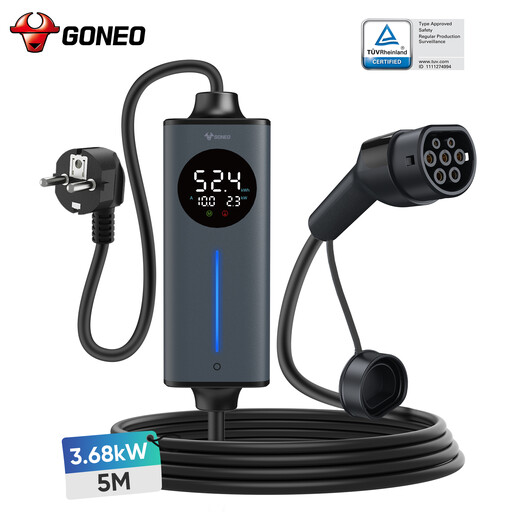
Why this model is a great fit: Ideal for EV drivers with a dedicated parking spot near a socket (e.g., in a garage). The 5-metre cable length is sufficient for standard parking situations and avoids unnecessary cable clutter. A straightforward solution for daily overnight charging.
This charger features integrated RCD protection (30mA AC + 6mA DC) and NTC temperature monitoring. This covers the critical safety and overheating risks.
Offers all necessary safety features in a compact and cost-effective package. The plug-and-play operation makes it particularly user-friendly.

Why this model is a great fit: Perfect for renters or apartment owners whose parking space is further away from the nearest socket. The 8-metre cable length provides the necessary flexibility to bridge more awkward distances without resorting to unsafe extension cords.
The longer cable length solves the problem of insufficient reach. At the same time, all safety-relevant features like AC/DC fault protection and temperature management are retained, ensuring safe operation.
The timer function allows for scheduled charging during off-peak hours, which helps to save on electricity costs. The LED display also provides real-time data on the charging process.
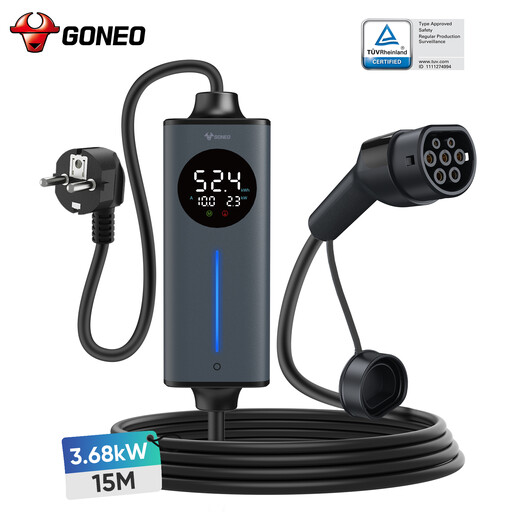
Why this model is a great fit: The top choice as a Type 2 emergency charging cable for on the go. Anyone who travels frequently or visits friends and family without a wallbox is prepared for any eventuality with the 15-metre version. Maximum reach means maximum independence.
This model completely eliminates the problem of cable length. The robust housing and high-quality cable are designed for mobile use and frequent packing/unpacking, which minimises material wear and tear.
Provides ultimate flexibility for charging at virtually any Schuko socket, regardless of the distance to the vehicle. All convenience and safety features are retained.
We have compiled a complete, up-to-date list of products that meet these strict selection criteria and European safety regulations.
Yes, charging from a household socket is safe, provided a few conditions are met. Only use a high-quality mobile charging cable with integrated safety features like AC and DC fault current detection and temperature monitoring. It is also recommended to have the socket checked by an electrician, especially in older buildings. Avoid using standard extension cords or power strips.
The charging time depends on your vehicle's battery capacity and its state of charge. As a rule of thumb: Charging Time (in hours) = Battery Capacity (in kWh) / Charging Power (in kW). A 50 kWh battery would therefore take about 13.9 hours (50 kWh / 3.6 kW) to charge from 0 to 100%. For a daily commute of about 50 km, you often only need to top up 8–10 kWh, which is easily done overnight in 2.5 to 3 hours.
Yes, many models offer the ability to manually adjust the current (and thus the charging power). Common levels are 8A, 10A, 13A, and 16A. This feature is particularly useful if you are unsure about the load capacity of the electrical system. By reducing the current to, for example, 10A (approx. 2.3 kW), you decrease the load on the circuit and increase safety, although this will extend the charging time.