
Lieferung heute & morgen

Qualitätsgarantie

Willkommens-Angebote freischalten: KOSTENLOSE Lieferung | Bis zu 80 % RABATT | Kostenlose 30-Tage-JoyPlus-Testphase
App herunterladen
A 3-in-1 charging cable can replace several individual cables for smartphones, tablets, power banks or headphones. This is particularly practical for families, commuters and travellers. However, multi-charging cables vary considerably in terms of connector combinations, charging power, data transfer and build quality.
If you only look for terms such as “fast charging” or “universal”, you could end up buying a cable that does not deliver the expected performance with your power adapter or is unsuitable for a particular device. The following points will help you avoid common buying mistakes.
A cable with three ends might offer USB-C, Lightning and Micro-USB, for example. The connector on the power-adapter side is also important:
A 3-in-1 cable with a USB-A input cannot automatically be connected to a USB-C power adapter. Before buying, you should therefore compare both ends of the cable with your existing charger and devices.
Specifications such as 3.5 A, 6 A or 100 W describe technical maximum values under suitable conditions. The actual power delivered depends on factors including the power adapter, the device, the connector being used and the supported charging protocol.
A fast-charging cable does not replace a compatible power adapter. With a USB-C to USB-C cable, Power Delivery (PD) or Quick Charge (QC) may be relevant. With a multi-charging cable featuring several branches, you should also check whether the connectors can be used simultaneously or only one at a time.
A braided outer casing can protect the cable against abrasion and twisting. However, weak points often develop where the plug meets the cable. Reinforced plug housings, a clearly specified cable length and straightforward care instructions are therefore useful features.
The cable should not be pulled out of the socket by the cable itself or sharply bent immediately behind the plug. Damaged insulation, loose plugs or visible wires are reasons to stop using the product.
For a charging cable for iPhone and Android, a combination of Lightning, USB-C and Micro-USB is often practical. However, users with only newer USB-C devices may not need a 3-in-1 cable. For a USB-C smartphone and tablet, a higher-power USB-C charging cable may be the more suitable solution.
Before buying, check:
With a fast-charging cable, the maximum current and supported standards should be stated in the product specifications. A high wattage can only be used if the power adapter and end device support the same technical requirements.
The data function is not the same on every universal charging cable, either. Some models are designed exclusively for charging, while others allow synchronisation. For example, the Hoco U104 is stated to support data transfer only via the USB-C connector.
For a desk, 1 to 1.5 metres is usually a convenient length. A 2-metre cable offers greater reach beside a bed or in a hotel, but takes up more space when travelling. A travel charging cable with a retractable mechanism can make transport easier, but it should be extended and retracted without applying force.
Look out for:
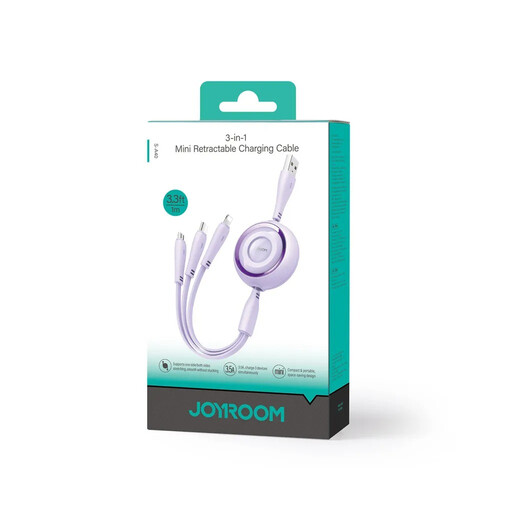
Why this product suits this profile: This retractable 1-metre cable combines USB-C, Lightning and Micro-USB with a USB-A connector, making it suitable for everyday use, the office or short trips.
The connector types are clearly specified. The retractable mechanism reduces loose cable lengths, but should only be operated gently.
Three device connectors, a 1-metre length, PC and TPE materials, plus a specified maximum current of 3.5 A.
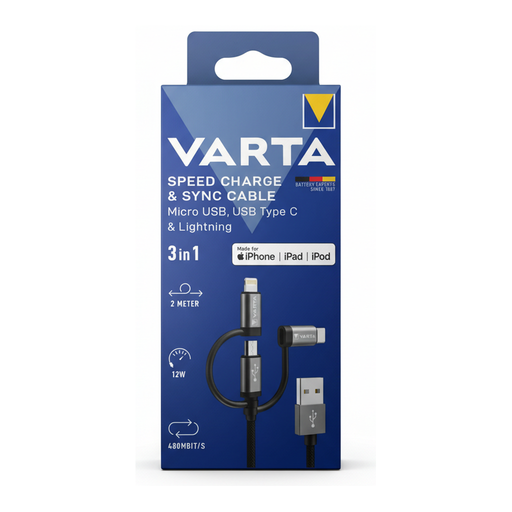
Why this product suits this profile: The 2-metre length provides extra reach at your desk or in a hotel. The detachable tips support Micro-USB, USB-C and Lightning.
The product specifications list the individual tips and the USB-A input side. According to the supplier, the Lightning tip is MFi certified; this certification does not automatically apply to the other connectors.
Nylon outer casing, a 2-metre length, and charging and data synchronisation via compatible connections.
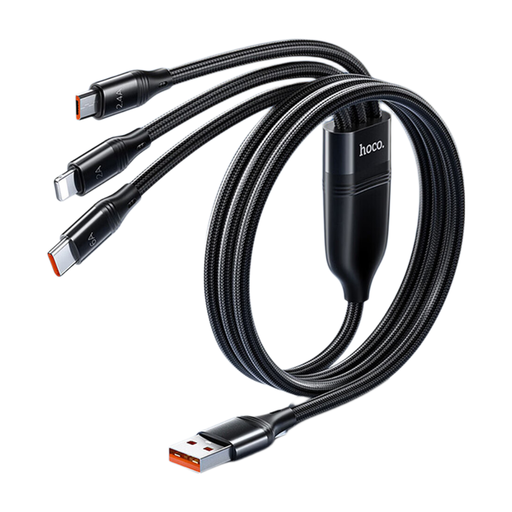
Why this product suits this profile: The 1.2-metre cable is aimed at households with iPhone, Android and USB-C devices and offers a clearly specified connector combination.
The specifications distinguish between charging and data transfer: according to the product description, synchronisation is only supported via USB-C.
USB-A to Lightning, Micro-USB and USB-C, nylon outer casing, aluminium plugs and a specified maximum current of 6 A.
We have put together a complete, regularly updated list of products that fully meet these strict selection criteria and the safety regulations applicable in the EU.
That depends on the model. Some cables have several plugs but only allow one connector to be used at a time. Other models are specifically designed to charge several devices simultaneously. The product description and information about the maximum current should be checked before buying.
There is no standard service life. It depends on the number of bending cycles, pulling and twisting, heat, moisture and the quality of the plug strain relief. For longer use, pull the cable out by the plug rather than the cable, store it loosely and replace it if you notice any visible damage.
No. Fast charging requires a suitable charging protocol, as well as a compatible power adapter and end device. Specifications such as 6 A or 100 W are maximum values and do not necessarily apply to every connector. With a USB-C charging cable, you should also check PD or QC compatibility and the power limits of all components involved.