
Lieferung heute & morgen

Qualitätsgarantie

Willkommens-Angebote freischalten: KOSTENLOSE Lieferung | Bis zu 80 % RABATT | Kostenlose 30-Tage-JoyPlus-Testphase
App herunterladen
A 3-in-1 infrared thermometer can combine forehead, ear and object measurements in a single device. This is practical for families with babies, children and adults, for older people and when travelling. However, models vary considerably in terms of measurement modes, memory, operation and cleaning.
As a Joybuy Product Recommendation Officer, I have identified the most important purchasing criteria to help you assess marketing claims more effectively and choose a suitable fever thermometer for children and adults.
Many devices display a result within one second. On its own, however, this says little about how meaningful the reading is in practice. With a forehead thermometer, distance, angle, perspiration, cold skin or a hat worn shortly beforehand can affect the result. For ear measurements, correct positioning and a clean sensor are important.
You should therefore look for clear instructions and always use the same measurement method when comparing readings.
Some products are marketed as 3-in-1 thermometers without clearly distinguishing the three measurement types in everyday use. Before buying, you should be able to see whether the device can switch between forehead thermometer, ear thermometer and object thermometer modes. It is also important to check whether the object mode is actually intended for liquids such as milk or bathwater.
An audible alarm can be disruptive at night or when caring for small children. A thermometer with a fever alarm is more practical if it also offers a silent mode and clearly visible display lighting. Check whether the alarm is both visual and audible, and whether the temperature unit can be switched between Celsius and Fahrenheit.
A versatile device should clearly identify its modes:
For babies, contactless forehead measurement is often easier because the child does not need to be touched. Ear measurement may require a different technique. Always read the instructions for use and regard the readings as a guide, not a substitute for a medical examination.
A memory function can be helpful for families who want to record several readings throughout the day. The models available differ, for example, in the number of memory slots. According to the product description, the AILE device stores 32 readings, while the Treesmile FC-IR100 has 35 memory slots.
A coloured backlight can make it quicker to interpret readings. Even so, colours and thresholds should not automatically be treated as a diagnosis. If unusual readings persist or someone is generally unwell, medical advice is required.
The measuring tip should be cleaned after use in accordance with the instructions. A fully enclosed sensor can make maintenance easier. You should also check:
The CE marking should be identifiable on the product, its packaging or the accompanying documentation. It does not prove that every reading is suitable for every situation. For medical devices, the instructions for use, intended purpose and warnings are also decisive.
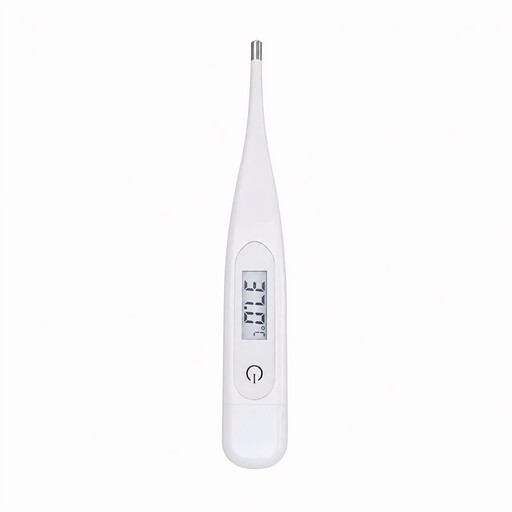
Why this product suits this profile: This pen-shaped digital thermometer focuses on traditional body temperature measurement and is easy to store in a medicine cabinet or travel bag.
The measurement range, 0.1 °C resolution and error specifications are stated in the product description. There is no unclear multi-function operation that you have to work out in everyday use.
Mercury-free design, °C/°F switching and a display with 0.1 °C resolution.
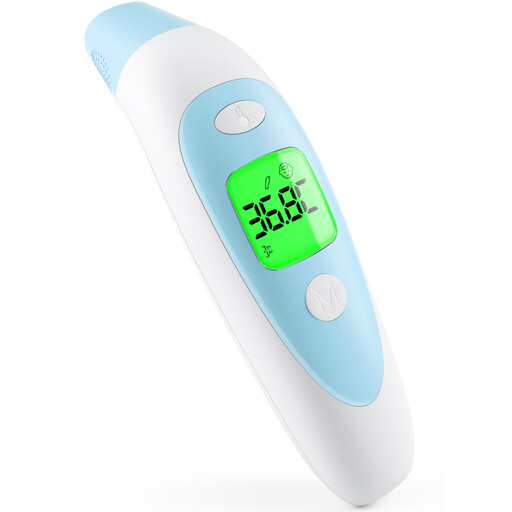
Why this product suits this profile: For households looking for a contactless thermometer with ear, forehead and object modes, as well as a memory function.
The three measurement types are described as separate modes. A fever alarm, silent mode and coloured display address the common difficulty of operating a thermometer at night.
According to the product information, CE- and ISO-certified, with 32 memory slots and Celsius-to-Fahrenheit switching.
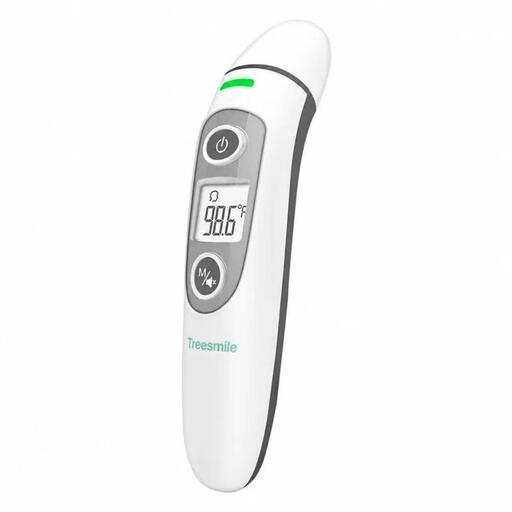
Why this product suits this profile: Suitable for families who regularly want to check body temperature as well as the temperature of milk, food, rooms or bathwater.
The manufacturer describes ear, forehead and object modes, as well as a separate silent operation setting. This allows use to be adapted to the situation and time of day.
35 memory slots, three-colour display lighting, fever alarm and supplied with two AAA batteries.
We have put together a complete, regularly updated list of products that fully meet these strict selection criteria and the safety regulations applicable in the EU.
To keep readings comparable, you should follow the same procedure wherever possible:
A CE-certified thermometer may be suitable for monitoring health at home. However, it is not a substitute for a medical diagnosis. Medical advice should be sought for infants, high fever, unusual behaviour or persistent symptoms.
Its lifespan depends on the batteries, sensor care, storage conditions and frequency of use. Store the device in a dry place, protected from heat and out of children’s reach. If it shows visible damage or produces unclear readings, it should no longer be used.
There is no general answer to this. Both methods require correct use and can be affected by the surroundings, positioning or skin conditions. The instructions for use and a consistent measurement method are the key factors.
The infrared thermometers featured here do not normally involve disposable costs, such as those associated with devices using disposable probes. Ongoing expenses may arise from replacement batteries. Also check whether special attachments are intended for ear mode.