
Lieferung heute & morgen

Qualitätsgarantie

Willkommens-Angebote freischalten: KOSTENLOSE Lieferung | Bis zu 80 % RABATT | Kostenlose 30-Tage-JoyPlus-Testphase
App herunterladen
For serious table tennis players, the choice of ball is just as critical as the choice of paddle. A poor-quality ball can make the flight path unpredictable, distort the bounce, and ultimately hinder training progress or match success. Yet, the market is flooded with products whose labels promise more than they deliver. Many fall into common traps, especially when searching for 3-star table tennis balls, leading to frustration and unnecessary expense.
This guide will help you identify the crucial quality markers and distinguish marketing hype from genuine performance data. We'll highlight the most common pitfalls and show you what to look for to find a ball that meets your standards for precision and consistency.
To avoid a bad purchase, you should focus on objective and verifiable criteria. These three factors define the quality of a professional table tennis ball.
For anyone looking for tournament table tennis balls, this is the most important criterion. Certification by the International Table Tennis Federation (ITTF) guarantees that a ball meets strict standards. Every ITTF-approved ball has been tested for the following parameters:
Only balls that pass these tests offer the consistency and predictability required for competition.
Modern professional table tennis balls are made of Acrylonitrile Butadiene Styrene (ABS). Contrary to a common misconception, seamless balls are not necessarily superior. In fact, many of the world's leading competition balls, like the Double Fish V40+, are manufactured with a high-precision seam. This production technique often allows for even more exact control over roundness and wall thickness uniformity. The result is an extremely stable centre of gravity and very reliable flight and bounce characteristics.
The hardness of the ball directly affects ball control and spin generation. A ball with optimised hardness provides crisp feedback on impact and enables precisely placed shots. Furthermore, the matte surface of modern ABS balls ensures a consistent coefficient of friction, which makes receiving spin shots more predictable.
Based on the criteria above, we have compiled a selection of balls suitable for specific player profiles.
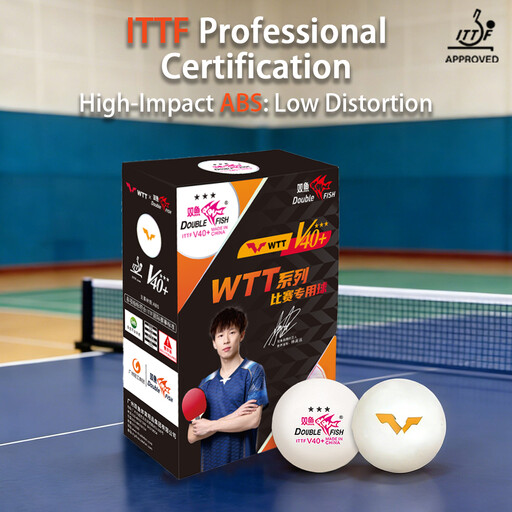
Why This Fits Their Persona: This ball is designed for players who refuse to compromise. As the official ball for international WTT tournaments, it perfectly replicates the feel expected at a professional level. Ideal for direct match preparation and competitive league play.
It has verifiable ITTF and WTT certification, bypassing the trap of misleading '3-star' labels. The high-quality ABS material ensures durability.
Official competition ball with maximum flight stability and precision. Made from impact-resistant ABS material with a seam for a stable centre of gravity.
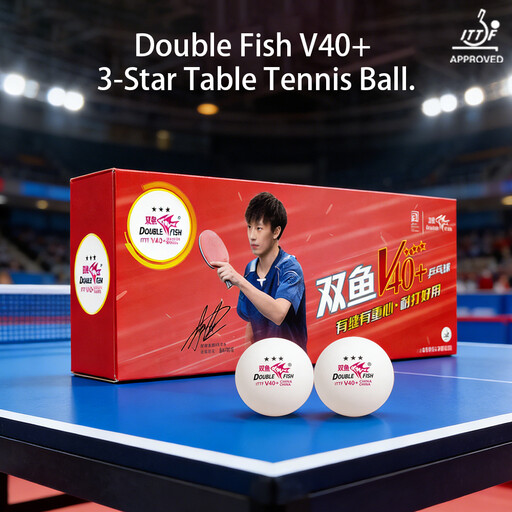
Why This Fits Their Persona: For players who train several times a week and don't want to sacrifice competition-level quality. The 10-pack offers excellent value for intensive training without compromising on ball consistency.
This ball also meets strict ITTF standards and is made from the same high-grade ABS material as the official WTT ball. It bridges the quality gap between training and competition.
Offers competition quality for demanding training sessions. The larger pack size is economical for players with high ball consumption.
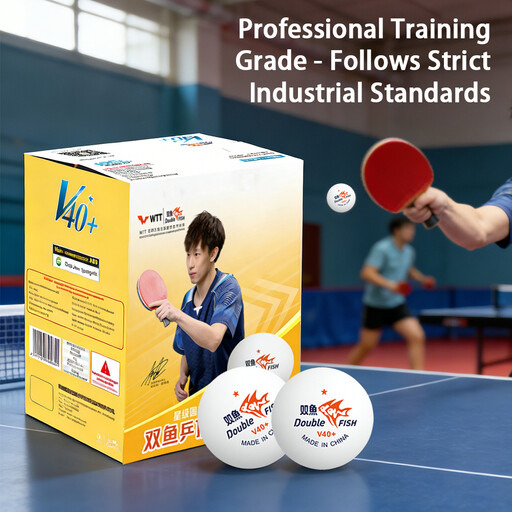
Why This Fits Their Persona: For clubs or players who do multi-ball training, quantity and consistency are crucial. These 1-star balls offer far greater uniformity and durability than generic bulk packs, making them a very economical choice for this type of practice.
It avoids the pitfall of buying cheap, mass-produced balls that have wildly different playing characteristics. These balls are manufactured to industry standards for a stable bounce.
High quantity with reliable quality for multi-ball training. The impact-resistant ABS material ensures a long lifespan even with intensive use.
We've compiled a complete, up-to-date list of products that fully meet these strict selection criteria and standards.
The star rating is a quality system used by manufacturers to classify their balls.
The material is very crucial. The switch from celluloid to 40+ ABS plastic balls was a significant step for the sport. ABS is not only safer (less flammable) but also generally more durable. The material noticeably affects playing characteristics: ABS balls tend to have slightly less spin than celluloid balls and a slightly higher, but more consistent, bounce. Players need to adjust their technique slightly but benefit from a more predictable game.
No, this is a common misconception. The quality of a ball does not depend on whether it has a seam, but on the precision of the manufacturing process. Leading manufacturers have perfected the production of seamed balls to the point where they often exhibit greater consistency in roundness and wall thickness than many seamless models. The Double Fish V40+ is an example of a state-of-the-art competition ball with a seam that is used at the highest international level.