
Lieferung heute & morgen

Qualitätsgarantie

Willkommens-Angebote freischalten: KOSTENLOSE Lieferung | Bis zu 80 % RABATT | Kostenlose 30-Tage-JoyPlus-Testphase
App herunterladen
A 3-wheel children’s scooter can make it easier for children from around three years old to get started with scooting. The front wheels increase the support base, while the child steers by shifting their weight. However, models vary considerably in their construction, weight capacity and handling. Eye-catching LED lighting alone says little about how practical a scooter is for everyday use.
Parents and grandparents should therefore check carefully before buying whether the scooter is suitable for the child’s height, weight and intended use. The following advice will help you avoid common purchasing mistakes.
The statement “for children aged 3 to 10” is a guide, but it does not replace checking the handlebar height and maximum weight capacity. Children of the same age can be different heights. If the handlebar is too low, the child will ride with a hunched back; if it is too high, controlling the scooter may be more difficult.
You should therefore look for:
A height-adjustable children’s scooter can be used for longer, provided that its adjustment range suits the child’s height.
Children’s scooters with LED wheels are popular with kids. On many models, the light effects are generated by the movement of the wheels and do not require batteries. However, they are primarily a design feature. LED wheels do not replace suitable protective equipment or adult supervision.
Before buying, check that the wheels are firmly attached, run smoothly and are suitable for the intended surface. Small wheels can react more strongly to uneven surfaces on tarmac, paving or damp ground.
A folding children’s scooter is practical if it needs to be stored in the car, cellar or home. However, the folding mechanism must not compromise stability. Check the product description for the intended folding procedure and, before every ride, make sure that all locking mechanisms are securely engaged.
With a lean-to-steer scooter, the handlebars are not simply turned. The child shifts their weight slightly to the left or right to change direction. This principle can feel intuitive at low speeds, but it should initially be practised on a level, dry and clear surface.
A children’s kick scooter for ages 3 and up should also have an easy-to-understand braking system. On many children’s scooters, the brake is positioned above the rear wheel and operated with the foot. Show your child how the brake works, without suddenly jumping onto the deck while riding.
A scooter with an anti-slip deck has a textured surface that can give the feet more grip. The width, usable standing area and finish of the edges are also important. A wide deck may be easier for younger children to control, but it takes up more space during transport.
Check before every use:
The maximum weight capacity must suit the child’s body weight. One of the models listed below has a stated limit of up to 30 kg. This limit should not be exceeded. Typical children’s scooters are also not designed for use on stairs, steep slopes, wet paths or in traffic.
A helmet, along with suitable knee and elbow pads, is recommended for children. Adult supervision is particularly important for children under six; the specific safety instructions for each product take priority.
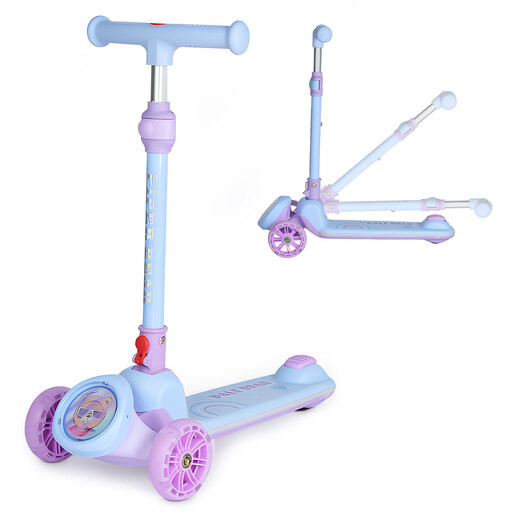
Why this product suits the profile: This model combines three wheels, adjustable handlebar height, lean-to-steer steering and a wide anti-slip deck. It is therefore suitable for families looking for essential features for the playground, courtyard or quieter paths.
The product details list specific features rather than making only general design claims: adjustable height, a wide standing area and three wheels.
Adjustable handlebars and an anti-slip deck; LED light-up wheels according to the product name.

Why this product suits the profile: For families who prefer several adjustment options, the product description specifies four handlebar heights and a weight limit of up to 30 kg.
The age recommendation is supported by specific technical details. However, you must still compare the child’s height and weight before buying.
Four stated handlebar heights, a wide anti-slip deck and LED-lit wheels.
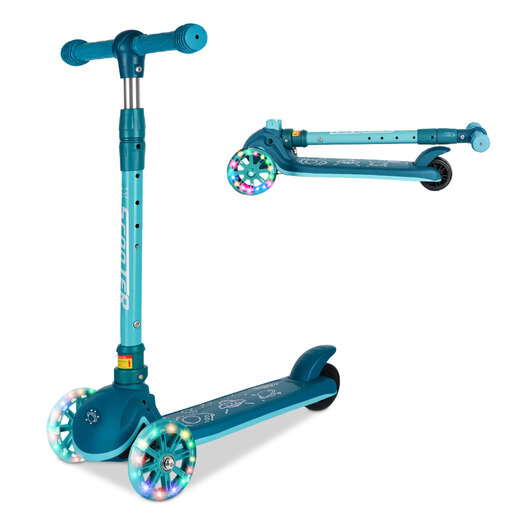
Why this product suits the profile: The folding design is useful for families with limited storage space or who transport the scooter frequently. Height adjustment and lean-to-steer steering are also specified.
The folding function is not treated as a substitute for safety checks: before every ride, you should check the locking mechanism, handlebars and wheels.
Folding construction, height-adjustable handlebars and light-up wheels according to the product details.
We have put together a complete, regularly updated list of products that fully meet these strict selection criteria and the safety regulations applicable in the EU.
A children’s scooter as a gift should not be chosen based solely on its colour or lighting effects. For scooters for girls and boys, neutral criteria are more useful: Is the handlebar height suitable? Is the deck wide enough? Are the age and weight recommendations clearly stated? Will the scooter mainly be used in a courtyard, on the pavement or on uneven ground?
For younger children, a three-wheel design with lean-to-steer steering is often easier to learn than a two-wheel model. For children aged six and over who want to learn tricks at a skatepark, special stunt scooters are the appropriate choice. These are constructed differently from a height-adjustable children’s scooter and should not be confused with one another.
This depends on the specific product information, the child’s height and their stage of development. A model with three wheels, a wide deck and a low handlebar position can make getting started easier. Initially, it should be used on a level, dry surface and under supervision.
The service life depends on the handlebar adjustment range, weight limit, build quality and the child’s growth. Adjustability can allow a suitable riding position to be maintained for longer. Nevertheless, the wheels, screws, brake and folding or locking components must be checked regularly.
On many children’s scooters, the LED wheels are activated by movement while riding. Whether a particular model requires batteries should be checked against the relevant product description and instruction manual. Lighting effects are not a substitute for a helmet, protective equipment or choosing safe routes.