
Lieferung heute & morgen

Qualitätsgarantie

Willkommens-Angebote freischalten: KOSTENLOSE Lieferung | Bis zu 80 % RABATT | Kostenlose 30-Tage-JoyPlus-Testphase
App herunterladen
A 3-wheel kids' scooter is often at the top of the wish list, whether as a birthday gift for boys and girls or simply to encourage more outdoor activity. The selection is vast, but not every model lives up to its promises. Before you make a decision, it's crucial to understand the most common pitfalls, which often only become apparent after the purchase.
As your Joybuy Product Recommendation Officer, I have analysed the key features to offer you objective guidance. This guide focuses on the impartial criteria that define a good kick scooter for kids and helps you distinguish marketing hype from genuine quality features.
It's a huge disappointment when a new scooter ends up in a corner after just a short time. This is often due to design or material weaknesses that are difficult to spot beforehand.
To avoid the problems mentioned above, you should focus your attention on three technical specifications. These define the scooter's safety, comfort, and durability.
A height-adjustable scooter is only a good investment if it truly grows with the child. Pay attention to the specific adjustment range of the handlebar, given in centimetres (e.g., 65 cm to 85 cm). A wide range ensures that the scooter allows for an ergonomic posture over several years. Equally important is the maximum weight capacity. Models rated for up to 30 kg or even 50 kg offer greater stability and a longer lifespan, especially for older or fast-growing children.
The deck is the foundation for secure footing. Two features are crucial here:
The ride quality is largely determined by the wheels and the steering.
Based on the criteria above, we have identified a few models that are suitable for different user profiles.
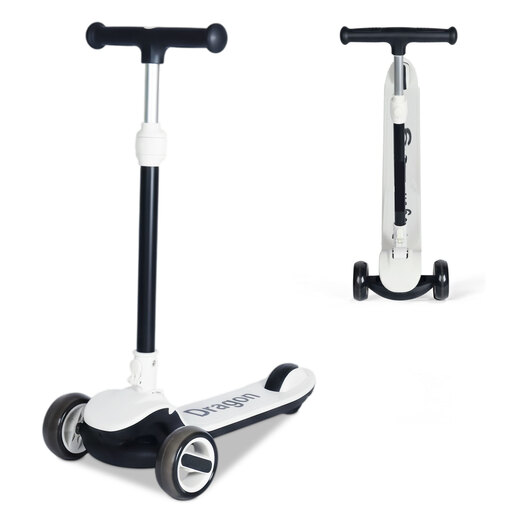
Why it's a good fit: Ideal for toddlers from 3 years old who are learning to ride a scooter. The focus is on stability and easy handling to build self-confidence.
The intuitive lean-to-steer mechanism is specially designed for beginners, avoiding the frustration of steering that is too stiff or unstable.
The extra-wide deck provides a large standing area and high stability, which is crucial for those first few rides.
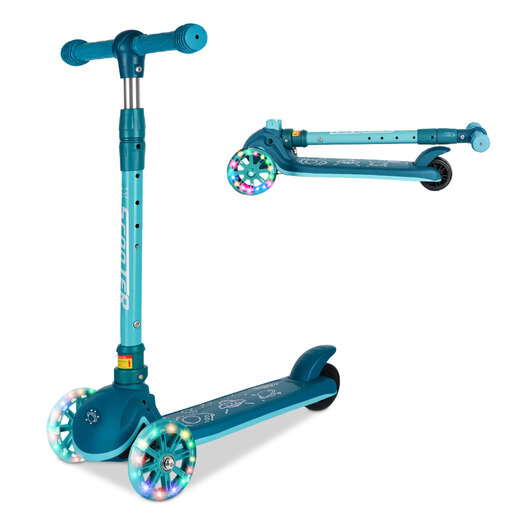
Why it's a good fit: Designed for long-term use. The height adjustment and robust construction make it suitable for children who want to use their scooter for several years.
This model avoids the "one-size-fits-all" trap with a wide, multi-level handlebar adjustment range, making its use across the stated 3-10 year age span realistic.
The folding feature makes it easy to transport and store, offering practical added value for everyday life.
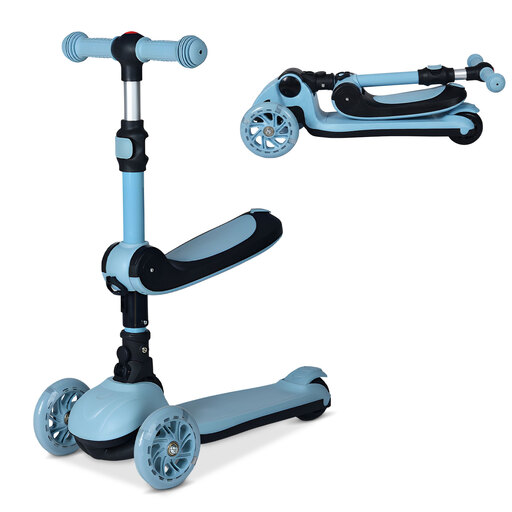
Why it's a good fit: For children who want more than just a scooter. The combination of a scooter and a ride-on offers varied play options and adapts to the child's abilities.
Instead of relying solely on light-up wheels, whose effect can diminish, this model offers a durable, mechanical feature with its swivel seat, which provides long-lasting fun.
The 2-in-1 functionality with the integrated seat allows very young children to use it as a ride-on toy, and it can later be easily converted into a classic kick scooter.
We've compiled a complete, up-to-date list of products that meet these strict selection criteria and safety requirements.
A scooter for ages 3 and up with three wheels is generally a good choice. The two front wheels provide high stability, making it easier for toddlers to keep their balance and focus on steering and pushing off. For children under 3, there are models with seats that can serve as a transition from a ride-on car to a scooter.
The light-up wheels work via an integrated dynamo. As the wheels spin, kinetic energy is generated, which powers small LEDs to light up. No batteries are required, which is convenient and eco-friendly. The brightness and longevity of the lights depend on the quality of the dynamo and LEDs.
Most models are designed to be ready to use in just a few simple steps. Typically, you only need to insert the handlebar into the designated opening on the deck until it clicks audibly into place. For height-adjustable models, the desired height is secured with a clamping lock or a push-button. It is important to check that all connections are secure before the first ride.