
Lieferung heute & morgen

Qualitätsgarantie

Willkommens-Angebote freischalten: KOSTENLOSE Lieferung | Bis zu 80 % RABATT | Kostenlose 30-Tage-JoyPlus-Testphase
App herunterladen
A 3-wheel kids' scooter is often the first vehicle children use to explore their surroundings independently. It promotes motor skills, a sense of balance, and brings a lot of joy to being outdoors. However, the market for kids' scooters is vast, and the choices can be overwhelming. Certain design features, often unmentioned in advertising, can quickly diminish the fun or render the scooter useless after a short time. This guide will show you which pitfalls to avoid and what objective criteria truly matter when making your selection.
Many products promise durability and safety, but in practice, flaws often emerge that severely limit their usability. Pay close attention to these three points to avoid a bad investment:
To ensure the scooter is safe, durable, and comfortable, you should check the following technical features before buying. These characteristics define the quality and practical value of a kids' scooter.
A height-adjustable kids' scooter is a fundamental requirement for long-term use. Look for models that offer multiple adjustment levels to precisely adapt the handlebar to the child's height. The correct handlebar height is approximately at the child's navel level. This allows for an upright posture and optimal control over the scooter. Models that cover an age range from 3 to 10 years typically have an adjustment range that grows with the child, making them usable for years.
The deck is the foundation for safe riding. A scooter for toddlers should have an extra-wide deck that provides enough space for both feet to be placed comfortably side-by-side or one behind the other. The material should feature a non-slip texture to ensure a secure grip even in damp weather or with smooth-soled shoes. Reinforced plastic or nylon composites offer a good combination of stability and low weight.
The type of wheels and the steering mechanism are decisive for the riding experience.
Based on the criteria mentioned, we have identified a few models that are suitable for different user profiles.
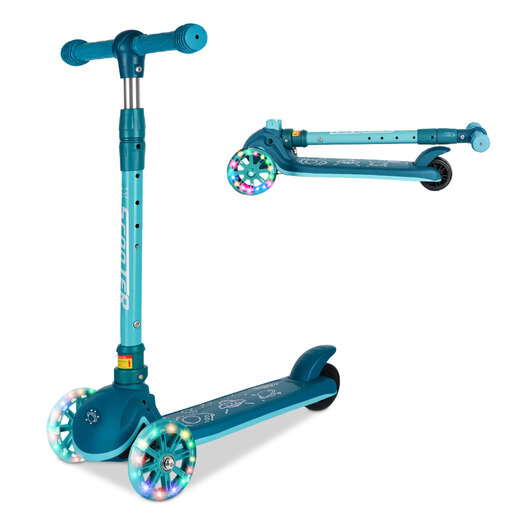
Why it's a good fit: Ideal for families who value practicality. The folding function makes it easy to transport in the car or store compactly at home, which is particularly advantageous for the first, often shorter, outings.
The wide, non-slip deck and intuitive lean-to-steer system provide beginners with the necessary stability and safety to learn balance, thus avoiding the danger of a narrow, insecure footing.
The simple folding mechanism makes this scooter exceptionally easy to transport and store. The height adjustment ensures it can be used for several years.

Why it's a good fit: Designed for long-term use. This model is aimed at parents looking for a robust outdoor toy that grows with their child and can withstand more intensive use.
Thanks to the 3-level height adjustment of the handlebar, it bypasses the common problem of a scooter that doesn't grow with the child. It can be adapted to the child's height for years, avoiding the need for an early replacement.
The robust construction and stable deck are designed for durability. The PU light-up wheels ensure a smooth ride and good visibility.

Why it's a good fit: Perfect as a gift for children who are thrilled by light-up effects. The dynamic LED modes on the wheels and deck make this scooter a real eye-catcher.
This model goes beyond simple light-up wheels by offering dynamic lighting effects. It avoids the disappointment of dim or quickly failing lights by using eye-catching and durable LED technology.
The combination of multi-level height adjustment, a folding mechanism, and special lighting effects makes it a versatile and attractive gift for children.
We have compiled a complete, up-to-date list of products that fully meet these strict selection criteria and German safety regulations.
1. From what age is a 3-wheel kids' scooter suitable? A 3-wheel kids' scooter is generally suitable for children aged 3 and up. The three wheels provide high stability, allowing even younger children without a fully developed sense of balance to ride safely. Always pay attention to the manufacturer's specific age recommendations and ensure that the child can safely touch the ground with both feet.
2. How does lean-to-steer work on a kids' scooter? With lean-to-steer, the front wheels are not rigidly connected to the handlebar. Instead, the child leans the handlebar to the left or right, which causes the entire deck to tilt slightly to the side, steering the wheels in the desired direction. This type of control is very intuitive as it corresponds to the natural body movement when cornering and prevents abrupt steering manoeuvres.
3. Do the light-up wheels need batteries? No, most high-quality scooters with light-up wheels use an integrated dynamo. The rotational movement of the wheels generates energy that makes the LEDs light up. Therefore, no batteries are required, making operation maintenance-free and environmentally friendly. The lights work as long as the scooter is in motion.