
Lieferung heute & morgen

Qualitätsgarantie

Willkommens-Angebote freischalten: KOSTENLOSE Lieferung | Bis zu 80 % RABATT | Kostenlose 30-Tage-JoyPlus-Testphase
App herunterladen
The search for the right 3-wheel kids' scooter can quickly become overwhelming. The market offers a plethora of models that, at first glance, all seem safe and fun. However, the details often hide weaknesses that not only dampen the fun but can also lead to an unnecessary second purchase. As your Joybuy Product Recommendation Officer, I'm here to help you identify the crucial features and make an informed choice.
Before we turn to the recommended features, it's important to know the common pitfalls. Many products lure you in with colourful designs but neglect fundamental functional aspects.
A common issue is scooters advertised as "scooters for kids ages 3 and up" that offer no adjustability. Children grow quickly at this age. A scooter with a fixed handlebar height is often too small after just one season, which compromises the child's posture and makes the purchase uneconomical.
Budget-friendly models often skimp on material quality. Watch out for wobbly handlebars, thin plastic decks that bend under weight, and hard plastic wheels. Such wheels offer little to no shock absorption, are noisy, and wear out quickly. Imprecise steering that doesn't respond to weight shifting can be frustrating and unsafe for new riders.
A kids' scooter with light-up wheels is undoubtedly a huge draw for children. However, this feature shouldn't distract from fundamental flaws. Some manufacturers invest more in aesthetics than in the quality of the ball bearings, the sturdiness of the frame, or the effectiveness of the brake. A flashing scooter that rolls poorly or has a failing brake is not a good product.
To avoid a bad purchase, you should focus your attention on three core technical parameters. These determine the safety, longevity, and riding enjoyment for your child.
Modern 3-wheel scooters suitable for toddlers use a lean-to-steer mechanism. Instead of turning the handlebar like on a bicycle, the child steers by shifting their body weight to the left or right. This type of control is more intuitive for young children, promotes a sense of balance, and prevents abrupt, dangerous handlebar turning at higher speeds. The two front wheels provide a stable base.
A crucial criterion for long-term use is a height-adjustable handlebar. Look for models that offer at least three to four different height settings. A good adjustment range is typically between approx. 60 cm and 85 cm. This allows the scooter to accompany the child for several years. Also, check the maximum weight capacity, which should generally be 50 kg to ensure a sturdy build.
The quality of the wheels and the deck is fundamental to the riding experience and safety.
Based on the quality criteria mentioned, we have compiled a few products from our range for different requirements.
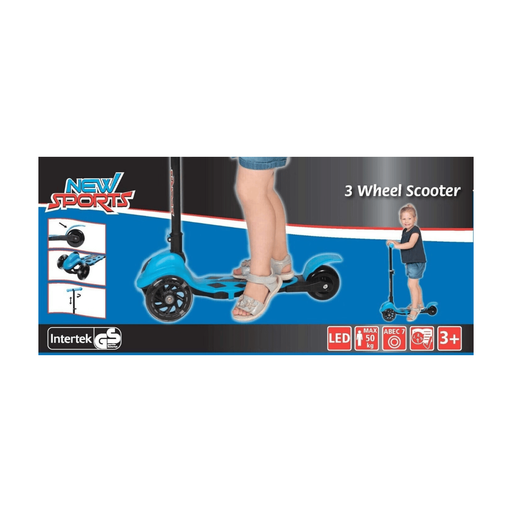
Why this model fits: Ideal for families looking for a functional and safe entry-level model without paying for extra effects. It focuses on the core functions for new riders.
This model forgoes superfluous extras and focuses on a solid basic construction with a weight capacity of 50 kg. The front wheel lock provides additional stability for the first riding attempts, thus avoiding the problem of unstable steering for beginners.
The scooter is foldable, which makes storage and transport easier. The ABEC-7 ball bearings represent good rolling quality in this price range.
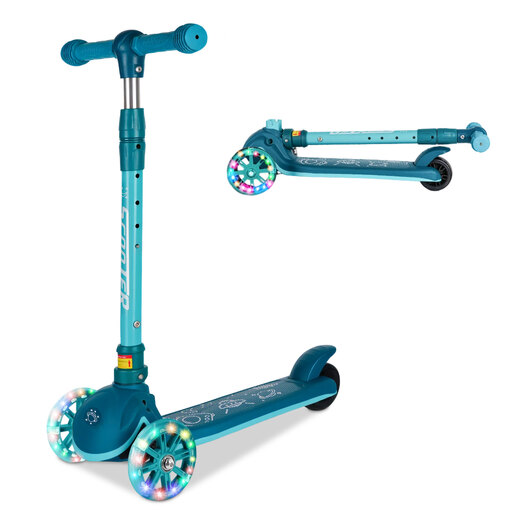
Why this model fits: Perfect for parents seeking a long-term investment. The wide age range of 3 to 10 years is made possible by a robust and adaptable design.
This model directly addresses the pitfall of rigid construction. The height-adjustable handlebar grows with the child, making the scooter usable for many years. The combination of lean-to-steer and a non-slip deck provides the necessary safety.
The combination of durability through adjustability, the intuitive lean-to-steer system, and the easy folding function makes it a versatile companion for boys and girls.
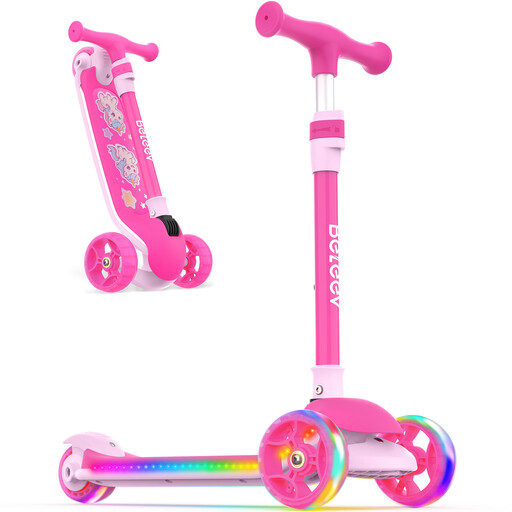
Why this model fits: For kids who prioritise visual effects. This scooter combines the fun of light-up features with the necessary safety and quality standards.
Here, the light-up effects are not achieved at the expense of quality. The scooter features a wide, non-slip deck, height adjustment, and the safe lean-to-steer system. The lights are a well-designed extra, not a compensation for flaws.
The combination of battery-free light-up wheels and a battery-powered light-up deck with 8 modes offers a special riding experience. The maximum weight capacity of 50 kg (110 lbs) and the wide age range (3-12 years) speak to its robust construction.
We have compiled a complete, up-to-date list of products that fully meet these strict selection criteria and German safety regulations.
Most manufacturers specify a minimum age of 3 years. However, more important than age are the child's motor skills. A 3-wheel scooter is ideal as soon as a child can walk confidently and maintain their balance well. The lean-to-steer system supports the development of coordination and is often easier for beginners than classic steering.
Having a foldable scooter is primarily a matter of convenience. If you plan to transport the scooter frequently in the car, store it in a small apartment, or take it on holiday, a folding function is very advantageous. For use purely around your own home, it is not essential but does increase storage convenience.
Even though a scooter with three wheels is more stable than a two-wheeled model, wearing protective gear is essential. A properly fitting and certified helmet is the most important component for protecting against head injuries. Additionally, knee and elbow pads are recommended to prevent scrapes during falls. Always supervise your child while they are riding.