
Lieferung heute & morgen

Qualitätsgarantie

Willkommens-Angebote freischalten: KOSTENLOSE Lieferung | Bis zu 80 % RABATT | Kostenlose 30-Tage-JoyPlus-Testphase
App herunterladen
A 3-wheel kids’ scooter can make it easier for children from around three years old to get started with scooting. Compared with a two-wheeled model, the additional contact point provides a different basis for balance. However, the description “3 wheels” alone is not enough to assess whether a 3-wheel children’s scooter is suitable for everyday use.
Many product descriptions highlight LED wheels, folding mechanisms or particularly wide decks. What really matters, however, is whether these features are suitable for the child’s age, height and intended use. Three common buying misconceptions frequently lead to the wrong choice:
Many children’s scooters with three wheels use a Lean-to-Steer system. The direction is controlled by shifting the body weight and tilting the handlebar slightly. This differs from turning the handlebar in the conventional way and may take a little time to get used to.
With a height-adjustable children’s scooter, the handlebar should be adjustable so that the child can stand upright with their arms slightly bent. Statements such as “for children aged 3 to 10” are a useful guide, but they do not replace an individual comparison of the child’s height and weight with the manufacturer’s specifications. For example, one model states a maximum load of up to 30 kg, while the NSP 3-Wheel Scooter is specified for up to 50 kg.
A non-slip deck can give the foot better grip. Look for a sufficiently large standing surface, rounded edges and a surface that does not become slippery even with a small amount of moisture. A wide deck makes it easier for beginners to position their supporting foot, but it does not automatically make the scooter suitable for every child.
Kids’ scooters with LED wheels use different power sources depending on their design. On many models, the lighting effects are generated while riding without batteries. The illuminated deck on the Beleev V2-Pure, however, requires two AA batteries, which are not included according to the product details. These ongoing costs should be taken into account before buying.
A children’s scooter with a brake will often have a rear footbrake. Some models also feature a steering lock or a front brake function. The brake should be easy for the child to reach, and its attachment and operation should be checked before every use.
With a folding children’s scooter, the locking mechanism, screws and joints should be checked regularly. The NSP model’s product details recommend unfolding the scooter completely, engaging all locks and checking loose parts regularly. For care, a damp cloth with mild soap is generally sufficient; water should not get into the bearings or joints.
Regardless of the model, scooters should not be used in road traffic. A helmet, knee and elbow pads, and supervision by an adult are particularly advisable for younger children. Read the recommended age, maximum load, warnings and details of the responsible person in the EU before buying and before first use.
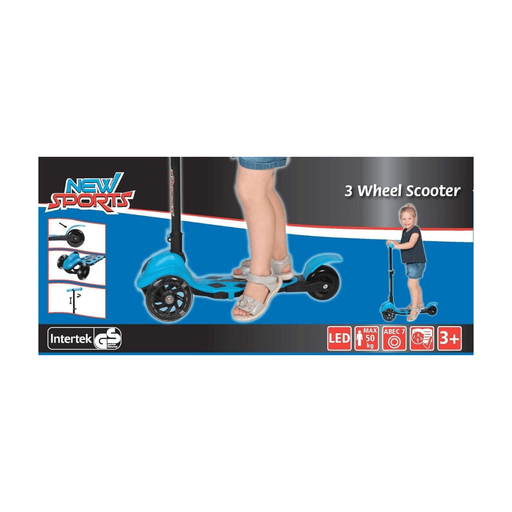
Why this product suits this profile: According to the product details, this model combines a folding function with a front-wheel lock and is designed for children aged 3 and over, with a maximum load of up to 50 kg.
The product description gives specific details about wheel size, load capacity, minimum age and braking function instead of focusing solely on decorative features.
Folding design, front-wheel lock, 110 mm wheels and a stated maximum load of 50 kg.

Why this product suits this profile: Ideal for families looking for multiple adjustable positions and a combination of LED wheels, an LED deck and a folding function.
The stated handlebar range includes three height positions; the product also specifies a maximum load of 110 lb and a rear footbrake system.
Three handlebar heights, folding construction, a wide non-slip deck and battery-powered deck lighting.

Why this product suits this profile: This model is aimed at families who prefer a folding children’s scooter with a brake and a wide standing surface for leisure rides and outings.
The description lists handlebar adjustment, a folding function, three illuminated wheels, an extra-wide deck and a brake as specific features.
Adjustable and folding handlebar, wide deck plate, LED wheels and a stated brake.
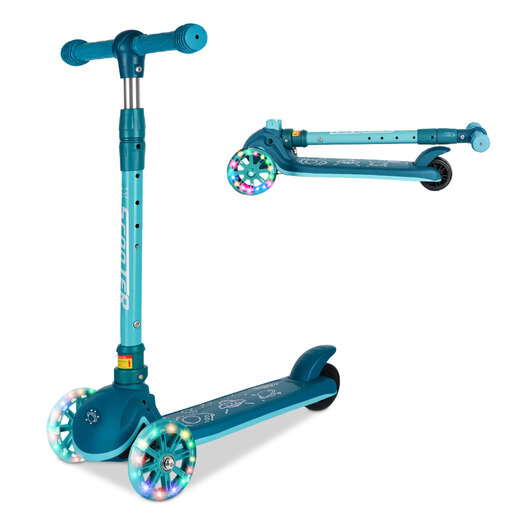
Why this product suits this profile: This model is worth considering for parents who want to combine compact storage with Lean-to-Steer steering and a height-adjustable handlebar.
The product name explicitly highlights the folding function, anti-slip deck, LED wheels and three handlebar heights.
Folding format, Lean-to-Steer system, height-adjustable handlebar and non-slip standing surface.
We have put together a complete, regularly updated list of products that fully meet these strict selection criteria and the safety regulations applicable in the EU.
According to the product details, many models in this category are intended for children aged 3 and over. Actual riding behaviour also depends on the child’s height, weight, coordination and ability to follow instructions. The scooter should first be used on a flat, traffic-free surface under supervision.
The usable lifespan depends primarily on handlebar heights, maximum load, the condition of the materials and the child’s height. A height-adjustable children’s scooter may remain suitable for longer than a model with a fixed handlebar height. Nevertheless, the wheels, deck, brake, screws and folding joint should be checked regularly. If there are cracks, unusual play or a locking mechanism that does not work reliably, the scooter should no longer be used.
That depends on the lighting system. Many LED wheels generate light as they move and do not require batteries according to the available product details. An LED deck, however, may be battery-powered. Check whether batteries are included, which size is required and whether the lighting element can be switched off. LED features are an added extra and should not be confused with road lighting.