
Lieferung heute & morgen

Qualitätsgarantie

Willkommens-Angebote freischalten: KOSTENLOSE Lieferung | Bis zu 80 % RABATT | Kostenlose 30-Tage-JoyPlus-Testphase
App herunterladen
A 3-wheel kids’ scooter can make it easier for children from around three years old to start scooting. At the same time, models vary considerably in handlebar height, deck design, weight capacity and braking equipment. Focusing only on flashing wheels or eye-catching colours can mean overlooking important factors for everyday use.
Three common buying misconceptions occur particularly often:
The manufacturer’s age recommendation is a guide. You should also check:
The handlebar should be approximately level with the child’s chest or navel when they are standing upright. Handles set too low can result in a hunched posture, while handles that are too high make control more difficult. With a balance bike for toddlers, both feet should be able to reach the ground securely wherever possible.
A wide, non-slip deck provides more room for the standing foot. The surface should offer sufficient grip even in light dampness. The steering system is also important for a 3-wheel kids’ scooter:
LED wheels are a feature, but not proof of quality. Check the wheel size and whether the wheels are suitable for the intended surface. Many models are suitable for even paths, courtyards and smooth park areas, but not for use on public roads.
A rear-wheel foot brake can help the rider slow down. It should be easy to reach and should not protrude beyond the rear wheel. Check the following before every ride:
Different requirements apply to children’s vehicles depending on the type of product. Information about the CE marking, intended age group, maximum load and warnings should be clearly available on the product page, packaging or in the instructions. A scooter is not intended for use on public roads unless the manufacturer expressly states otherwise.

Why this product suits this profile: This model combines an age range of 3 to 10 years with an adjustable handlebar and a wide deck. It is therefore suitable for families looking for an uncomplicated children’s scooter for use on even paths.
The product description lists specific features such as a non-slip deck and lean-to-steer system, rather than promoting just a design feature.
Three wheels, adjustable handlebar, wide deck and illuminated wheels according to the product information.
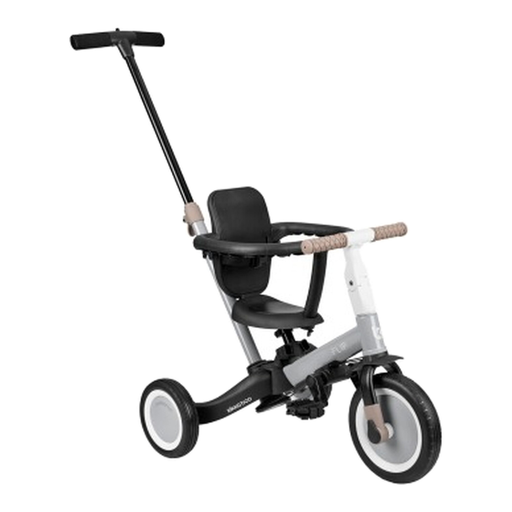
Why this product suits this profile: The 5-in-1 design is appealing to families looking for a children’s vehicle with a push handle and several usage stages. According to the description, this model is intended for children aged 1 to 5 years.
The individual operating modes, adjustable seat and three-stage push handle are described in detail, making it easier to compare the product with your intended usage plan.
Five modes, height-adjustable seat, 2-point harness system, net weight of 5.6 kg and stated dimensions of 70 × 45 × 65–91 cm.

Why this product suits this profile: This 3-wheel kids’ scooter is designed for children aged 3 to 10 and is aimed at families who want to combine adjustable settings with eye-catching wheels for leisure rides.
The product information specifies four handlebar heights, a wide non-slip deck and a maximum load of up to 30 kg.
LED-illuminated wheels, four adjustable handlebar positions, lean-to-steer system and 30 kg limit according to the product description.

Why this product suits this profile: A balance bike for toddlers can be an alternative to a scooter if the child would first like to practise balance and steering around corners. According to the product name, this model is designed for children aged 2 to 6.
Rather than assuming that a child is ready for pedals or a scooter too soon, this concept takes into account a vehicle without pedals and with adjustable contact points.
12-inch version, adjustable seat and handlebar, puncture-proof tyres and low weight according to the product information.
We have put together a complete, regularly updated list of products that fully meet these strict selection criteria and the safety regulations applicable in the EU.
Many models are listed as kids’ scooters for ages 3 and over. Height, weight, balance and the ability to understand instructions are also important factors. For younger children, a balance bike or a children’s vehicle with a push handle may be better suited to their stage of development. First use should always take place on level ground away from traffic and under direct supervision.
The useful life depends on the weight limit, handlebar adjustment, care of the materials and the child’s growth. An adjustable kids’ scooter may remain suitable for longer than a model with a fixed handlebar height. Even so, the maximum load and the child’s height must be checked again regularly. Loose screws, damaged wheels or a cracked deck are reasons to stop using the vehicle.
LED wheels are primarily a visible design feature. They do not replace a brake, a sturdy deck or protective equipment. For safety, the correct size, controlled speed, suitable ground and adult supervision are more important. Kids’ scooters should not be used in road traffic.