
Lieferung heute & morgen

Qualitätsgarantie

Willkommens-Angebote freischalten: KOSTENLOSE Lieferung | Bis zu 80 % RABATT | Kostenlose 30-Tage-JoyPlus-Testphase
App herunterladen
A 3-wheel kids’ scooter offers a wide base through its two front wheels and can make it easier for children to get started with scooting. However, models vary considerably in their steering systems, deck width, height adjustment and ease of transport. An eye-catching design or illuminated wheels alone reveal little about whether the scooter is suitable for the child’s age, height and intended use.
The most important buying decisions can be narrowed down to a few points that are easy to check. This helps parents avoid common purchasing mistakes and choose a scooter for children that will genuinely be used in everyday life.
The description “kids’ scooter from 3 years” is only a starting point. Children develop at different rates. Handlebars that are too low can lead to an awkward posture, while handlebars that are too high make the scooter harder to control. The key factors are therefore the adjustable handlebar positions and the manufacturer’s information on the child’s height and the maximum load.
A 3-wheel kids’ scooter with LED wheels can be highly visible while riding and look appealing. However, lighting does not replace a non-slip deck or a working rear brake. Buyers should check whether the wheels actually light up while moving, what wheel size is specified and whether replacement parts are available.
A folding kids’ scooter is practical for the car, the cellar or public transport. However, the folding mechanism must not activate accidentally and should be fully locked into place before every ride. With cheaper models, handlebar play, loose screws or a narrow riding surface may also be potential drawbacks. The product description, assembly instructions and customer service options should all be considered before buying.
With a lean-to-steer scooter, the direction of travel is not controlled solely by turning the handlebars in the traditional way. The child shifts their weight slightly to the left or right. This design can make cornering more intuitive, but it does require a short adjustment period.
For younger children, a wide front axle with a stable riding surface is important. Parents should initially let their child ride on level ground away from traffic and explain how to use the scooter.
A non-slip deck helps provide a secure footing, particularly when the scooter is used outdoors on slightly damp ground. Look for:
A high stated maximum load is no substitute for following the age and usage instructions. Children should wear a suitable helmet when riding; depending on the surroundings, knee and elbow pads may also be advisable.
A height-adjustable kids’ scooter can be used for longer if the lowest and highest handlebar positions suit the child’s height. Check whether adjustment can be carried out without tools and whether the setting locks securely into place.
The rear brake should be easy to reach and must not rub against the tyre when applied. For families who often take the scooter with them, folding handlebars or a compact folding mechanism are practical features to consider. All screws must be checked in accordance with the assembly instructions before first use.
For children’s products offered in the EU, the manufacturer or importer details, warnings and the CE marking, where applicable to the product, should also be clearly identifiable. This information should match the product page and packaging. A CE marking is not an independent quality seal. Instead, it indicates that the responsible supplier has declared compliance with the applicable EU requirements.
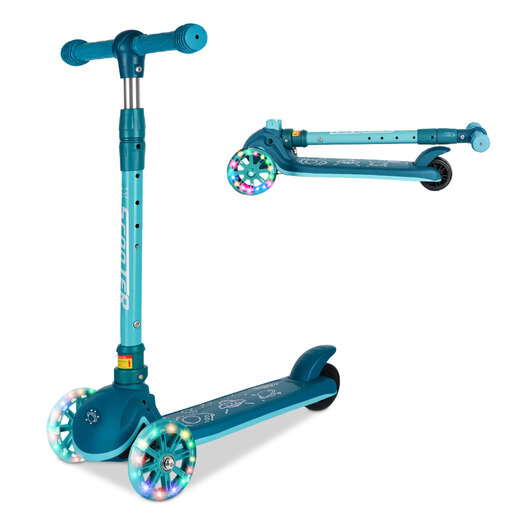
Why this product suits this profile: This model combines three wheels, an adjustable handlebar, a non-slip deck and a folding design for beginners from 3 years up to the stated age of 10.
The combination of lean-to-steer functionality and adjustable handlebar height reduces the risk of buying a rigid starter model that will quickly become unsuitable.
Three wheels, LED wheels, a folding design and an adjustable steering column according to the product description.

Why this product suits this profile: This model is aimed at families who value adjustable components, a wide riding surface and different LED modes.
The specifications state four adjustable handlebar heights and an extra-wide deck. This makes it easier to compare key dimensions before buying.
LED-lit wheels, four handlebar positions, a wide non-slip riding surface and lean-to-steer design.

Why this product suits this profile: This 4-wheel scooter with a swivel seat is specified for children aged 3 to 8 and can be an alternative when a seated option is wanted alongside standing.
The four wheels and seating function clearly distinguish it from a conventional 3-wheel kids’ scooter. This helps buyers match the product more accurately to its intended use.
Four wheels, swivel seat, adjustable height and a stated maximum load of 100 kg.
We have put together a complete, regularly updated list of products that fully meet these strict selection criteria and the safety regulations applicable in the EU.
Before the first ride, adults should assemble the scooter fully and check all screw connections. Then check:
Level paths away from traffic are ideal for getting started. Wet conditions, slopes, stairs and heavily trafficked areas increase the risk of falls and should be avoided. A kids’ scooter is not a vehicle for use on public roads.
Many models are specified as kids’ scooters from 3 years. Alongside age, the child’s height, weight, motor skills and the manufacturer’s stated maximum load are all important. The child should be able to stand securely, reach the handlebars and understand instructions.
This depends on the handlebar range, deck size, maximum load and the child’s growth. A model with several handlebar positions may remain suitable for longer than a scooter with a fixed height. Parents should still check regularly that the child can maintain an upright posture and operate the scooter safely.
No. LED wheels are primarily a visible extra feature. When choosing a children’s kick scooter, sturdy wheels, a non-slip deck, a suitable handlebar and a working brake are more important. LED wheels can be taken into account as an additional factor, but they should never replace a safety check.