
Lieferung heute & morgen

Qualitätsgarantie

Willkommens-Angebote freischalten: KOSTENLOSE Lieferung | Bis zu 80 % RABATT | Kostenlose 30-Tage-JoyPlus-Testphase
App herunterladen
A 3-wheel kids’ scooter can make it easier for children from around three years old to get started with scooting. The three wheels provide a broad base, but they do not replace supervision or suitable protective equipment. Before buying, parents should therefore look beyond colour, LED wheels and attractive design.
The construction, weight capacity and ability to adjust the scooter to the child’s height are key considerations. Our selection highlights which features matter in everyday use and which marketing claims deserve closer scrutiny.
Kids’ scooters with LED wheels are visually appealing to many children. On various models, the wheel lights are powered by movement, while LED elements on the deck may require additional batteries. Illuminated wheels are not a substitute for visibility in traffic and are not safety equipment.
It is also important to check whether batteries are included. On the Beleev model, for example, the LED deck lighting requires two AA batteries, which are not included according to the product information.
The description ‘kids’ scooter from age 3’ is only a starting point. Your child’s height, handlebar height and weight must also be taken into account. Handlebars that are too low can encourage an awkward posture, while handlebars that are too high make the scooter harder to control.
Before buying, check the following:
A folding kids’ scooter can be useful when transporting it in the car or storing it at home. However, the folding mechanism should lock securely and must not be able to release accidentally during use. Non-folding models may have a simpler construction, but they require more storage space.
With a lean-to-steer scooter, the direction of travel is not changed solely by turning the handlebars. The child shifts their body weight slightly to the left or right. This design is found on many 3-wheel models and should initially be practised on a flat surface away from traffic.
For younger children, this type of steering can feel more straightforward than freely turning handlebars. However, the turning circle and responsiveness vary depending on the design. A supervised test ride is still advisable.
A kids’ scooter with a wide anti-slip deck offers more room for the feet than a narrow footboard. Look for:
A wide deck can make getting started easier, but it does not automatically make the scooter suitable for every age group.
Many children’s scooters have a rear foot brake. It should be easy to reach, and you should explain how to use it when practising with your child. The wheels should roll smoothly but must not have noticeable sideways movement.
The weight capacity must be observed. The Neuleb YFQ, for example, has a stated limit of 30 kg in the product information. The Beleev model is listed with a maximum load of 110 lb. These limits should not be exceeded.
The product information also highlights the need for protective equipment and use away from public roads. Due to the stated warnings, the models mentioned are not intended for children under three.

Why this product suits the profile: The combination of three wheels, lean-to-steer design, adjustable handlebars and a wide anti-slip deck covers the basic requirements for beginners.
The product information lists specific features rather than focusing solely on colour or lighting: adjustable handlebars, a wide footboard and a lean-to-steer system.
Three wheels, illuminated wheels, adjustable handlebars and a wide anti-slip footboard according to the product description.

Why this product suits the profile: Ideal for families who want to compare several adjustable heights, a folding function and additional deck lighting.
The product description distinguishes movement-powered LED wheels from battery-powered deck lighting and clearly states the battery requirements.
Three handlebar heights, folding design, rear brake and a stated weight of 6,1 lb according to the product information.
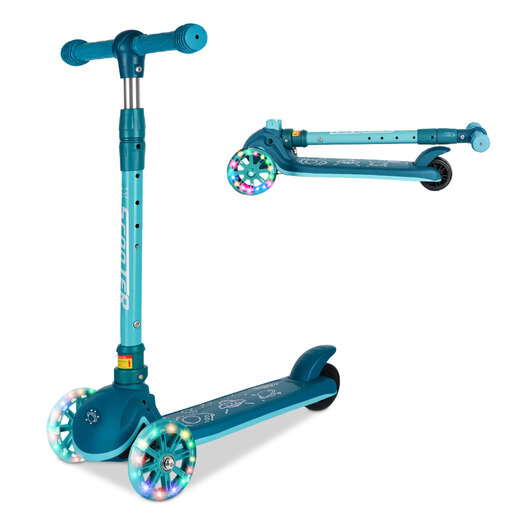
Why this product suits the profile: The folding function is useful for families with limited storage space, frequent car journeys or changing locations.
The product information combines the folding function with an adjustable handlebar and also mentions the anti-slip deck and lean-to-steer design.
Folding design, illuminated wheels, height-adjustable handlebars and a slip-resistant footboard according to the product description.
Before ordering a children’s kick scooter, it is worth carrying out this quick check:
We have put together a complete, regularly updated list of products that fully meet these strict selection criteria and the safety regulations applicable in the EU.
According to the product information, many models are intended for children from the age of three. However, your child’s height, weight, handlebar height and motor skills are also important. Your child should initially use the scooter under supervision on a flat, clear surface.
The useful life depends on the weight capacity, adjustable handlebar height and your child’s growth. A height-adjustable kids’ scooter may remain suitable for longer than a model with a fixed handlebar position. The wheels, deck, brake and folding joint should be checked regularly for wear and loose connections.
For LED wheels that light up through movement, batteries are normally not required for the wheels. Additional LED lighting on the deck may require batteries, however. Parents should therefore distinguish between movement-powered illuminated wheels and battery-powered elements before buying.