
Lieferung heute & morgen

Qualitätsgarantie

Willkommens-Angebote freischalten: KOSTENLOSE Lieferung | Bis zu 80 % RABATT | Kostenlose 30-Tage-JoyPlus-Testphase
App herunterladen
Choosing a 3-wheel scooter for a child aged 3 and up can be a challenge, given the vast array of models and features. Well-intentioned purchases often lead to frustration when the product doesn't meet expectations or quickly becomes unusable. This guide focuses on the crucial features that ensure durability and a fun ride, helping you to sidestep common purchasing traps.
Many products advertise flashy features that, in practice, have significant flaws. Three typical problems often lead to disappointment:
To avoid a bad purchase, you should focus on objective, technical parameters. These three aspects are decisive for the functionality and longevity of a kids' scooter.
Most three-wheeled scooters for toddlers use a lean-to-steer mechanism. Instead of turning the handlebar like on a bicycle, the child steers by shifting their body weight. This system intuitively promotes a sense of balance and motor coordination. The two front wheels provide high stability against tipping, which allows children from 3 years old to get started safely.
A height-adjustable kids' scooter grows with your child and can be used for several years. Look for a handlebar that can be locked into several positions to ensure an ergonomically correct posture during different growth phases. A foldable toddler scooter offers additional advantages: it can be stored in the car trunk, hallway, or taken on trips to save space. A simple and secure folding mechanism is of great importance here.
The quality of the wheels is crucial for the riding experience. PU (polyurethane) wheels are a good standard, as they offer a blend of durability and cushioning. A kids' scooter with light-up wheels can increase visibility and the fun factor, provided the LEDs are powered by motion (dynamo-powered) and not by batteries. A wide and non-slip deck gives the child a secure footing. The rear brake should be easy to reach and operate by simply stepping on it.
A note on safety: Regardless of the scooter model you choose, wearing a well-fitting helmet is essential. A helmet like the OutdoorMaster Ibex Youth & Kids Bike Helmet provides reliable impact protection thanks to its ABS outer shell and shock-absorbing EPS core.
Here are some recommendations tailored to different user profiles that meet the quality criteria mentioned above.

Why This Fits Their Persona: Ideal for families looking for a durable and versatile outdoor toy that brings joy for several years and adapts to the child's growth.
The 3-level adjustable handlebar prevents the scooter from being outgrown too quickly. The wide, non-slip deck provides stability for beginners.
The combination of lean-to-steer, light-up wheels, and a wide age range (3-10 years) makes it a companion that grows with your child.
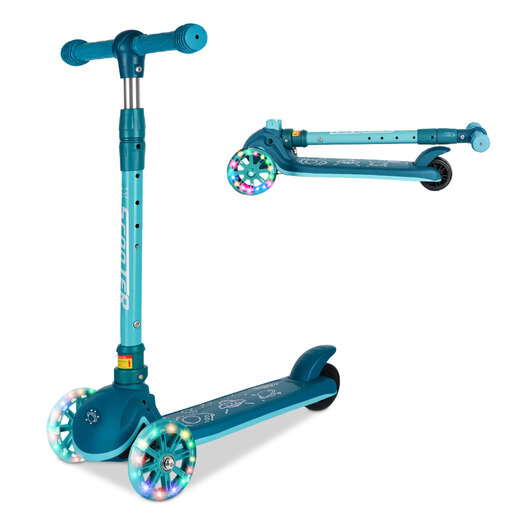
Why This Fits Their Persona: Perfect for families with limited storage space or for those who regularly transport the scooter in the car, whether for a visit to the grandparents or a trip to the park.
This model combines the crucial height adjustment with an easy folding mechanism, without compromising the stability of the deck.
Its foldability makes the scooter extremely practical for a mobile lifestyle. The light-up wheels and robust construction are maintained.

Why This Fits Their Persona: Designed for parents and grandparents whose top priority is stability and safety for their child's first attempts at riding. Ideal for boys and girls who are just starting to find their balance.
The extra-wide deck directly counteracts the risk of an unstable stance, giving the child a large, secure surface to place both feet if needed.
The focus is clearly on maximum stability. The intuitive lean-to-steer system and the easy-to-use foot brake support a safe learning process.
We have compiled a complete, up-to-date list of products that fully meet these strict selection criteria and UK/EU safety regulations.
A three-wheeled scooter is generally suitable for children from about 3 years of age. The three wheels provide high stability, which allows even younger children without a fully developed sense of balance to ride safely and gain their first experiences. Always check the manufacturer's age recommendation.
With lean-to-steer, the scooter is controlled not by turning the handlebar, but by the child shifting their body weight. When the child leans to the right, the scooter steers to the right, and vice versa. This mechanism is very intuitive and promotes the development of balance and coordination.
Most models are designed to be ready for use in just a few simple steps. Typically, you only need to insert the handlebar into the designated opening on the deck until it clicks audibly into place. For foldable models or for adjusting the handlebar height, there is usually a simple clamp or button mechanism. Assembly with tools is rarely required. Nevertheless, always read the manufacturer's enclosed instructions before the first use.