
Lieferung heute & morgen

Qualitätsgarantie

Willkommens-Angebote freischalten: KOSTENLOSE Lieferung | Bis zu 80 % RABATT | Kostenlose 30-Tage-JoyPlus-Testphase
App herunterladen
Choosing the right scooter for a three-year-old can be a challenge. Parents and relatives look for a model that is not only fun but, above all, safe, stable, and durable. A good kids' scooter for ages 3 and up should grow with the child and adapt to their developing motor skills.
This article serves as a guide. It highlights key features to look for when making your selection and presents a variety of models to help simplify your decision-making process.
To make an informed decision, several technical and functional aspects are important. The following points will help you objectively compare the features of different models.
For toddlers just starting out, stability is a crucial factor. A kids' scooter with 3 wheels—two in the front and one in the back—offers a wider base and greater tip-resistance compared to two-wheeled models. This design makes it easier for children to maintain their balance and focus on steering and propelling themselves. Many of these scooters for toddlers feature a lean-to-steer mechanism, where the child directs the scooter by shifting their weight. This intuitively promotes coordination and a sense of balance.
Children grow quickly. A height-adjustable kids' scooter is therefore a smart investment. Models with a multi-level adjustable handlebar can be used for several years, adapting to the child's height. Pay attention to the manufacturer's specified maximum weight capacity and recommended age and height ranges to ensure the kick scooter for kids offers a long lifespan.
A foldable kids' scooter is especially beneficial for families who frequently transport the scooter or want to store it compactly when not in use. A simple folding mechanism and a lightweight design make everyday handling much easier. Another popular feature is a kids' scooter with light-up wheels. These wheels are often powered by motion (dynamo effect) and don't require batteries. They not only add to the fun but can also improve visibility in low-light conditions.
Here is a selection of models that cater to different needs and preferences. Each model is presented with its specific features.

Why this model stands out: This model combines a classic scooter with a detachable seat. The four wheels provide extra stability, making it particularly suitable for the youngest riders. The high maximum weight capacity of 100 kg indicates a robust construction.
Advantages:
Who is this model for? This model is a great choice for parents looking for a versatile and exceptionally stable entry-level scooter for children from 3 years old, which offers a very long lifespan thanks to the detachable seat.

Why this model stands out: The Beleev V2 is distinguished by its comprehensive LED lighting. Not only the wheels but also the deck light up, creating a striking look. The wheels illuminate without batteries through motion, while the deck features 8 different, battery-powered light modes.
Advantages:
Who is this model for? Ideal for children and parents who value a striking design and practical handling. The folding mechanism and low weight make this scooter for kids a convenient companion for on-the-go.
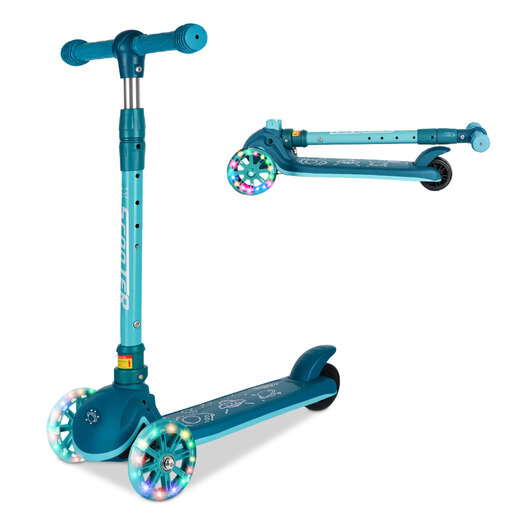
Why this model stands out: This model focuses on the core features of a good entry-level scooter: stability from three wheels, an intuitive lean-to-steer mechanism, and everyday practicality thanks to its folding design. The light-up wheels provide an extra incentive for kids.
Advantages:
Who is this model for? A solid choice for families looking for a straightforward, safe, and practical 3-wheel kids' scooter that combines the most important features for children aged 3 to 10.
If you haven't found the right model for your needs among these recommendations, there are many other variations to discover. Different designs, colour schemes, and feature combinations offer a wide selection.
Browse our entire selection of scooters and accessories to compare more models.
1. What type of scooter is best for a 3-year-old? For children aged 3 and up, a 3-wheel kids' scooter is often recommended. The two-front-wheel configuration provides high stability and makes it easier for beginners to keep their balance. Models with a lean-to-steer mechanism also playfully promote motor skill development.
2. What should I look for in terms of scooter safety? Key safety features include a low, non-slip deck for a secure footing, an easily accessible and effective rear-wheel brake, and a sturdy frame. Regardless of the model, a child should always wear appropriate protective gear, including a helmet, knee pads, and elbow pads, when riding.
3. Are light-up wheels just a visual gimmick?Kids' scooters with light-up wheels are very popular with children. Beyond the fun factor, they can also have a practical benefit by slightly increasing the visibility of the scooter and the child in low-light conditions, such as at dusk. Many of these wheels operate via a dynamo and do not require batteries, making them low-maintenance.