
Lieferung heute & morgen

Qualitätsgarantie

Willkommens-Angebote freischalten: KOSTENLOSE Lieferung | Bis zu 80 % RABATT | Kostenlose 30-Tage-JoyPlus-Testphase
App herunterladen
A large chest freezer with around 300 litres of usable capacity is a smart investment for families, garden owners, and anyone looking to plan ahead and save money with bulk purchases. However, the selection process has hidden pitfalls that can quickly turn a good investment into a purchase you'll regret. Certain technical features are often overlooked, leading to malfunctions or impractical daily use. This guide will show you what to look for to find an appliance that reliably and durably meets your needs.
Before looking at specific models, it's important to understand the typical problems that can arise after your purchase. These three points often lead to disappointment:
To avoid these mistakes, you should check three core technical aspects before buying. These will determine if a chest freezer is right for your needs.
The climate class indicates the temperature range in which a refrigerator or freezer operates flawlessly. For unheated spaces like a garage or basement, this is the most important criterion for a chest freezer for a garage.
For use in regions where garage temperatures can drop below 10°C in winter, an appliance with the SN-T climate class is ideal. These models cover a wide range from +10 °C to +43 °C and often feature special technologies to ensure operation even at lower temperatures. Carefully check the manufacturer's specifications to confirm that the appliance is explicitly approved for operation in cold environments.
A 300L chest freezer offers a huge amount of storage but also requires a significant footprint. Measure the available space precisely and plan for additional room for ventilation (usually 5–10 cm on the sides and back). Also, consider the clearance needed to fully open the lid.
Modern appliances offer more than just cooling. Two features are particularly noteworthy:
Based on these objective criteria, we have identified models that are particularly well-suited for specific user profiles.
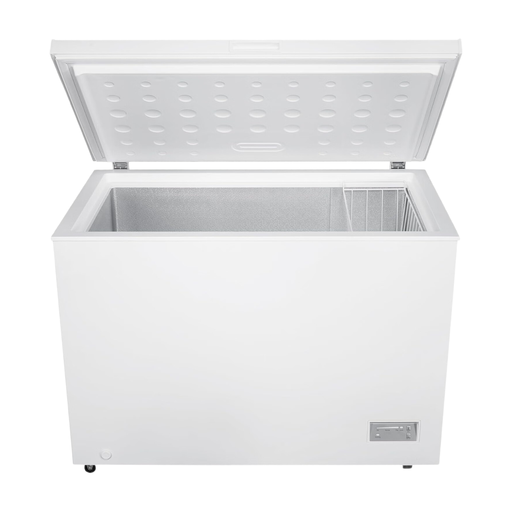
Why It's a Match: Ideal for users who store large quantities of food from the garden, hunting, or bulk shopping. Its suitability for unheated rooms makes it the perfect solution for a basement or garage.
Thanks to the SN-T climate class, operation in cold environments is guaranteed. The integrated temperature alarm protects your stock, and the four transport wheels solve the problem of immobility.
With 308 litres, it offers a very large capacity and all the necessary features for reliable long-term storage in utility rooms. The operating noise of 40 dB is discreet for this size class.

Why It's a Match: For users who value organisation and quick access. Instead of a chest, this upright freezer features drawers that provide a perfect overview of your frozen goods.
The No-Frost technology prevents ice build-up and eliminates manual defrosting. The appliance is also suitable for operation in unheated rooms down to -15 °C and is extremely quiet at 34 dB.
Maximum organisation with 5 drawers and 3 compartments. The SmoothFit door closes flush, allowing for seamless integration into kitchen units or alcoves.
We have compiled a complete, up-to-date list of products that fully meet these strict selection criteria and safety standards.
As a rule of thumb, you can store about 50-60 kg of frozen goods per 100 litres of usable capacity. A 300-litre chest freezer can therefore hold approximately 150-180 kg. This meets the needs of a four- to five-person family that regularly stocks up.
No. Only appliances with a climate class designed for low ambient temperatures (e.g., SN) are suitable for operation in an unheated garage or a cold basement. Look for the manufacturer's explicit approval for temperatures below +10 °C to avoid malfunctions in winter.
The 4-star rating (****) indicates that the appliance can reach and maintain a temperature of -18 °C or colder. This is the prerequisite for the long-term storage of food for several months. Additionally, fresh food can be safely frozen in a 4-star compartment. Appliances with fewer stars are only suitable for short- to medium-term storage of already frozen products.