
Lieferung heute & morgen

Qualitätsgarantie

Willkommens-Angebote freischalten: KOSTENLOSE Lieferung | Bis zu 80 % RABATT | Kostenlose 30-Tage-JoyPlus-Testphase
App herunterladen
A 300-litre folding wagon offers plenty of storage space, can be stored compactly after use and makes it easier to transport garden materials, shopping or camping equipment. However, advertising claims often differ significantly in their practical relevance. A large capacity does not automatically mean a high load capacity, and wide wheels alone do not guarantee safe handling on sand or slopes.
For families, campers, festival-goers, gardeners and beach visitors, it is therefore worth taking a close look at the technical specifications. The following criteria will help you choose a suitable 300L folding wagon and avoid common buying mistakes.
For some models, the stated litre capacity refers to the interior with the rear wall open or the side panels unfolded. This can significantly alter the actual usable base area during normal use. You should therefore check:
For the Portal 21813, the capacity is stated as 300 litres with the rear wall open. The internal dimensions are given as (98 + 38) × 45 × 38 cm. This information is more useful for planning than the litre figure alone.
A high-capacity load wagon is not automatically suitable for every heavy load. The stated maximum load, weight distribution and ground conditions are what matter. Drinks, paving slabs or firewood can quickly reach the permitted weight.
A 132 kg folding wagon, for example, is sufficient for many everyday and leisure uses, but cannot be compared with a model that states a higher load capacity. The maximum load must not be exceeded. When heavily loaded, the weight should be distributed as evenly as possible across the loading area to prevent the wagon from tipping.
Narrow plastic wheels generally roll without problems on asphalt, but may dig into sand, gravel or damp grass more easily. For a camping wagon or a garden and beach wagon, wheel diameter, tyre width and bearings are therefore important.
The brake is just as important: a transport wagon with a brake should be secured on slopes with the parking function engaged. On models with two brakes, both sides must lock correctly. Also look for a protected folding mechanism and make sure that hands and fingers cannot get caught in the joints when folding the wagon.
A 300-litre wagon is suitable for larger equipment, but it also requires enough space in the boot, cellar or shed. You should therefore compare:
According to the product specifications, the Portal 21813 measures up to 143 × 54 × 63 cm when unfolded and folds down to 35 × 26 × 80 cm. This makes it easier to plan storage in many vehicles or storage areas than with a wagon for which only the litre capacity is stated.
A frame made from alloy steel provides a defined basis for the load capacity. Polyester or 600D Oxford fabric are typical materials for folding transport wagons. What matters is whether the fabric can be cleaned easily after use at the beach or in the garden.
Removable wheels are practical because sand and dirt can be removed from the axles and bearings. The Portal 21813 is described as having PU wheels with internal bearings and quick-release fittings. After cleaning, the wagon and wheels should be allowed to dry completely before the folding wagon is stored away.
For uneven paths, folding wagons with large wheels and wider tyres are generally more practical than narrow rollers. Check whether the wheels have bearings, whether they can be replaced and whether the handle is height-adjustable.
A wagon with two brakes can provide additional security on slopes. However, the brake is no substitute for careful loading. The wagon should never be left unattended, particularly on sloping ground.
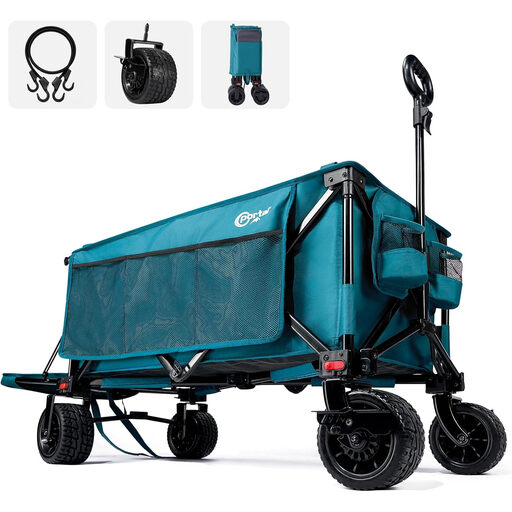
Why this product suits this profile: The wagon combines a stated capacity of 300 litres with folded dimensions of 35 × 26 × 80 cm. This makes it suitable for families, gardeners and occasional camping trips where compact storage is important.
The product specifications state both the conditions for the 300-litre capacity and the internal and folded dimensions. This makes it easier to assess the storage space than by relying on an isolated advertising figure.
300 litres, stated load capacity of 132 kg, PU wheels with bearings, quick-release wheels, two brakes, side pockets and cup holders.
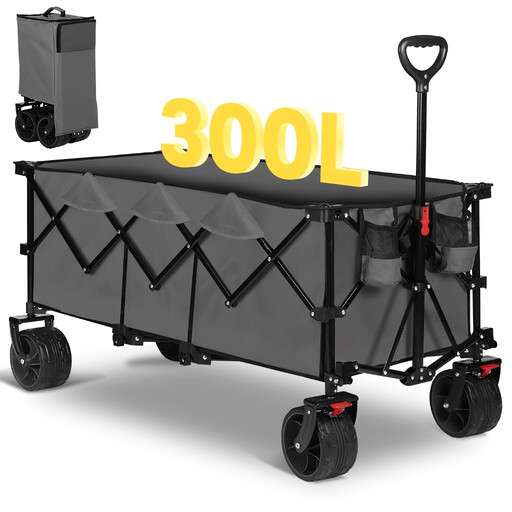
Why this product suits this profile: The combination of 300 litres, a stated load capacity of 200 kg and wide 7-inch tyres is aimed at users who regularly transport heavier equipment for the garden, camping or events.
The load capacity is stated separately from the storage space. Wide tyres, bearings and brakes address common weaknesses on uneven ground and when carrying heavy loads.
600D Oxford fabric, four-way folding mechanism, one-handed operation, 300 litres, stated load capacity of 200 kg, wide tyres, brakes and two cup holders.
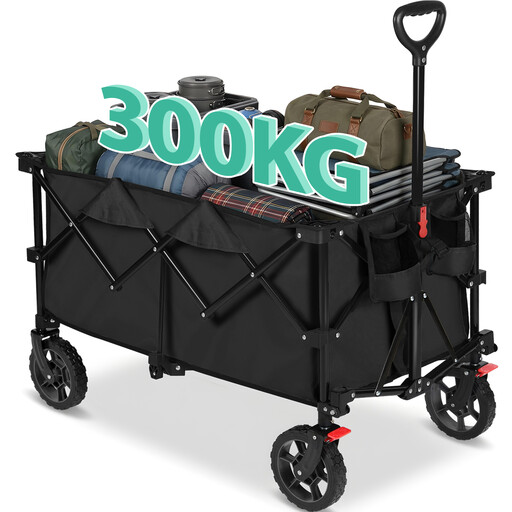
Why this product suits this profile: This model is an alternative for frequent users who value the stated load capacity of 300 kg more than a capacity of 300 litres. It is suitable for heavy garden materials, shopping and equipment.
The lower load capacity is stated clearly. This allows buyers to weigh up maximum volume against a higher stated load capacity, rather than treating the two as equivalent.
200-litre load capacity, stated load capacity of 300 kg, painted steel frame, adjustable handle and one-handed folding mechanism.
We have put together a complete, regularly updated list of products that fully meet these strict selection criteria and the safety regulations applicable in the EU.
Before ordering a folding transport wagon, you should check the following points:
Many models do not require complicated assembly. Usually, the wagon is pulled apart or unfolded, after which the wheels are attached using a quick-release fitting. Before using it for the first time, make sure that all wheels are fully locked into place. There must be no objects in the mechanism when folding the wagon.
The service life depends on the load, ground conditions, cleaning and storage. Overloading, consistently damp storage and sand in the bearings can accelerate wear. After use at the beach or on gravel, the wheels and frame should be cleaned and the wagon folded away dry.
A folding wagon does not require fuel and, during normal use, mainly incurs care and possible replacement-part costs. Removable wheels and replaceable components can make maintenance easier. The key is to observe the permitted load capacity and regularly check the brakes and wheel fittings.