
Lieferung heute & morgen

Qualitätsgarantie

Willkommens-Angebote freischalten: KOSTENLOSE Lieferung | Bis zu 80 % RABATT | Kostenlose 30-Tage-JoyPlus-Testphase
App herunterladen
Purchasing a child car seat is one of the most important decisions for new and expectant parents. A 360° i-Size car seat promises maximum safety and comfort from birth to school age. However, the market is flooded with models whose marketing claims often create more confusion than clarity. Before making an investment that will last for over a decade, it's crucial to understand the most common pitfalls.
Many parents invest in an expensive seat, only to find it's impractical or not as durable as they had hoped. Watch out for these three typical problems:
To make an informed decision, you should focus on the technical fundamentals that are crucial for safety and usability.
The i-Size regulation is the current European safety standard and an evolution of the older ECE R44/04. The key advantages for your child's safety are:
To stabilise the seat and reduce rotational movement in a crash, there are two common systems:
For a rotating car seat with ISOFIX, a car seat with a load leg is often the more practical solution. The load leg remains firmly anchored to the ISOFIX base and does not need to be detached when rotating the seat towards the door. A top tether, in contrast, often needs to be unfastened and re-secured after buckling the child in, which limits the convenience of the rotation feature.
A true all-rounder that is an infant carrier and child seat in one must offer more than just a wide size range. Look for the following features:
Based on the criteria above, we present a model that meets the requirements for a long-term, safe, and practical solution.
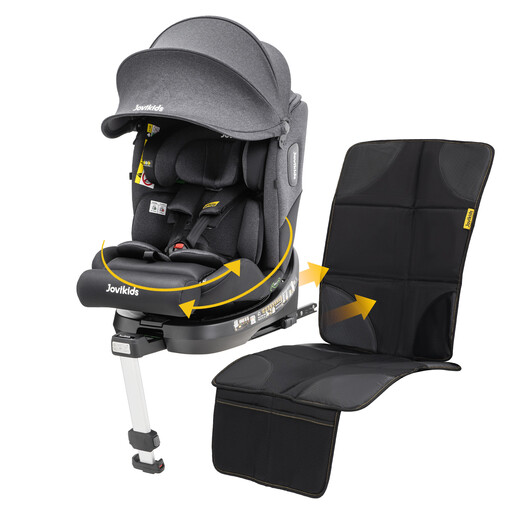
Why This Fits Their Persona: This model is designed for parents looking for a single, long-term purchase to transport their child from birth until they no longer need a car seat. It covers the entire period and combines i-Size safety with the convenience of 360° rotation.
It bypasses the "hidden complexity" trap by combining ISOFIX and a load leg, which allows for smooth 360° rotation without extra adjustments. The 12-position adjustable headrest and removable inserts ensure true adaptability, avoiding the "false flexibility" trap.
Certified to the latest ECE R129 i-Size standard. Its long-term usability from 40 cm (birth) to 150 cm (approx. 12 years) eliminates the need for future purchases.
We have compiled a complete, real-time updated list of products that fully meet these strict selection criteria and EU safety regulations.
According to the ECE R129 regulation, rear-facing transport is legally required until a minimum age of 15 months and a height of 76 cm. However, safety experts and automotive clubs recommend keeping children rear-facing for as long as possible, ideally up to 4 years of age, as this offers the best possible protection in a crash.
In most cases, yes. However, a key exception is vehicles with storage compartments in the floor of the rear footwell. The load leg must not be placed on the lid of such a compartment, as it could break in an impact. Before purchasing, always check your vehicle's manual and the car seat manufacturer's compatibility list to ensure it is suitable.
While an all-in-one car seat for 40-150 cm is designed for up to 12 years of use, its actual lifespan is limited by material degradation. Plastics can become brittle over time. Most manufacturers recommend replacing a seat after 7 to 10 years, even if it has never been in a crash. You can usually find the exact expiration date on a sticker on the seat or in the manual.