
Lieferung heute & morgen

Qualitätsgarantie

Willkommens-Angebote freischalten: KOSTENLOSE Lieferung | Bis zu 80 % RABATT | Kostenlose 30-Tage-JoyPlus-Testphase
App herunterladen
As a Joybuy Product Recommendation Officer, I analyse product data and user feedback daily. A clear pattern has emerged: when it comes to high-performance portable power supplies like a 3600W power station, three common misconceptions often lead to costly purchasing mistakes. This guide will help you correctly interpret technical specifications and make an informed choice for your needs.
Many purchasing decisions are based on marketing promises rather than hard facts. Pay close attention to the following points to avoid disappointment.
Manufacturers often prominently advertise a high wattage figure that only refers to the peak power (surge power). The device can only provide this for a few seconds, for example, to handle a motor's inrush current. For continuous operation—such as running a refrigerator or power tools—only the rated power (continuous power) is crucial. A power station advertised with 6000W but offering only 2000W of continuous power will quickly reach its limits or shut down under a higher sustained load.
The type of battery significantly determines the safety, lifespan, and performance of your power station. Older lithium-ion (Li-ion) batteries can pose a higher safety risk if damaged or overheated. Modern alternatives like Lithium Iron Phosphate (LiFePO4) and especially the innovative solid-state power station (Solid-State Battery) offer clear advantages. Cycle life indicates how many times the battery can be fully charged and discharged before its capacity significantly degrades. A low number means you will have to replace the unit sooner.
For home backup power, an uninterruptible power supply (UPS) is essential. A true power station with UPS functionality switches to battery power within milliseconds during a power outage. This allows sensitive devices like computers, servers, or medical equipment to continue running without interruption. Many cheaper models only offer a "pass-through" charging function with a much longer switchover time, which is unsuitable for protecting sensitive electronics.
To find the right power station for your purposes, you should carefully examine the following technical specifications.
The choice of battery is fundamental. Here is a brief overview of the most common types:
A 3600W power station with a corresponding continuous output is a powerhouse. It can typically power multiple devices simultaneously:
Look for a diverse range of ports: multiple AC outlets, USB-A and USB-C ports (ideally with Power Delivery up to 100W), and 12V DC outputs for camping accessories.
A good power station can be recharged in several ways:
Another advantage of modern devices is their operation as a quiet power generator. Unlike loud and odorous petrol or diesel generators, they operate virtually silently and are emission-free.
Based on the criteria above, we have identified a product that is particularly well-suited for a demanding user group.
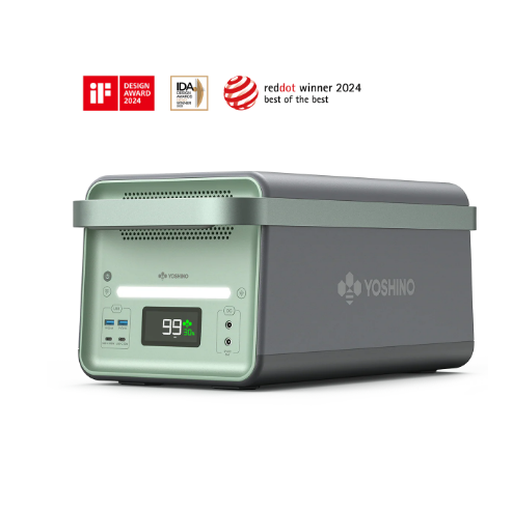
Why This Fits Their Persona: Ideal for homeowners seeking a future-proof backup power supply and for tech enthusiasts who prioritise maximum safety and longevity. Solid-state technology is the current gold standard for demanding applications.
This model offers a true continuous output of 3600W, uses advanced solid-state battery technology for superior safety and longevity, and features a true UPS function with a fast switchover time to protect sensitive devices.
High cycle life of 4000 cycles to 80% capacity. Wide operating temperature range from -20 to 40°C. Comprehensive safety certifications, including T?V S?D and CE.
For users with different priorities, such as a focus on maximum portability for camping or a tighter budget, there are also suitable solutions. In this case, it is advisable to consider models with a lower capacity (e.g., 1000-2000Wh) or those with the proven LiFePO4 technology, which offers excellent value for money.
We have compiled a complete, up-to-date list of products that fully meet these strict selection criteria and German safety regulations.
1. How long can a 3600W power station provide backup power to my home? The runtime depends on the battery's capacity (in watt-hours, Wh) and the power consumption of the connected devices. For example, a station with 2562Wh like the Yoshino B3600SST can run a modern refrigerator (approx. 150W) for about 15-17 hours or power several LED lamps and a laptop for many hours.
2. Is a 3600W solar generator suitable for completely off-grid living? Yes, such a setup provides a solid foundation for off-grid living. However, success heavily depends on the incoming solar energy. With a maximum solar charging input of 600W and optimal sun conditions, the battery can be recharged in a single day. In poor weather or with high consumption, it may be necessary to reduce usage or install a larger solar array.
3. Why is a solid-state power station safer than conventional models? The crucial difference lies in the electrolyte. Conventional lithium-ion batteries use a liquid, flammable electrolyte. If damaged or overheated, this can lead to a fire. Solid-state batteries use a solid, non-flammable electrolyte. This eliminates that specific risk and makes the batteries more resilient to high temperatures and physical damage overall.