
Lieferung heute & morgen

Qualitätsgarantie

Willkommens-Angebote freischalten: KOSTENLOSE Lieferung | Bis zu 80 % RABATT | Kostenlose 30-Tage-JoyPlus-Testphase
App herunterladen
An ergonomic office chair with a footrest can be a practical choice for long work, study or gaming sessions. However, a lengthy product description doesn’t automatically mean the chair will suit you. What matters is whether it can be adjusted to fit your body, workspace and the way you’ll actually use it.
Office chair buyers commonly fall into three traps:
When seated, your feet should rest as fully as possible on the floor. There should also be a little space between the back of your knees and the front edge of the seat. That’s why an office chair with adjustable seat depth can be particularly useful for people of different heights.
According to the product details, the NEWTRAL MAGICH-BPro/GPro has an adjustable seat depth of 37.5 to 47.5 cm. The seat height can be adjusted across a range of 6 cm. These measurements can help you narrow down your options, but they’re no substitute for checking how the chair fits you personally.
An adjustable lumbar support should do more than simply be present: you should be able to adjust its height, depth or firmness. The headrest also needs to suit your height. An office chair with a headrest can be useful when reclining, provided the headrest offers enough adjustment.
The NEWTRAL model mentioned above is listed with a headrest that moves with you and lumbar support with five locking positions and adjustable firmness. This is a specific description of its features, not proof of medical effectiveness. Claims such as orthopaedic desk chair should therefore be treated with caution: they don’t automatically mean the chair has medical certification or is suitable for every individual.
4D armrests can typically be adjusted up and down, forwards and backwards, and sideways or at an angle. This makes it easier to position them in relation to your desk. Check the technical details to confirm exactly how they move.
A recline function should offer several clearly specified positions. The NEWTRAL MAGICH-BPro/GPro is listed with settings of 96°, 120° and 136°. The separate office chair with 4D armrests is described as having a four-position backrest adjustment. Details like these are more useful than vague claims such as ‘multifunctional’.
When it comes to the footrest, also look for:
For long periods of sitting, breathable mesh upholstery can help with airflow. A moulded foam seat may feel different, so consider its width and firmness. There’s no one-size-fits-all answer when it comes to personal comfort.
Also check for:
The NEWTRAL model’s product details list a weight capacity of up to 136 kg, a detachable steel base and aluminium castors. The separate mesh model is listed as supporting up to 120 kg and as suitable for people up to 185 cm tall. Check these figures against your own needs before buying.
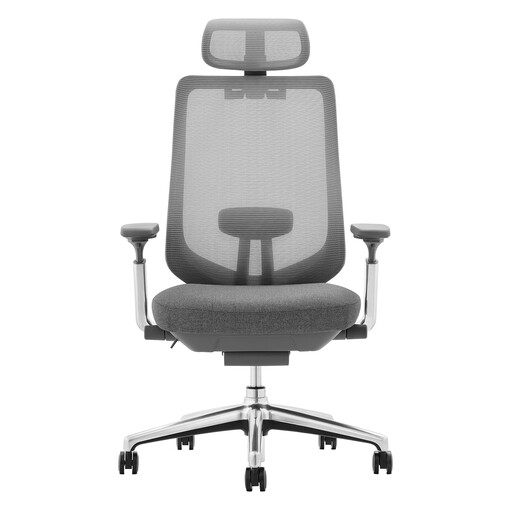
Why this product suits this profile: This chair combines adjustable seat depth with 4D armrests, making it a good fit for home-working spaces where flexible everyday features are a priority.
The product details specify the adjustment directions, a sliding seat and a four-position backrest, rather than relying solely on vague comfort claims.
4D armrests, adjustable seat depth, breathable mesh and a stated weight capacity of up to 136 kg.
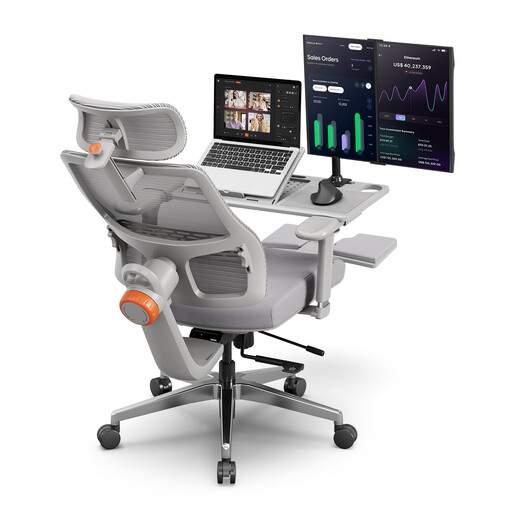
Why this product suits this profile: A good option if you’re looking for an ergonomic office chair with a wide range of adjustments, a footrest and several recline positions.
The seat depth, armrests, lumbar support and backrest are described with specific measurements or positions. The footrest retracts, so it doesn’t have to take up space in your work area.
Seat depth from 37.5 to 47.5 cm, five lumbar support positions, 4D armrests and three stated recline angles.
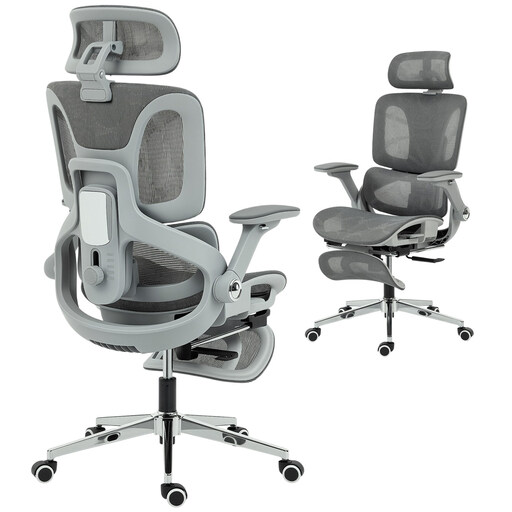
Why this product suits this profile: Designed for frequent use, this chair has a separate backrest section, folding armrests and a footrest for breaks or reclining.
The description specifies a maximum recline of 135°, a detachable headrest, folding armrests and a weight capacity of up to 120 kg.
Split backrest, separate lumbar support, breathable mesh and fold-away 4D armrests.
Start with the seat height: both feet should rest firmly on the floor. Then adjust the seat depth, backrest, lumbar support and armrests. The armrests should support your forearms without raising your shoulders. Pull out the footrest for breaks or when reclining, provided it doesn’t get in the way of your work.
Its lifespan depends on the load it carries, its materials and mechanism, your flooring and how well you look after it. Before buying, check the maximum weight capacity, the construction of the base and whether replacement parts are available. Castors and gas lifts are typical components whose condition should be checked regularly with frequent use.
It depends on your workspace and how you plan to use the chair. A recline function can be useful for short breaks or changing your sitting position. For focused work, the right seat height, sufficient seat depth and correctly adjusted armrests matter more than having the greatest possible recline. The footrest should retract fully so it doesn’t get in the way of your usual work routine.