
Lieferung heute & morgen

Qualitätsgarantie

Willkommens-Angebote freischalten: KOSTENLOSE Lieferung | Bis zu 80 % RABATT | Kostenlose 30-Tage-JoyPlus-Testphase
App herunterladen
Choosing the right material is a critical step for the success of any 3D printing project. With the wide variety of 3D printer filament available, deciding between materials like PLA, PETG, and ABS can seem complex. Each material offers specific properties that make it more or less suitable for certain applications.
This guide is designed to objectively explain the key differences between the most common filament types. The goal is to provide you with an informed basis to find the right 3D printing material for your needs—whether for rapid prototyping, aesthetic models, or high-strength mechanical parts.
Before making a decision, several fundamental criteria should be considered. These will help narrow down your choices and prevent print failures.
The choice of material depends directly on the intended application of the printed object.
The most common standard for desktop 3D printers is 1.75mm filament. It is crucial that the filament diameter remains consistent across the entire spool. Tight tolerances (e.g., ±0.02 mm) ensure smooth extrusion and prevent issues like nozzle clogging or uneven layers. Always check for compatibility with your printer model before purchasing.
High-quality filament is free of impurities and is precision-wound onto the spool to prevent tangling during a print. Another important aspect is storage. Materials like PETG and ABS are hygroscopic, meaning they absorb moisture from the air. Moist filament leads to poor print quality, bubbling, and brittle parts. Therefore, dry storage in sealed bags with desiccant is essential. A 1kg white filament spool is a common size that offers a good balance between quantity and manageability.
Based on material properties and applications, we have compiled a selection of filaments. If you're looking to buy Polymaker filament, the following options provide a reliable foundation for various projects.
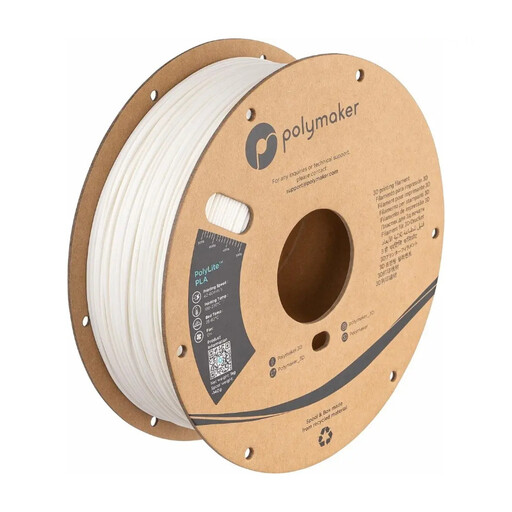
Why It Stands Out: This PLA filament uses Polymaker's patented Jam-Free technology. According to the manufacturer, it increases the filament's softening temperature before it enters the melt zone, reducing the risk of clogging from heat creep. It is based on high-quality Ingeo PLA raw material for consistent print results.
Advantages:
Who Is It For?: Ideal for beginners and advanced users looking for a reliable, everyday filament for prototypes, models, and visually appealing objects.
View Product: Polymaker PolyLite PLA White 1.75 mm
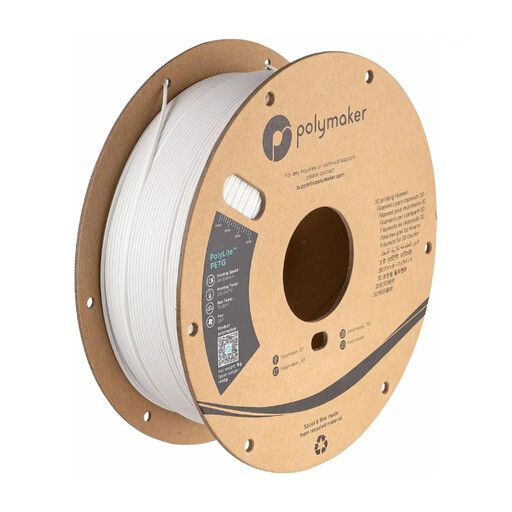
Why It Stands Out: PolyLite PETG is positioned as a well-balanced material that combines the stiffness of PLA with the toughness of ABS. It is characterised by excellent layer adhesion and low warping, making it a great choice for mechanical parts that require high dimensional stability.
Advantages:
Who Is It For?: For users who need a durable filament for functional parts like enclosures, brackets, or mechanical prototypes and are looking for greater resilience than PLA without the complexities of printing with ABS.
View Product: Polymaker PolyLite PETG White 1.75 mm
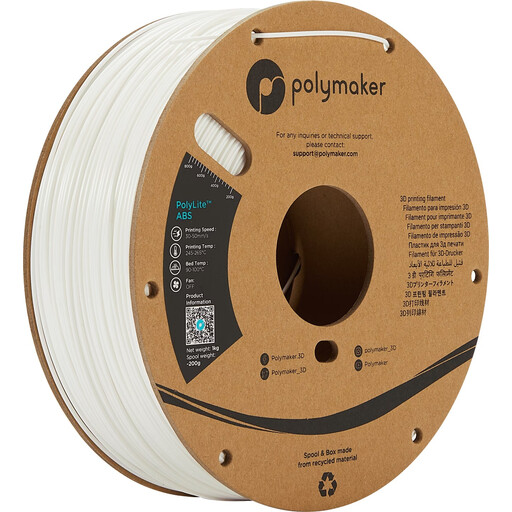
Why It Stands Out: This ABS filament was engineered to mitigate the typical drawbacks of ABS. According to Polymaker, it uses a specialised, mass-polymerised ABS resin that releases significantly fewer volatile compounds and less odour during printing compared to conventional ABS. It retains the high impact resistance and temperature resistance for which ABS is known.
Advantages:
Who Is It For?: For experienced users, engineers, and makers who produce parts for use under mechanical stress or at higher temperatures (up to approx. 100 °C). A printer with a heated bed and, ideally, an enclosed build chamber is required.
View Product: Polymaker PolyLite ABS White 1.75 mm
This selection covers the most common use cases. However, if you are looking for other colours, materials, or specific accessories, you can find more products in our range.
Discover our full range of printing materials and accessories in the White Printer category.
PLA is the easiest to print but less durable. PETG offers a good balance of ease of use and mechanical stability. ABS is the most resistant to impact and heat but is the most challenging to print.
For most functional parts exposed to everyday stress, PETG filament is an excellent choice. It combines good strength with a degree of flexibility and is easier to print than ABS. When maximum impact resistance and heat resistance are required, ABS filament remains the top choice, provided the necessary printing conditions can be met.
Many filaments, especially PETG and ABS, are hygroscopic and absorb moisture from the ambient air. This moisture vaporises explosively in the printer's hotend, causing crackling sounds, bubbling, heavy stringing, and poor layer adhesion. The result is visually unappealing and mechanically weak parts. Therefore, dry storage in airtight containers with desiccant is crucial for print quality.