
Lieferung heute & morgen

Qualitätsgarantie

Willkommens-Angebote freischalten: KOSTENLOSE Lieferung | Bis zu 80 % RABATT | Kostenlose 30-Tage-JoyPlus-Testphase
App herunterladen
Choosing the right filament is crucial for the success of any 3D print. An unsuitable material can lead to poor print results, clogged nozzles, or failed projects. The market is especially saturated with PLA filament 1.75mm, the most widely used material for FDM printers. The differences in quality, properties, and applications can make the buying decision challenging.
As your Joybuy Product Recommendation Officer, my mission is to provide you with clear guidance. This article presents objective information and a selection of PLA filaments tailored to specific requirements—from high print speeds to unique surface finishes. The goal is to help you make an informed decision for your next project.
Before you decide on a product, you should consider a few fundamental properties that significantly influence the quality and outcome of your print.
The aesthetic of the finished printed object heavily depends on the filament's surface finish. While standard PLA often produces a glossy, slightly plastic-like surface, matte PLA filament offers an alternative for professional and artistic applications. Matte filaments absorb light, which makes layer lines less visible and gives the object a more premium, textured feel. This is particularly advantageous for creating prototypes, architectural models, or decorative items.
With the development of modern 3D printers that achieve ever-higher speeds, special High Speed PLA has also been developed. This filament is formulated to melt and cool more quickly and uniformly at high feed rates. This reduces the risk of underextrusion and ensures clean print quality even at speeds of up to 600 mm/s. If efficiency and rapid iterations are your priority, a high-speed filament is a worthwhile consideration.
The environmental aspect is also increasingly coming into focus. An eco-friendly PLA is made from renewable resources like corn starch and is biodegradable under industrial conditions. Another factor is the packaging. A filament on a cardboard spool reduces plastic waste compared to conventional hard plastic spools. These spools are not only lighter but also easier to recycle, making them a more eco-conscious choice.
Here you will find a curated selection of PLA filaments that stand out for their specific properties, catering to different use cases.

Why It Stands Out: This filament from CAILAB is specially engineered for a high-quality, matte surface. The new formula aims to minimise layer lines and give prints an artistic, non-glossy finish. The colour palette is inspired by macaron tones, offering a unique selection for creative projects.
Pros:
Who Is It For? For users who place a high value on the aesthetics of their prints and prefer a professional, non-plastic look. Ideal for designers, artists, and makers creating models with fine surface textures.
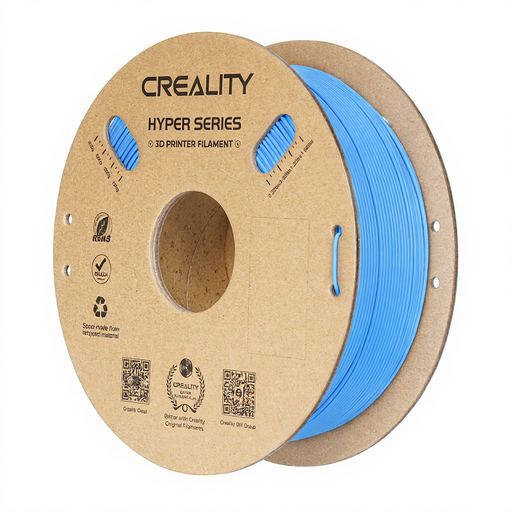
Why It Stands Out: Creality Hyper PLA is designed for maximum print speed. According to the manufacturer, it supports speeds of up to 600 mm/s, making it an excellent option for rapid prototyping and producing large quantities in a short amount of time.
Pros:
Who Is It For? For users of high-speed 3D printers who need to produce functional parts, prototypes, or large models in the shortest possible time without compromising on fundamental print quality.
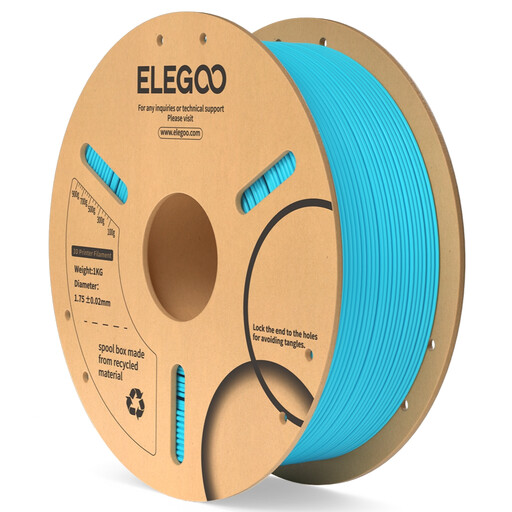
Why It Stands Out: Elegoo combines reliability with a focus on sustainability in this filament. The delivery on a cardboard spool reduces plastic waste. At the same time, high manufacturing quality is ensured through neat, tangle-free winding and precise diameter control.
Pros:
Who Is It For? For eco-conscious users as well as beginners looking for a reliable and easy-to-handle filament. The neat winding and high dimensional accuracy make it a solid choice for everyday printing projects.
The selection presented here covers specific use cases. If you need a different colour or a filament with other properties, there is a wider variety to explore.
? Explore our full range of blue 3D printer filament
1. How do I properly store PLA filament 1.75mm? PLA is hygroscopic, meaning it absorbs moisture from the air. Improper storage can lead to brittle filament and poor print quality. It's best to store your filament in an airtight bag or box along with a desiccant (silica gel). Keep it in a cool, dry place away from direct sunlight.
2. What is the difference between PLA and PLA+? PLA+ (often called PLA Pro or Tough PLA) is a modified version of standard PLA. The exact composition varies by manufacturer, but in general, PLA+ is formulated to have higher impact resistance and better temperature resistance than conventional PLA. It is often less brittle, making it more suitable for mechanical parts that need to withstand some stress.
3. Can I use high-speed PLA on a normal 3D printer? Yes, High Speed PLA can also be used on standard-speed printers. It will behave similarly to regular PLA in that setting. However, it only reaches its full potential at high print speeds, as its special formulation allows for rapid melting and cooling, which can cause issues with standard PLA at a high pace. So, using it on a slower printer is possible, but not necessarily economical.