
Lieferung heute & morgen

Qualitätsgarantie

Willkommens-Angebote freischalten: KOSTENLOSE Lieferung | Bis zu 80 % RABATT | Kostenlose 30-Tage-JoyPlus-Testphase
App herunterladen
Distracting echo in your home office, unclear voices on video calls or a reverberant gaming room are often caused by hard, reflective surfaces. 3D wood acoustic panels can reduce sound reflections in a room while adding a decorative touch to your walls. But appearance isn’t the only thing to consider. The materials, coverage and installation all affect whether the panels are right for your space.
Wall-mounted acoustic panels mainly improve the acoustics within a room. They can dampen sound reflections and echo, but they won’t provide complete soundproofing against voices from a neighbouring flat or traffic noise coming through a thin wall. That would require structural measures, such as adding layers to the wall, decoupling or installing specialist soundproofing.
A single set of acoustic panels may look large in product photos, but it might cover just 0.72 m². Depending on the size of your room, that may not be enough for an office or studio. Before buying, measure the wall, plan the layout you want and check the distance from any furniture.
Adhesive fixings can be useful in rented homes, but they won’t stick to every type of wallpaper or wall finish. Screws provide a more permanent fixing, but leave holes. Panels installed on the ceiling also need to be secured differently from those fitted to a wall. Check the wall’s load-bearing capacity and the manufacturer’s instructions before installation.
Many wood-slat acoustic panels have an MDF core, a wood-effect or veneer finish, and a sound-absorbing felt backing. Felt can help dampen high-frequency reflections in a room, but the actual effect depends on factors such as material thickness, the gap from the wall, installation method and the area covered.
The products described here are listed as having an MDF core with a wood veneer or wood-effect finish and felt backing. Some product descriptions specify MDF with low VOC emissions. This shouldn’t be taken as a blanket guarantee about indoor air quality. If you’re sensitive to smells, ask whether material or emissions test results are available.
The most commonly available modules measure 60 × 30 cm. According to the product details, four panels cover 120 × 60 cm or 0.72 m². A set of 20 covers 600 × 60 cm or 3.6 m², if the modules are arranged in a continuous row.
For straightforward planning:
For a home office, a targeted area behind your desk or opposite your microphone is often enough to get started. In a studio, podcast room or home cinema, you’ll want to consider several reflective surfaces. The best layout for reducing echo is different from what you’d need to reduce noise travelling between neighbouring rooms.
Walnut, oak and grey acoustic panels mainly differ in the look they create. Dark walnut shades make a bold statement, oak feels lighter and more neutral, while grey finishes can work well with modern office and gaming setups.
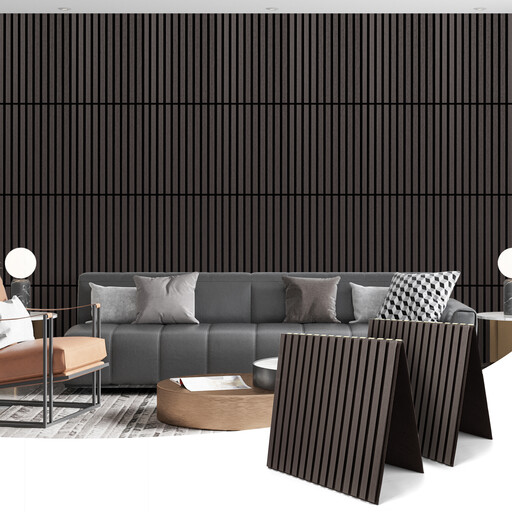
Why it suits this profile: Two foldable 120 × 60 cm panels are ideal for a small feature area in a home office, gaming room or podcast space.
The clearly defined overall size makes it easy to see how much area you’ll have. The foldable design is intended to make installation simple and require few tools.
Set of 2, each measuring 120 × 60 cm; walnut wood-effect finish and foldable construction, according to the product details.
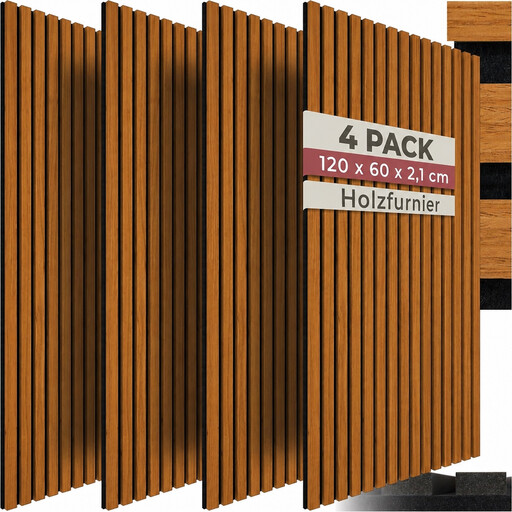
Why it suits this profile: This modular set of four gives you a clearly defined coverage area, with an MDF core, walnut veneer and acoustic felt. It’s well suited to home offices, meeting rooms and living spaces.
The product details list the size of each panel, the total dimensions and the materials. This makes it easier to plan the coverage and installation method in advance.
4 panels with a total coverage of 0.72 m²; adhesive or screw fixing is supported, according to the product details.
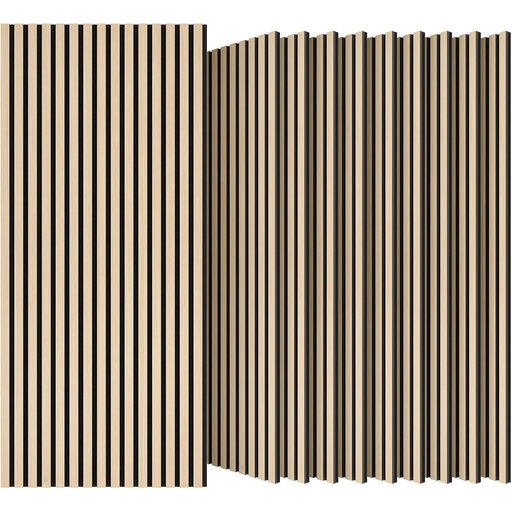
Why it suits this profile: With 3.6 m² of coverage, this larger set is well suited to bigger feature walls, studios, recording rooms, offices and home cinemas.
The larger set means you’re less likely to need lots of small packs. Its stated total coverage also makes it easier to plan your room.
20 panels, each measuring 60 × 30 cm; oak-effect finish, MDF core and felt backing, according to the product description.
We’ve put together a complete, regularly updated list of products that meet these strict selection criteria and fully comply with the safety regulations in force in the EU.
Before fixing the panels in place, make sure the wall is clean, dry and as level as possible. If you’re using adhesive, test it on an inconspicuous area first. In rented homes, check whether removing the adhesive could damage the wallpaper or paint. For screw fixing, you’ll need wall plugs suitable for the type of wall.
Protect the wood-effect finish and felt from prolonged exposure to moisture. Dust can usually be removed with a dry or slightly damp cloth. Harsh cleaning products may damage the surface or veneer. Only install panels directly behind radiators or in areas with high humidity if the product details say it’s suitable.
It depends on the size of the room, the furniture and the effect you’re looking for. For a workspace, a targeted area behind your desk or near your microphone can be a good place to start. If there’s a lot of echo, consider several reflective surfaces and calculate the total coverage using the product dimensions.
Their main purpose is to reduce reflections and echo in your own room. They’re not a substitute for structural soundproofing and won’t completely block noise from neighbouring flats. For that, you’ll need wall constructions with suitable insulation and decoupling.
Their lifespan depends on how they’re installed, physical wear, humidity, sunlight and care. With use in a dry indoor space, secure fixing and gentle cleaning, MDF, veneer and felt surfaces can remain in good condition for a long time. Check the relevant product page for specific information on durability.