
Lieferung heute & morgen

Qualitätsgarantie

Willkommens-Angebote freischalten: KOSTENLOSE Lieferung | Bis zu 80 % RABATT | Kostenlose 30-Tage-JoyPlus-Testphase
App herunterladen
Echo in your home office, reverberating conversations in the meeting room, or distracting reflections during podcast and gaming recordings – these are often caused by hard, smooth surfaces. 3D wood slat acoustic panels can reduce sound reflections in a room while doubling as a modern wall covering. However, your choice shouldn't be based solely on colour or marketing claims.
Wood slat acoustic panels primarily improve room acoustics. A felt backing or an absorbent core can dampen sound waves in the room and reduce reverberation. However, this doesn't automatically mean that conversations, music or traffic noise will be significantly quieter through a solid wall.
If you're looking for acoustic panels to reduce echo, you should pay attention to the absorption performance figures. For genuine sound insulation between flats, structural measures involving wall construction, decoupling and suitable insulation materials are usually required.
A small set can work as a decorative accent, but it won't automatically treat an entire room. Before buying, measure the wall width, room size and the main reflective surfaces. Walls opposite your desk, speakers, microphone or screen are particularly important.
A set of four panels measuring 60 × 30 cm each covers 0.72 m² in total. Larger sets of 20 panels of the same individual size provide 3.6 m². These figures make quantity planning easier and prevent reorders that might have a slightly different colour appearance.
"Tool-free installation" can work differently depending on the adhesive, wall surface and panel weight. On textured wallpaper, powdery surfaces or delicate wallpaper, a patch test is advisable. In rented accommodation, you should also check in advance whether adhesive mounting or screws are permitted.
With MDF panels, it's worth looking at the material core, veneer, felt backing and emission ratings. According to the product descriptions, the featured products are offered with MDF, wood veneer and acoustic felt, or in the foldable versions with a high-density fibre material and fabric cover. Claims such as "low VOC" should be understood as manufacturer statements and do not replace individual testing of room air or formal certification.
3D slats create a textured surface. However, for sound absorption, it's the construction behind the slats that really matters. A sound-absorbing wall decoration should therefore feature not just decorative wooden strips but also a suitable felt or fibre layer.
Look for:
The individual size of 60 × 30 cm is consistent across several of the wood panels featured here. Depending on the set, you'll create either a compact accent area or a longer wall design. Measure the desired area including cut-outs for sockets, radiators and doors.
For a home office, a targeted area behind your workstation may be sufficient. In a studio, podcast room or conference room, a larger, evenly distributed treatment can be more effective than a fully decorated single wall.
Walnut and oak acoustic panels differ mainly in their visual effect. Walnut and dark walnut finishes appear more contrasting, while oak and grey oak look lighter and more understated. Also check whether the slats should be mounted vertically or horizontally, and whether multiple sets will visually match each other.
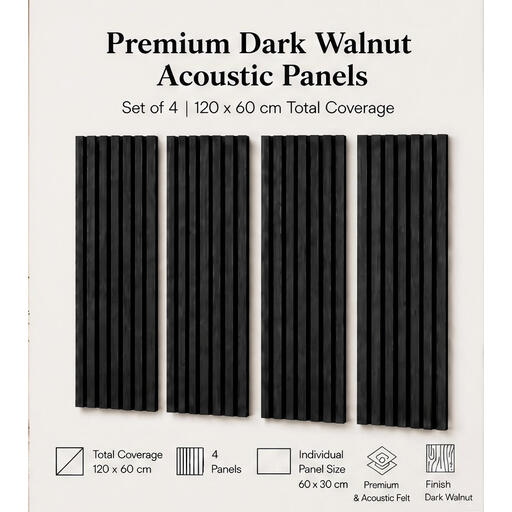
Why this product fits the profile: The compact set of four panels with 0.72 m² coverage is ideal for a small accent behind your desk, in a gaming room or home office.
The stated total area makes the coverage transparent and prevents you from estimating the required quantity based solely on product images.
Four panels measuring 60 × 30 cm each, MDF core, grey oak veneer and acoustic felt backing.
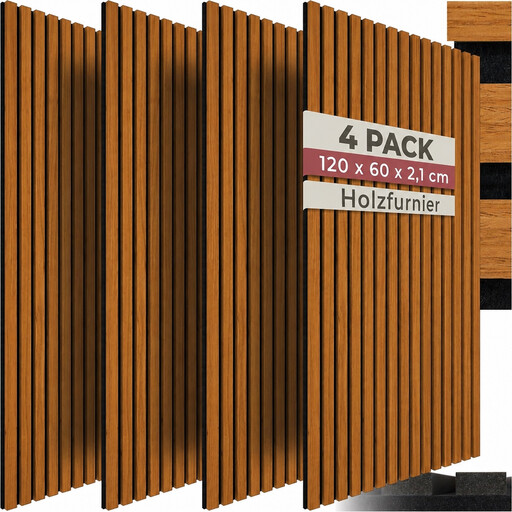
Why this product fits the profile: The walnut finish combines a textured 3D slat look with a compact area for your living space, office or recording corner.
The product data specifies the material construction, individual dimensions and total area. This makes it easier to match the panel quantity with your wall area before installation.
MDF core with walnut veneer, acoustic felt backing and installation option using adhesive or screws according to the product description.
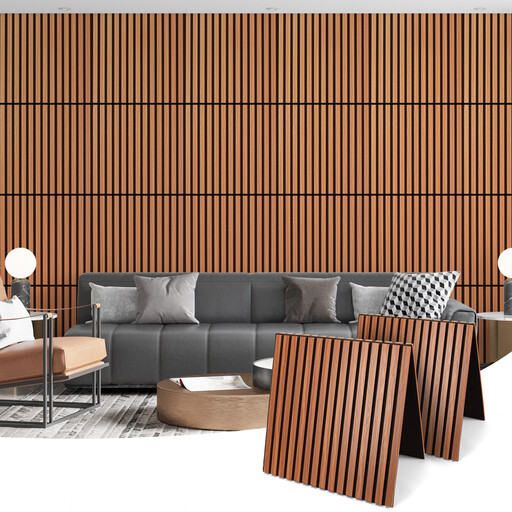
Why this product fits the profile: Two large, foldable panels measuring 120 × 60 cm each are designed for podcast rooms, studios, gaming rooms and frequently used workstations.
The large individual coverage reduces the number of joints between small elements. The foldable design also makes it easier to adapt to your intended wall mounting.
Two panels providing a combined 1.44 m² area, foldable construction and included mounting materials according to the product description.
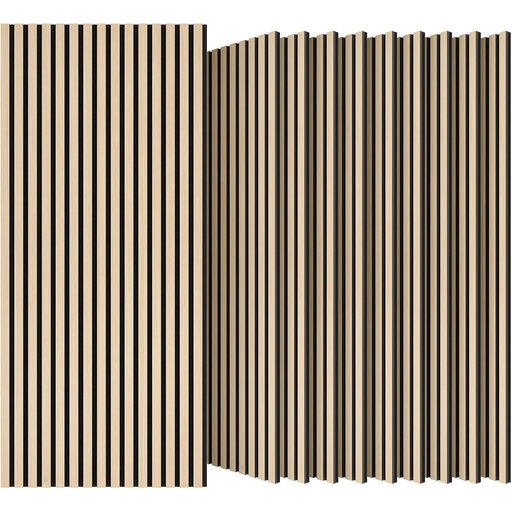
Why this product fits the profile: The 20-piece set with 3.6 m² total coverage is ideal for longer walls in studios, offices, conference rooms or spacious living areas.
The stated area makes planning larger projects easier. The MDF core and felt backing are clearly specified, rather than marketing solely with a decorative 3D surface.
20 panels measuring 60 × 30 cm each, oak veneer, acoustic felt backing and installation using adhesive or screws according to the product description.
We've put together a complete, regularly updated list of products that fully meet these strict selection criteria and the safety regulations in force in the EU.
They can reduce reverberation and sound reflections in a room if they are fitted with an absorbent backing or a suitable core. The effect depends on factors including the area, room size, furnishings and position. They do not replace structural sound insulation against noise from neighbouring flats.
That depends on the room size and your goal. For a decorative area behind your desk, a set with 0.72 m² may be sufficient. In rooms with strong reverberation or multiple reflective walls, a larger area is required. First measure the planned wall zone and compare it with the stated total area of the set.
Many models can be installed using adhesive or screws according to the product description. For rented accommodation, a solution that can be removed without leaving residue is generally more practical, but its suitability depends on the wall and adhesive system. Before installation, consider your tenancy agreement, landlord requirements and the wall surface.