
Lieferung heute & morgen

Qualitätsgarantie

Willkommens-Angebote freischalten: KOSTENLOSE Lieferung | Bis zu 80 % RABATT | Kostenlose 30-Tage-JoyPlus-Testphase
App herunterladen
A 4-piece screw clamp set is useful when workpieces need to stay securely in position while gluing, screwing or aligning. However, not every clamp is suitable for every task. Unclear information about clamping force, clamping range or materials often leads buyers to choose a set that is too small, too weak or unnecessarily heavy for their own workshop.
This buying guide explains what DIYers, woodworking enthusiasts, joiners, cabinetmakers and model makers should look for before buying. The focus is on clear, understandable product data rather than vague marketing claims.
High clamping force can be useful for sturdy workpieces and strong joints. However, excessive pressure can leave marks or cause deformation when working with delicate wood types or thin panels. The key consideration is therefore not just the stated force, but also whether protective caps, even pressure distribution and a finely adjustable spindle are provided.
The clamping range describes how far the jaws can open. The throat depth or working depth, on the other hand, indicates how far the clamp can reach into the workpiece from its edge. A model with a large clamping range but a shallow throat depth may still be unsuitable for wide panels.
A push button or quick-release mechanism makes rough positioning easier. The screw mechanism is still crucial for the actual fixing process. Buyers should check whether the movable jaw is guided securely and whether the clamp can be tightened in a controlled manner. A quick mechanism cannot replace careful alignment.
For smaller repairs, model making and narrow gluing tasks, clamps with a 120 to 150 mm clamping range are often sufficient. For furniture components, frames or larger panels, 150 mm 300 mm screw clamps are more versatile because two sizes are included in the same set.
A 4-piece set with two short and two longer clamps can cover a range of tasks. Even so, you should consider the shape of the workpieces: the clamping range must be greater than the width being secured, without operating the clamp at the end of its adjustment range.
The specification clamps with 272 kg clamping force refers to the maximum clamping force stated by the manufacturer. It should not be confused with the weight of the workpiece. High values are only useful if the frame, jaws and workpiece can withstand this level of load.
Soft pads are important for delicate surfaces. They reduce the risk of visible marks, but do not replace protective layers made from wood, plastic or card. The clamp should sit as close as possible to a right angle against the workpiece surface and should not be subjected to uneven, angled pressure.
For frequent use, steel clamps with a corrosion-resistant finish are a practical choice. Nickel-plated or otherwise protected steel can make maintenance easier, although moisture should still be avoided. Plastic components are commonly used for handles and protective caps.
For clamps for precision work, the following features also matter:
When using clamps, remember that the load limit specified by the manufacturer must not be exceeded. Overtightening can damage both the workpiece and the mechanism.
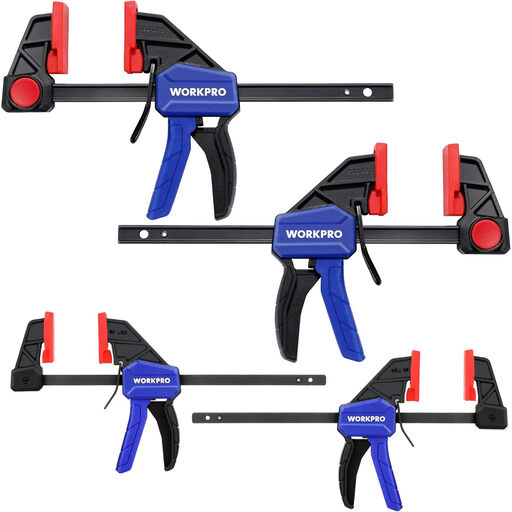
Why this product suits this profile: The combination of two 120 mm and two 150 mm clamps is suitable for smaller woodworking tasks, repairs and DIY projects where space is limited.
The product data states separate clamping forces of 23 kg for the mini clamps and 68 kg for the larger clamps. This makes it easier to match the pressure to the workpiece.
Reinforced nylon body, heat-treated steel bar, one-handed operation and soft TPU pads.
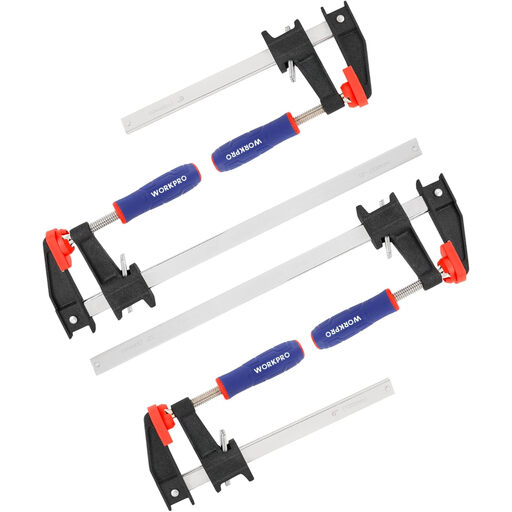
Why this product suits this profile: Two sizes, an 80 mm throat depth and a screw mechanism make this set suitable for a variety of woodworking tasks in the workshop.
The specifications clearly distinguish between clamping range, throat depth and clamping force. Protective caps support use on more delicate surfaces.
Four clamps, two each with a 150 mm and 300 mm clamping range, nickel-plated alloy steel and a stated clamping force of 272 kg.
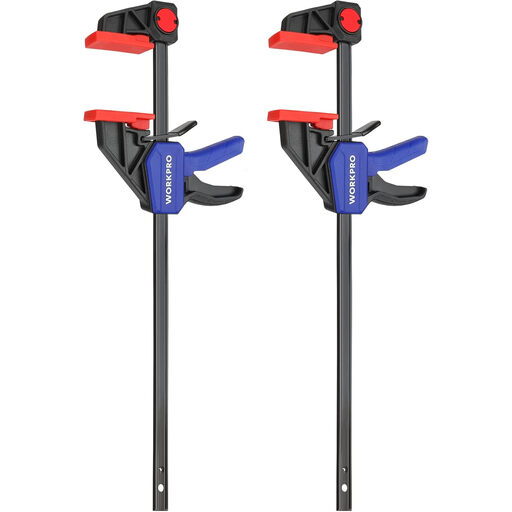
Why this product suits this profile: The convertible design is of interest to users who need to carry out spreading tasks as well as securing workpieces during assembly, woodworking or model making.
The product description states both a maximum clamping range of 305 mm and a spreading width of 440 mm. However, the second function should only be used when the jaw position has been correctly changed.
Hardened steel bar, quick-release mechanism, 60 mm throat depth and a stated clamping force of up to 68 kg.
Before clamping, the jaws should be aligned parallel to the edge of the workpiece. When gluing components, a dry test positioning is recommended before applying adhesive. This allows you to check that all clamps are within reach and that the pressure will be distributed evenly.
The following measures are useful for extending the service life:
When working with metal, wood or composite materials, you should also wear safety goggles and suitable work gloves. Keep your hands away from the area around the moving jaws.
We have put together a complete, regularly updated list of products that fully meet these strict selection criteria and the safety regulations applicable in the EU.
For small workpieces, 120 to 150 mm is often sufficient. For frames, furniture components and wider panels, 300 mm provides more flexibility. A set with several sizes is useful if the workpieces in your workshop vary considerably.
That depends on the material, size and task. A lower force is often enough for aligning small components. A higher specification can be useful when gluing sturdy wooden joints. The maximum clamping force should not automatically be used to its full extent, particularly on soft or coated surfaces.
There is no universal service life. It depends on the load, storage conditions, moisture and care. Models with a steel bar, protected surface and stable guidance are suitable for regular use, provided the load limits are observed.