
Lieferung heute & morgen

Qualitätsgarantie

Willkommens-Angebote freischalten: KOSTENLOSE Lieferung | Bis zu 80 % RABATT | Kostenlose 30-Tage-JoyPlus-Testphase
App herunterladen
As a Joybuy Product Recommendation Officer, I regularly analyse the market to provide you with clear, objective information for your purchasing decisions. Selecting the right 40+ table tennis balls is crucial for ambitious players and clubs, as the quality of the ball directly impacts game precision and training effectiveness. This guide will help you understand the differences between various ball types and make an informed choice that meets your performance and budget requirements.
The switch from celluloid to 40+ plastic balls has changed the material requirements. To make the right selection, three criteria are particularly important.
Modern table tennis balls are made of Acrylonitrile Butadiene Styrene (ABS), a plastic known for its durability and consistent bounce. There are two main manufacturing types:
For intensive training and competitions, a ball made of high-quality ABS material with precise manufacturing is a prerequisite for consistent performance.
The stars on a table tennis ball are a direct indicator of its quality grade and intended use:
Your specific needs determine the right choice:
Based on the criteria above, we have curated a selection of Double Fish balls that cover the different needs of players and clubs.
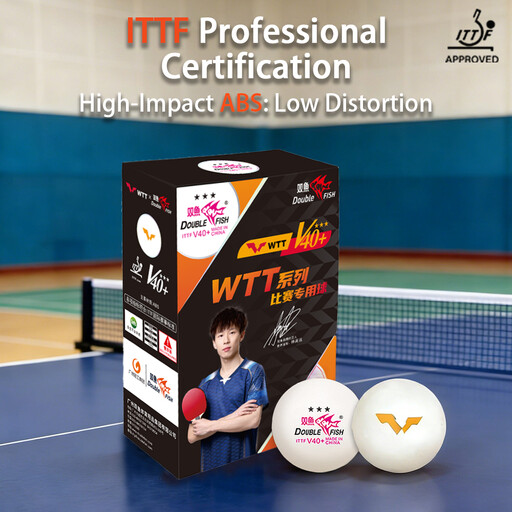
What makes it stand out: This ball is the official match ball for international professional tournaments and holds both ITTF and WTT certifications. Made from high-impact, seamed ABS material, it is designed for maximum precision and stability. The manufacturing technique ensures precise roundness and a stable centre of gravity, which guarantees minimal deformation and a reliable trajectory.
Pros:
Best for: Professional athletes, ambitious club players, and all official competitions where an ITTF approved ball is required.
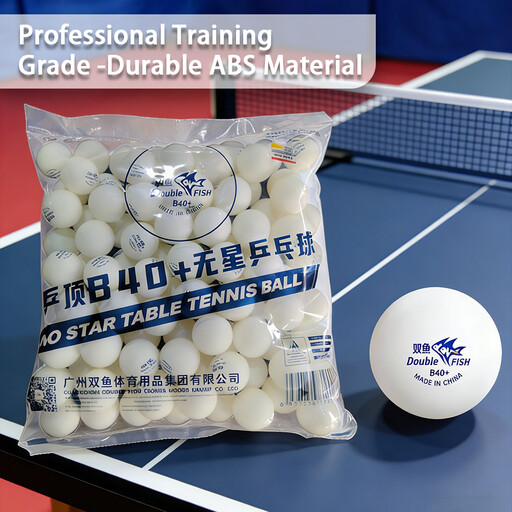
What makes it stand out: This ball was specifically developed for high-intensity training. According to the manufacturer, the durable ABS material is designed to withstand thousands of hits. Despite the lack of a star rating, the ball offers classic roundness and a stable rebound, making it a reliable partner for multi-ball training. The wear-resistant surface and low-noise design are further advantages for continuous use.
Pros:
Best for: Table tennis clubs, academies, and coaches who need a large quantity of robust table tennis training balls for daily multi-ball and robot training.
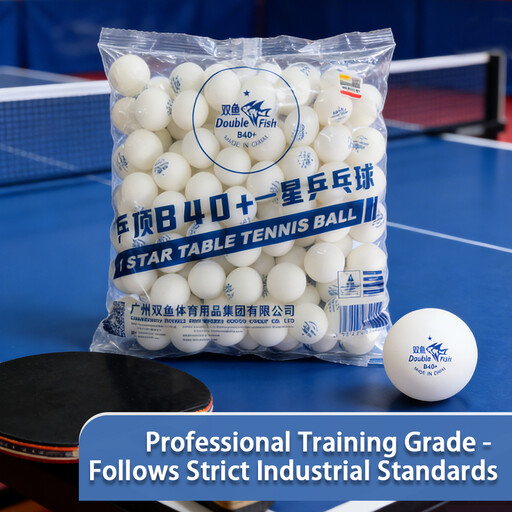
What makes it stand out: This 1-star ball bridges the gap between pure training balls and competition balls. It is made from a new, seamed ABS polymer and meets strict industry standards to retain its shape even during hours of intense practice. It offers a stable rebound and good spin response, making it an excellent choice for demanding technical training. The material properties also make it resistant to cold and heat.
Pros:
Best for: Advanced players and clubs who want a ball with more reliable performance than standard training balls for their regular practice, without needing 3-star quality.
The products presented here cover the core requirements for training and competition. However, if you are looking for balls with different characteristics or from other manufacturers, you can find more models in our range.
? Explore our full range of table tennis balls
The "40+" designation refers to the ball's diameter, which is slightly over 40 mm. This standard was introduced along with the switch from celluloid to plastic balls (like ABS). Compared to the old 40 mm celluloid balls, 40+ plastic balls have slightly different playing characteristics: they tend to be a bit slower and generate less spin, but they offer greater durability and a more consistent bounce.
The lifespan of a table tennis ball depends heavily on the intensity of use, the material, and how it is stored. High-quality table tennis training balls made of ABS are designed to withstand thousands of hits in multi-ball or robot training. Competition balls are generally used less frequently but with higher intensity. A ball can break at any time from an unfortunate edge ball or smash. Storing them in a cool, dry place away from sunlight helps extend their longevity.
For general training, 3-star table tennis balls are not strictly necessary. While they offer the highest consistency, they are often too expensive for training with high ball consumption (e.g., multi-ball training). Here, 1-star balls or special training balls in bulk, like a 100-pack of table tennis balls, are the more practical and economical choice. They provide sufficient quality for practicing stroke techniques and movement patterns. However, for final competition preparation or warming up before a match, using 3-star balls is recommended.