Homes with a narrow gap in the kitchen
You want to wash dishes every day without giving up worktop space for a countertop model. You’ll need a suitable space for a 45 cm freestanding or integrated appliance.


If you have a suitable space for a freestanding or integrated model next to or under the worktop, with the necessary connections, a 45 cm dishwasher is the obvious place to start: it leaves your worktop clear. Testberichte.de lists 9 to 12 place settings for almost all the models in its 45 cm overview, while MEDION gives its mini dishwasher DWT30 a capacity of three. A countertop model is an option if there’s no suitable space for an appliance and you have enough worktop space and a suitable drain for the specific model.
You want to wash dishes every day without giving up worktop space for a countertop model. You’ll need a suitable space for a 45 cm freestanding or integrated appliance.
A countertop model could be an option if there’s no suitable space for a freestanding or integrated appliance. The key considerations are the worktop space available and a practical way to supply and drain water.
If you wash lots of plates and cooking utensils every day, check the basket layout and interior space as well as the number of place settings, using the dishes you actually use as a guide.
A good fit if: you have a suitable floor space and the right connections, and want to keep the worktop clear.
Things to consider: It takes up floor space; freestanding doesn’t automatically mean suitable for installation under a worktop.
A good fit if: you have or are planning a suitable kitchen niche and want to keep the worktop clear.
Things to consider: The niche dimensions and cabinet door must suit the model; an integrated dishwasher isn’t designed to stand freely.
A good fit if: you don’t have a suitable space for a freestanding or integrated appliance but do have enough worktop space. A tank model may be an option if there’s no fixed water supply.
Things to consider: The appliance takes up worktop space and may hold fewer dishes; even with a tank model, waste water still needs to drain away.
| Buying consideration | What to look for when buying | Who is this important for? |
|---|---|---|
| Fit and worktop space | Check the full appliance and available-space dimensions, including depth; for an integrated model, check the niche and the specific design. | If I want to keep the worktop clear, I measure the available space for a freestanding or integrated model carefully. Around 33% of consumers prioritise getting the right fit without losing worktop space. |
| Water supply and drainage | Check whether the model needs a fixed water supply or specifically supports tank operation, and plan the drainage according to the instructions. | If there’s no fixed water supply where I plan to put it, I need a suitable alternative as well as a practical way to drain the water. Around 27% of consumers focus mainly on the water connection. |
| Space for everyday dishes | Check the place settings, basket layout and interior space against the plates, glasses and pans you use. | If I regularly have lots of dishes to wash, I want to know that my usual items will actually fit in the baskets. This is a priority for around 20% of consumers. |
| Energy and water use | The European Commission’s EU energy label includes figures such as kWh per 100 Eco cycles and litres per Eco cycle; check capacity and programme duration too. | If I wash dishes frequently, I compare the consumption figures for the specific model with how I expect to use it. Around 13% of consumers put ongoing energy and water costs first. |
| Noise | Compare the noise emissions and noise emission class of specific models; these figures alone don’t tell you how well a dishwasher cleans. | In a small kitchen close to the living area, I want to know how noisy the appliance is according to its label. Around 7% of consumers prioritise quiet operation. |
Width alone doesn’t tell you whether the height, depth, connections and design will suit the space. Freestanding and integrated appliances have different installation requirements.
Before buying, compare the model’s full dimensions and intended installation type with the space you have. If you’re choosing a freestanding model, also check that it’s specifically suitable for installation under a worktop.
A water tank is an alternative to a fixed water supply, but it doesn’t take care of draining the used water.
Check the instructions for the specific model to find out how to install and drain it. Filling the tank and draining the waste water must both be practical where you plan to put the appliance.
Filling the tank and draining waste water take up space and require regular hands-on attention.
As well as the energy efficiency class, the EU label includes other useful information, such as consumption, capacity and programme duration.
For the specific model, compare kWh per 100 Eco cycles and litres per Eco cycle alongside the appropriate load size and programme duration.
Bosch offers 45 cm wide freestanding and integrated dishwashers.
Siemens offers 45 cm integrated dishwashers in undercounter, semi-integrated and fully integrated designs.
MEDION offers countertop and mini dishwashers for kitchens where space is limited.
Bauknecht also offers 45 cm wide freestanding dishwashers.
Miele offers fully integrated 45 cm dishwashers for suitable kitchen niches.
This selection features freestanding 45 cm dishwashers for households that have a suitable floor space and want to keep the worktop clear.
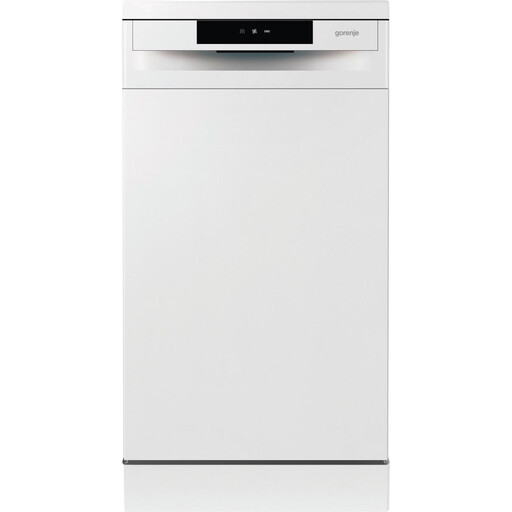 No image available
For everyday washing up if you have a suitable floor space; the freestanding design doesn’t take up worktop space.
45 cm; 9 place settings; 5 programmes; white; stainless steel interior.
 No image available
For everyday washing up in a suitable floor space, while keeping the worktop clear.
45 cm; 10 place settings; energy efficiency class C; stainless steel effect.
 No image available
For households looking for a freestanding appliance for everyday washing up and with a suitable floor space.
45 cm; 9 place settings; 6 programmes; silver; delay start.
 No image available
A freestanding 45 cm model for a suitable floor space if you want to keep the worktop clear.
45 cm; energy efficiency class E.
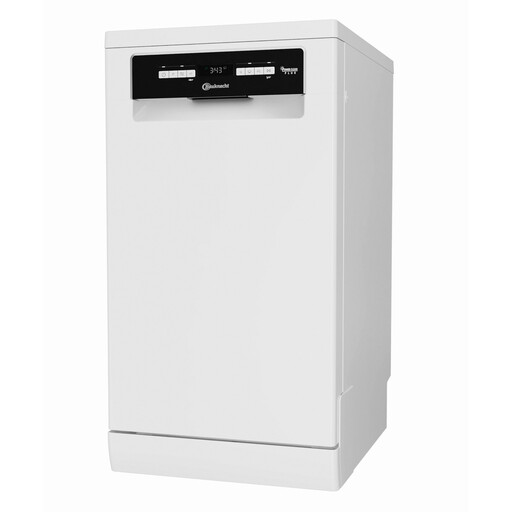 No image available
For everyday washing up if you have a suitable floor space and want to keep the worktop clear.
45 cm; 10 place settings; energy efficiency class D.
The EU energy label includes figures such as electricity consumption per 100 Eco cycles, water consumption per Eco cycle, capacity, programme duration and noise emissions. The European Commission lists these figures for the specified comparison basis; they aren’t a guarantee for other programmes.
Check the water hardness and set the water softener according to the instructions for your specific appliance. Bosch Hausgeräte explains this step as part of setting up the appliance; the German Environment Agency explains why regeneration salt or a suitable system is important for appliances with a water softener. For more economical washing, the German Environment Agency recommends a full load and the Eco programme.
Use the consumption figures for the specific model and take into account how often you expect to wash dishes. Compare kWh per 100 Eco cycles and litres per Eco cycle, rather than treating the energy efficiency class alone as an indication of cost.
No. In its information dated 13 December 2023, the German Environment Agency explains that electrical and electronic waste must be collected separately from unsorted household waste, and lists local collection points. If you’re returning an appliance through a retailer, check the terms of the specific purchase and return.