What should you look for when buying?
Start by measuring the space and deciding what sort of cabinet front you want. Then check how your mugs will fit and compare consumption figures based on your usual loads.
| What to consider |
What to check before buying |
Who is this important to? |
| Fit and design |
Check the space, door clearance, appliance dimensions, cabinet front, plinth and connections against the specifications for the specific model. |
If I have limited room during a renovation, I want to be sure the appliance and front will fit my planned kitchen. Around 33% of consumers put fit first. |
| Space for mugs |
Compare mug height and diameter with the rack layout and the rest of the load. If the racks are adjustable, also check the space underneath. |
If I regularly want to wash my mugs with plates and cutlery, the actual layout matters more to me than the number of place settings. Around 27% of consumers prioritise fitting mugs. |
| Consumption and running costs |
Compare kWh per 100 Eco cycles, litres per Eco cycle, capacity and programme duration. Take your own usage and electricity tariff into account. |
If the dishwasher runs often, I want to be able to estimate its ongoing energy and water use. Around 20% of consumers give running costs top priority. |
| Noise and programme duration |
Check the noise level in dB(A), Eco programme duration and the programmes available on the specific model. |
If I’m washing up in an open-plan kitchen or need my mugs at a particular time, noise and programme duration matter when planning. Around 20% of consumers prioritise noise and programme duration. |
In a fitted kitchen, the cabinet front, plinth and door movement all need to work with your plans. A freestanding appliance isn’t automatically suitable for fitting under a worktop just because it’s the right width. The German Environment Agency recommends a 60 cm appliance for households of two or more, provided it’s regularly run with a full load. This is a conditional recommendation: you’ll still need to check your kitchen and compare the appliance with your actual washing-up needs.
Joybuy products
The products below are slim freestanding dishwashers. Before choosing one, check the dimensions of your space and whether this design suits your kitchen plans.
 No image available
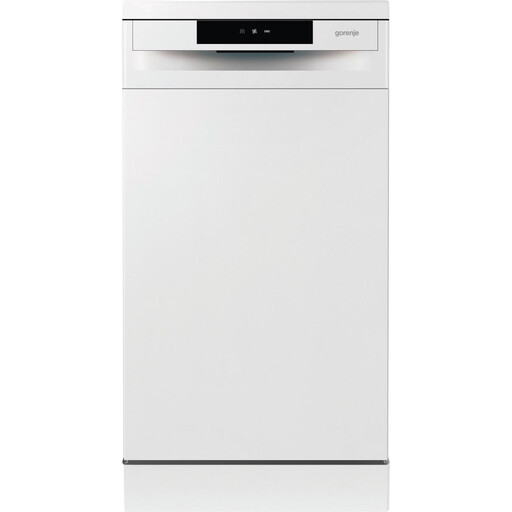
Gorenje GS520E15W, White
A freestanding design could suit a kitchen without a cabinet front; matching the width alone won’t tell you whether it fits your space.
45 cm wide; 9 place settings; 70 kWh per 100 cycles; 9 litres per cycle; 47 dB; Eco programme.
View at Joybuy
 No image available
Beko BDFS26040XQ, 45 cm
The height-adjustable top rack may come in handy when arranging mugs of different heights; remember to check the space in the rack below, too.
Freestanding; 10 place settings; energy class C; 59 kWh per 100 cycles; 8.9 litres per cycle; 44 dB(A); height-adjustable top rack.
View at Joybuy
 No image available
Exquisit EGSP52109-E-030E, Silver
A height-adjustable top rack and folding mug holders can be useful for mixed loads of mugs and dishes; try arranging your own mugs to see how they fit.
Freestanding; 9 place settings; 44.8 cm wide; 81.5 × 44.8 × 55 cm; 70 kWh per 100 Eco cycles; 9 litres per Eco cycle; 47 dB(A).
View at Joybuy
 No image available
Bosch SPS4HKW49E Series 4, White
Adjustable racks and mug shelves are useful when planning how to load the dishwasher; check the dimensions against the space you have in mind.
Freestanding; 45 cm wide; energy class E; 10 place settings; 76 kWh per 100 Eco cycles; 8.9 litres per cycle; 44 dB(A), 41 dB(A) on the Silence programme; removable worktop.
View at Joybuy
 No image available
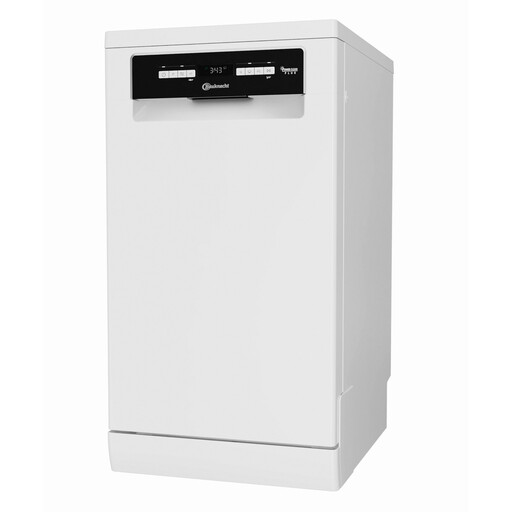
Bauknecht BSFO 3035 PF, 45 cm
A height-adjustable top rack and mug shelves can help with different types of load; check that your mugs fit alongside the rest of your dishes.
Freestanding; 10 place settings; 67 kWh per 100 Eco cycles; 9 litres per Eco cycle; 44 dB(A); appliance dimensions 850 × 450 × 590 mm.
View at Joybuy
Frequently asked questions
Is a width of 45 cm enough to determine whether it will fit?
No. Compare the specific appliance’s height and depth with the space, and allow for the cabinet front, plinth and door opening. Under-counter and fully integrated appliances may have different requirements for the kitchen front.
How should I look after the dishwasher if I regularly wash loads of mugs?
Run the Eco programme with a full load and don’t rinse dishes with warm water beforehand, as recommended by the German Environment Agency. If you have a water softener, set it for the local water hardness and follow the appliance instructions on using regeneration salt.
How can I estimate running consumption?
Compare kWh per 100 Eco cycles and litres per Eco cycle on a like-for-like basis. To work out your personal annual costs, you’ll also need to estimate how many cycles you’ll run and know your electricity tariff. The Verbraucherzentrale explains that Eco electricity consumption is provided as a comparison figure.
Which energy label applies to new dishwashers in Germany?
New household dishwashers use the EU energy label, with classes from A to G. The European Commission says it includes information such as Eco consumption, capacity, programme duration and noise level.
What should I check about taking away my old appliance?
When placing your order, check whether you can arrange collection of your old appliance and what conditions apply. The German Federal Environment Ministry explains the take-back obligations for online retailers; arrange collection, if required, when you enter into the contract.


