Households renovating their kitchen
If you want to machine-wash your dinner plates while the work is under way, you’ll need a temporary location that works with your future kitchen layout.


A freestanding 45 cm dishwasher could work as a temporary solution if the floor space, door clearance and connections at its temporary location are suitable. For your finished kitchen, the appliance type must fit the recess and cabinet door. Measure your dinner plates and check the basket layout for the specific model before comparing place settings and Eco programme consumption. The German Environment Agency points out that a fully loaded 60 cm dishwasher may be more efficient for households of two or more, if they generate enough dishes to fill it. So a slimline model isn’t automatically more economical.
If you want to machine-wash your dinner plates while the work is under way, you’ll need a temporary location that works with your future kitchen layout.
If your kitchen layout is fixed, the appliance dimensions, cabinet door and basket layout all need to suit the available space.
If space is limited, it’s worth considering the appliance width alongside how many dishes you typically use and how you load them.
A good fit if: There’s a suitable floor space with usable connections during the renovation, and you don’t need a cabinet door.
Things to consider: Check the floor space, door clearance and eventual location separately.
A good fit if: Your finished kitchen has a suitable gap beneath the worktop and you’re not planning a full-width cabinet door for the appliance.
Things to consider: The height, width and suitability for under-counter installation must match the specific gap.
A good fit if: The recess, connections and cabinet door for your finished kitchen are confirmed.
Things to consider: The cabinet door, hinge and plinth must suit the model. Semi-integrated models have a visible control panel, while fully integrated ones have a concealed panel.
A good fit if: There’s enough width after the renovation and you regularly have enough dishes for a full load.
Things to consider: The larger appliance takes up more space. The German Environment Agency says a fully loaded 60 cm dishwasher may be more efficient for households of two or more, if they generate enough dishes to fill it.
| Buying priority | What to look for | Who is this important to? |
|---|---|---|
| Space and fit | Check the appliance’s height, width and depth, door clearance and connections. For built-in models, also consider the cabinet door and plinth. | If I want to use the appliance during the renovation and later fit it into the kitchen units, I need to plan for both. Around 28% of consumers prioritise space and how the appliance will fit later. |
| Space for dinner plates | Measure your plate diameter and check the maximum size for your preferred basket configuration. | I want to know whether my plates will fit without making it awkward to load other dishes. Around 22% of consumers prioritise plate fit above all else. |
| Using the dishwasher during the renovation | Check the available space and water, drainage and electricity connections against the installation instructions. | If the kitchen isn’t finished yet, I need to be able to set the appliance up and use it now. Around 22% of consumers prioritise being able to use it straight away. |
| Consumption for your household | Compare kWh per 100 Eco cycles, litres per Eco cycle and how many wash cycles you expect to run. | I want to compare the consumption figures with my usual load size and washing frequency. Around 17% of consumers prioritise consumption above all else. |
| Noise and after-sales service | Check the noise rating on the energy label, as well as the repair process and specific warranty terms. | In an open-plan kitchen, I want to consider the noise level and know who to contact if something goes wrong. Around 11% of consumers prioritise noise and after-sales support. |
Freestanding, under-counter and integrated models have different requirements. Depth and door clearance can also be crucial.
Measure the temporary location during the renovation and the future installation space separately.
If the recess doesn’t fit or the cabinet door is missing, you may need to plan the installation again.
The usable plate height depends on the basket configuration. Changing it can affect the space available for dishes in the upper basket.
Measure your plates and check the maximum size for the basket layout you want on the specific model.
The old and new labels use different measurement and rating methods. The German consumer advice centre recommends checking the stated Eco consumption in kWh per 100 cycles.
Compare current models using their specific Eco figures on the same label basis.
Transport, installation and disposal are separate services. Delivery alone doesn’t confirm whether the appliance will be connected or your old one taken away.
Before ordering, get written confirmation of which services are included at your delivery address.
45 cm built-in models for a planned recess; the semi-integrated SPI4EMS02D is one specific example.
Fully integrated 45 cm options for a finished kitchen front; the SR63EX25KE is one model example.
Semi-integrated 45 cm options with a focus on basket layout; the DSS28021X is one specific example.
45 cm freestanding models are an option if you don’t need a kitchen cabinet door; the BSFO 3O35 PF is one model example.
45 cm freestanding models with a range of programmes; the GS541D10W is one specific example.
This selection includes freestanding 45 cm models for temporary use, plus a countertop dishwasher as an alternative if a permanent installation isn’t possible during the renovation. For each model, check that the location, connections and capacity suit your needs.
 No image available
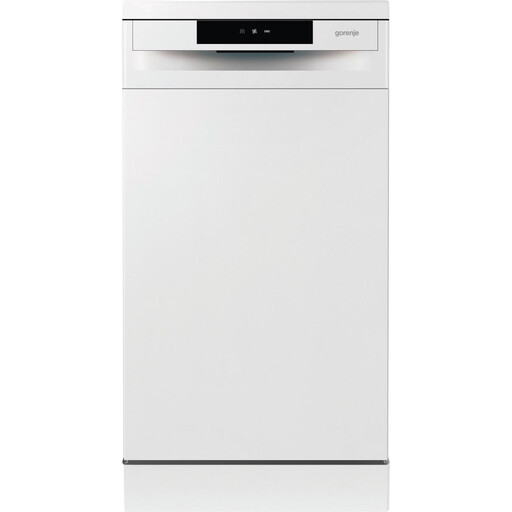
Freestanding design for a suitable location without a cabinet door.
9 place settings; height-adjustable upper basket; 5 programmes, including Eco and Intensive.
70 kWh per 100 Eco cycles and 9 l of water per Eco cycle.
 No image available
Freestanding design for temporary use, provided the location and connections are suitable.
10 place settings; height-adjustable upper basket; energy class C.
76 kWh per 100 Eco cycles and 8.9 l of water per Eco cycle.
 No image available
Freestanding design for a suitable space without a cabinet door.
9 place settings; 6 programmes, including Eco and Intensive; height-adjustable basket.
70 kWh per 100 Eco cycles and 9 l of water per Eco cycle.
 No image available
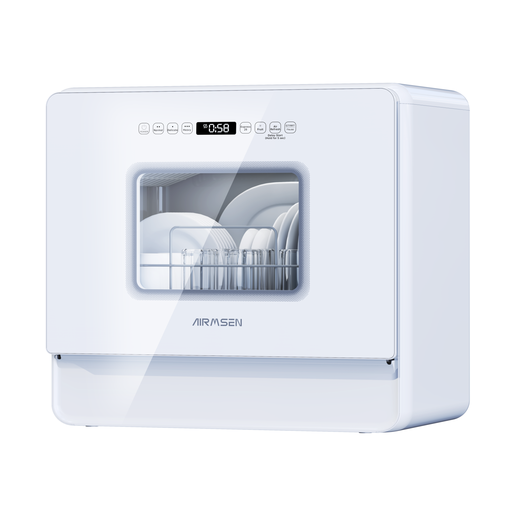
With its integrated water tank, this countertop model could be a temporary solution if a permanent installation isn’t available and you have a suitable surface.
5 place settings; according to the product description, plates up to 30 cm fit only when the upper basket is removed.
The integrated water tank holds 5 l; a minimum clearance of 59.7 cm is needed to fill it.
Measure their diameter and compare it with the specifications for the lower basket when the upper basket is in your preferred position. Beko gives pizza plates up to 30 cm as an example for the DSS28021X; this doesn’t apply to every 45 cm dishwasher.
Check the planned location and the available water, drainage and electricity connections against the installation instructions for the specific appliance. The appliance and recess dimensions alone don’t confirm that it can be connected safely.
Compare the stated kWh per 100 Eco cycles and litres per Eco cycle. The German Environment Agency recommends using the Eco programme, loading the dishwasher as fully as possible and not rinsing dishes with warm water first.
Dishwashers use an energy label with classes from A to G. Old and new classes or consumption figures aren’t directly comparable because the measurement and rating methods have changed. The label includes, among other details, Eco electricity consumption per 100 cycles.
No. The German Federal Ministry for the Environment lists municipal collection points, manufacturers and retailers as authorised take-back routes for old electrical appliances. Retailers have take-back obligations under certain conditions; check whether collection is available when you buy.