
Lieferung heute & morgen

Qualitätsgarantie

Willkommens-Angebote freischalten: KOSTENLOSE Lieferung | Bis zu 80 % RABATT | Kostenlose 30-Tage-JoyPlus-Testphase
App herunterladen
Capturing dynamic moments—whether on a motorcycle tour through the Alps, diving in the Red Sea, or during a fast-paced ski descent—places high demands on your equipment. A 4K action cam is designed to capture these very experiences in high quality. However, the market is filled with technical specs and marketing terms that can make choosing difficult.
This article serves as an objective guide. It highlights the crucial features of modern action cams and presents a selection of models tailored to specific use cases. The goal is to provide you with a solid foundation for your decision, helping you find the camera that meets your requirements.
To make the right choice, you should focus on a few core technical features. These are the primary determinants of the quality and usability of your footage.
For smooth footage during motion, an effective camera with image stabilisation is essential. Modern cameras use electronic image stabilisation (EIS), often supported by a 6-axis gyroscope. This system digitally compensates for shakes and rapid movements, resulting in a smoother video image without the need for an external gimbal.
Resolution determines the level of detail. 4K (3840 x 2160 pixels) has become the standard. A key differentiator is the frame rate (fps – frames per second). While 30 fps is sufficient for most scenarios, a 4K 60fps camera allows for capturing very fast motion with greater fluidity and offers more flexibility for slow-motion effects in post-production.
A waterproof camera is necessary for use in water sports or bad weather. There are two types: models that are natively waterproof to a certain depth, and those that require a special protective housing. An underwater 4K camera with a case can often reach depths of 30 metres or more, which is sufficient for most recreational divers and snorkelers. The housing's durability also protects the camera from impacts and dust, making it a reliable companion for outdoor activities.
Operating time is directly influenced by battery capacity. An action cam with long battery life is particularly advantageous for longer tours, for example as a motorcycle helmet camera, where frequent battery changes are impractical. Some models offer expandable battery solutions with add-on grips that can significantly extend recording time. At the same time, the form factor is crucial. A small action cam is more discreet, lighter, and can be mounted more flexibly, which is especially beneficial for vlogging or when attaching it to helmets and gear.
The following models from the SJCAM Action Cam brand offer a balanced combination of the features mentioned and are designed for different user profiles.
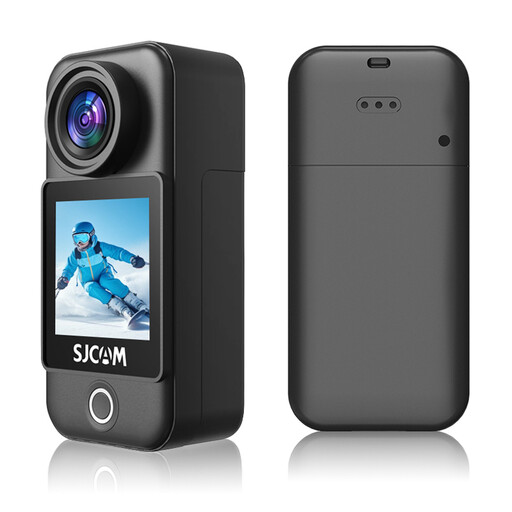
What makes it stand out: Weighing just 55 grams and with extremely compact dimensions (6.8 × 3.2 × 2.6 cm), the C300 Pocket is one of the smallest action cams on the market. It can be carried discreetly in a pocket and is ready to use instantly without weighing you down.
Advantages:
Who is it for? Ideal for vloggers, travellers, and everyday users looking for an extremely portable and discreet small action cam for spontaneous, high-quality recordings.
View details for the SJCAM C300 Pocket
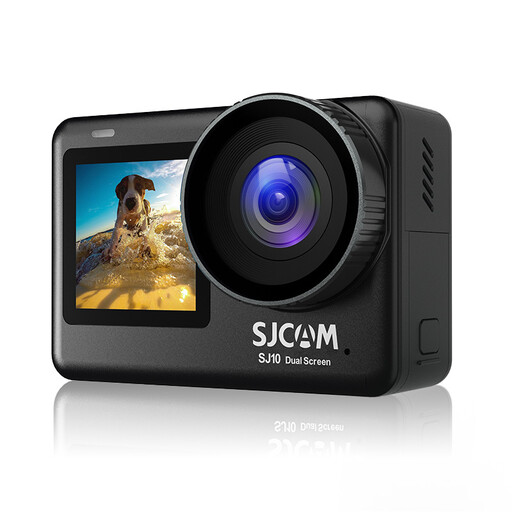
What makes it stand out: The dual-screen design, featuring a large 2.33-inch main touchscreen and a 1.3-inch front display, makes the SJ10 Pro a versatile vlogging camera. The front display significantly simplifies framing for self-recordings.
Advantages:
Who is it for? Perfect for content creators, vloggers, and action sports enthusiasts who need maximum framing control, a high frame rate, and the flexibility of a front display.
View details for the SJCAM SJ10 Pro
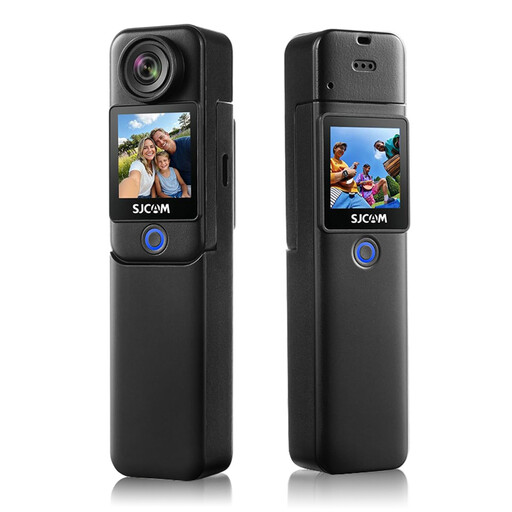
What makes it stand out: This model in the C300 series is designed for maximum endurance. Thanks to the included battery grip, it achieves a recording time of up to 460 minutes (over 7.5 hours) at 4K resolution, making it ideal for all-day use.
Advantages:
Who is it for? The ideal choice for users who need an action cam with long battery life, such as motorcyclists, hikers, or event videographers who want to record without interruption.
View details for the SJCAM C300 with Long Battery
Action cams are ideal companions for winter sports. To ensure you are fully equipped for your next adventure in the snow, you can also explore our selection of waterproof ski clothing and gear.
1. What does 6-axis image stabilisation mean in an action cam? 6-axis image stabilisation is an electronic system (EIS) that uses a gyroscope to detect and compensate for movement along six axes: forward/backward, up/down, left/right, as well as rotations (pitch, yaw, roll). This results in significantly smoother video footage during activities like running, driving, or skiing, without the need for mechanical accessories like a gimbal.
2. Can I also use a 4K action cam for vlogging? Yes, action cams work well as a vlogging camera. Models with a front-facing display, like the SJCAM SJ10 Pro, are particularly practical as they allow you to check your framing while recording. Their compact size, wide-angle lens, and durable build make them a flexible solution for vlogging on the go. Some models also support external microphones for improved audio quality.
3. How important is the frame rate (fps) in a 4K camera? The frame rate (fps) indicates how many individual frames are captured per second. 30 fps is a common standard and produces a natural, cinematic look. A 4K 60fps camera captures twice as many frames per second. This is advantageous for displaying very fast motion, as the video appears smoother. Additionally, a higher frame rate allows for the creation of high-quality slow-motion effects in video editing, as the video can be slowed down without a loss in quality.