
Lieferung heute & morgen

Qualitätsgarantie

Willkommens-Angebote freischalten: KOSTENLOSE Lieferung | Bis zu 80 % RABATT | Kostenlose 30-Tage-JoyPlus-Testphase
App herunterladen
Investing in a front and rear 4K dash cam is a wise decision for any driver who wants to document their journeys and be covered in case of an accident. However, the market is flooded with models making grandiose promises. In practice, many of these devices prove to be unreliable, leading to disappointment.
As your Joybuy Product Recommendation Officer, I'm here to help you identify the common pitfalls and make an informed decision. We'll focus on the technical specifications that truly matter and cut through the marketing hype.
The 3 most common pitfalls when buying a car camera:
To avoid the issues mentioned above, you should check three core parameters before buying. These define the reliability and practical value of a front and rear car camera in daily use.
High resolution is only useful if it's generated by a powerful image sensor. Look for models that explicitly use sensors from reputable manufacturers like Sony (e.g., from the STARVIS series). Only native 4K recordings (3840 x 2160 pixels) provide the necessary clarity to clearly identify license plates and road signs, even from a distance or at higher speeds. An interpolated resolution cannot guarantee this level of detail.
A functional parking mode requires a constant power supply, which is achieved using a hardwire kit. This kit connects directly to the vehicle's fuse box. A crucial feature here is an integrated battery monitor. This function monitors the car battery's voltage and automatically shuts off the dash cam before the voltage drops to a critical level. This ensures your vehicle remains ready to start while still being monitored.
For balanced image quality in changing light conditions, WDR (Wide Dynamic Range) and HDR (High Dynamic Range) are essential. These technologies compensate for extreme differences in brightness. For example, when driving out of a dark tunnel into bright sunlight, WDR and HDR prevent the image from becoming overexposed or underexposed. During night drives, they also reduce glare from oncoming headlights and improve visibility in dark areas.
Based on the criteria above, we have identified several models that represent a smart choice for different user profiles and use cases.
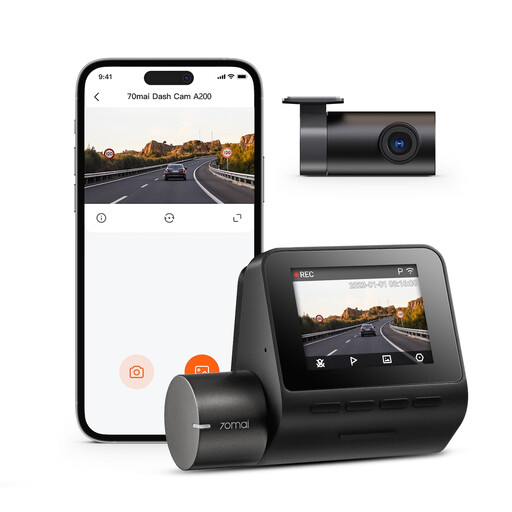
Why this model is a good fit: Ideal for commuters and daily drivers who need reliable dual-channel recording for evidence collection without stretching the budget for a 4K system. Its 1080P resolution is sufficient for most traffic situations.
Instead of advertising a low-quality 4K resolution, this model focuses on high-quality 1080P recording with HDR technology and the proprietary 70mai Night Owl Vision algorithm. This ensures solid performance in low-light conditions.
The front camera records at 60 frames per second (FPS), which ensures smoother videos and better detail capture during motion. It can be controlled either via the built-in screen or through a dash cam app control via Wi-Fi.

Why this model is a good fit: For tech enthusiasts and drivers who demand maximum image quality and a full feature set. The combination of a 4K front camera and a 1080P rear camera provides comprehensive documentation with high detail accuracy.
This model avoids the "fake 4K" pitfall by using a Sony STARVIS 2 sensor. This sensor is renowned for its high light sensitivity and image quality, delivering true 4K recordings with excellent night vision performance.
Integrated dash cam with GPS for recording route and speed. Data transfer and configuration are handled conveniently via dash cam with Wi-Fi and the companion app. A 64 GB memory card is included in the box.
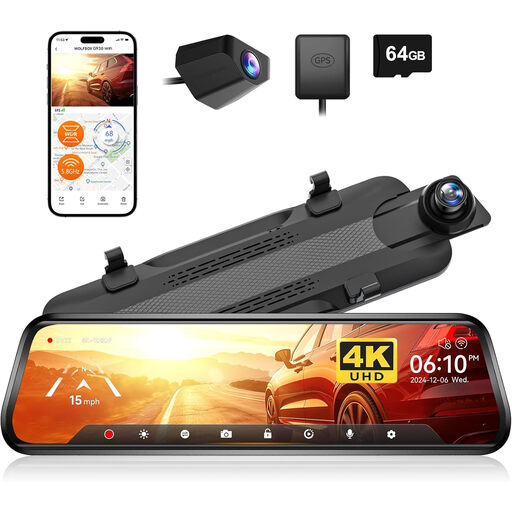
Why this model is a good fit: For drivers who prefer a stealthy solution that integrates seamlessly into the vehicle's interior. This rear-view mirror camera replaces the conventional interior mirror and functions as both a display and a dash cam.
The large 10-inch display offers a wide rear field of view, eliminating the blind spots of traditional mirrors. Its WDR technology also ensures a clear image in difficult lighting conditions and prevents glare from headlights.
Combines a 4K front camera with a rear camera that doubles as a parking aid. The device is operated via a touchscreen and features built-in GPS. A 64 GB card and GPS module are already included.
We have compiled a complete, up-to-date list of products that fully meet these strict selection criteria.
Yes, but their use is subject to local data protection and privacy laws (like GDPR in Europe). Recording must be event-triggered, such as in an accident. Continuous, non-event-based filming of public spaces is generally not permitted. Modern dash cams address this with a loop recording function, which continuously overwrites old footage. Only in the event of an incident (e.g., triggered by the G-sensor) is the relevant sequence saved as a write-protected file.
A reliable parking mode is implemented via a hardwire kit that connects the dash cam directly to the car's fuse box. This kit includes a voltage or battery monitor. It continuously measures the car battery's voltage. If the voltage drops below a predefined threshold (e.g., 11.8V), the monitor cuts power to the dash cam to prevent deep discharge of the battery and ensure the vehicle can still start.
Recording 4K video requires a fast and durable memory card. Due to the large file sizes, a microSD card with a speed class of U3 (UHS Speed Class 3) or V30 (Video Speed Class 30) is required. These guarantee a minimum sustained write speed of 30 MB/s, which is necessary for smooth, stutter-free 4K recording. For capacity, 64 GB to 256 GB is recommended to provide enough space for several hours of driving before loop recording overwrites older files. Before purchasing, check if a card is included with the dash cam.