
Lieferung heute & morgen

Qualitätsgarantie

Willkommens-Angebote freischalten: KOSTENLOSE Lieferung | Bis zu 80 % RABATT | Kostenlose 30-Tage-JoyPlus-Testphase
App herunterladen
Investing in a dash cam is a smart decision for enhancing road safety. A 4K front and rear dash cam can provide crucial evidence in the event of an accident. However, the market is crowded and filled with technical promises that aren't always kept. Many drivers end up with a device that fails at the critical moment.
As your Joybuy Product Recommendation Officer, I'm here to help you identify the common pitfalls and make an informed decision. We'll focus on the facts that truly matter.
Before you choose a model, you should be aware of the most common marketing traps that often lead to disappointment.
To avoid these traps, you should focus on three core technical features. These are the primary determinants of your dash cam's reliability and image quality.
A high resolution is only useful if the sensor can deliver the corresponding data.
A dash cam's reliability is directly linked to its power supply and data storage method.
Modern features significantly enhance the convenience and practical utility of a dash cam.
Based on the criteria above, we have identified several models suitable for different needs and user profiles.
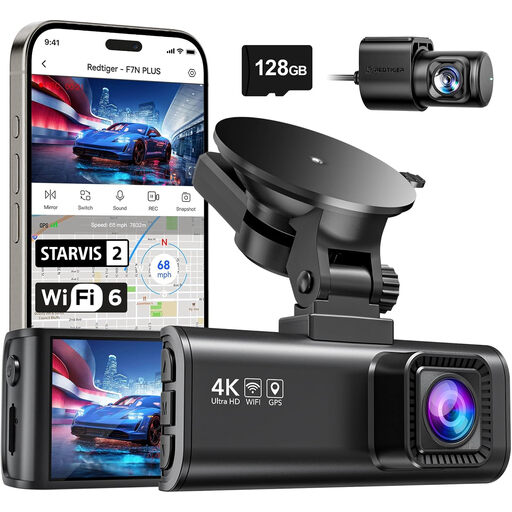
Why This Fits Their Persona: Ideal for commuters and daily drivers who want reliable front and rear documentation of traffic events without unnecessary frills. The combination of a 4K front camera and a solid 1080p rear camera offers a well-rounded safety package.
This model uses a Sony STARVIS 2 sensor for true 4K recordings and good night vision. Instead of a failure-prone battery, it uses a durable supercapacitor, ensuring the reliability of its parking mode.
Balanced performance with true 4K front resolution and fast 5.8GHz Wi-Fi for swift data transfers to your smartphone.
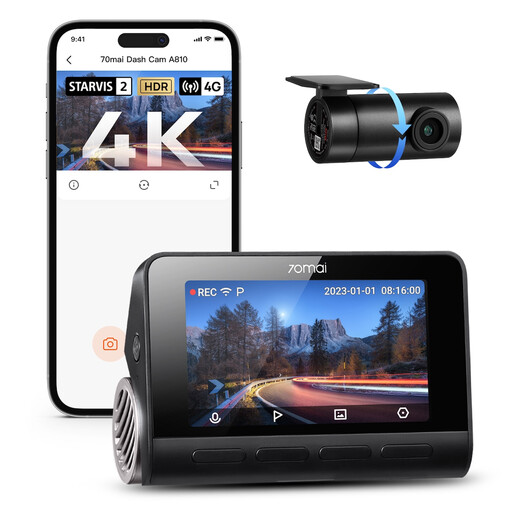
Why This Fits Their Persona: For drivers who value top-tier image quality and cutting-edge technology. This model offers not only 4K but also AI-powered features and the option for 4G connectivity for remote access.
The A810 delivers true 4K HDR footage thanks to its Sony STARVIS 2 IMX678 sensor. The parking mode is supported by an AI motion detection algorithm that more reliably distinguishes between relevant events and harmless movements.
Outstanding image quality day and night due to the advanced sensor and Dual-HDR. The optional 4G connectivity (hardwire kit required) enables remote monitoring and real-time notifications.
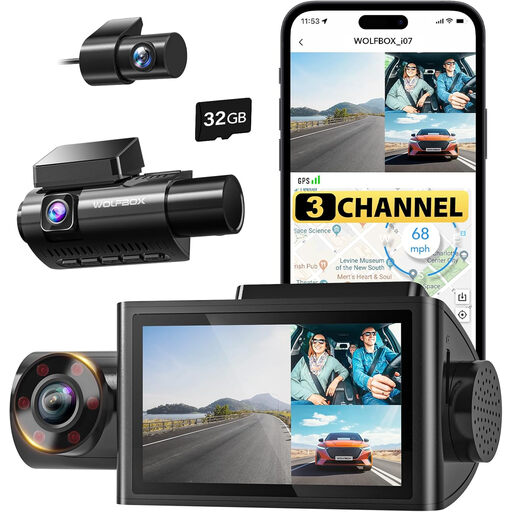
Why This Fits Their Persona: Perfect for drivers who need to monitor not only the road but also the vehicle's interior, e.g., for rideshare services or to document in-car interactions. A true 3-channel dash cam offers comprehensive protection.
Instead of an incomplete solution, this model offers an integrated 3-channel system. The interior camera features infrared LEDs that enable true night vision inside a pitch-black cabin—a feature many cameras lack.
Simultaneous recording of the front (1440P), interior (1080P), and rear (1080P) for complete 360-degree surveillance. Integrated GPS and Wi-Fi are also included.
We have compiled a complete, up-to-date list of products that fully meet these strict selection criteria and relevant regulations.
Yes, using a dash cam is generally permitted in Germany, but it is subject to strict data protection regulations (GDPR). Continuous, non-event-based recording of public spaces is not allowed. Most modern dash cams solve this with loop recording, where old footage is continuously overwritten. Only in the event of an incident (e.g., an emergency recording triggered by the G-sensor) is the relevant clip saved permanently. This event-based storage is generally permissible and can be accepted as evidence in court.
A battery (usually lithium-ion) stores energy chemically and is susceptible to performance degradation in the extreme temperatures found in a car during summer or winter. A supercapacitor stores energy physically and is far more robust against heat and cold. It has a significantly longer lifespan and ensures more reliable operation, especially for demanding parking mode use.
Yes, for most advanced parking modes, a hardwire kit is required. This kit connects the dash cam directly to the vehicle's fuse box, supplying it with power even when the ignition is off. It typically includes a low-voltage cutoff feature that protects the car's battery from deep discharge by cutting power to the camera if the battery voltage drops to a critical level.