
Lieferung heute & morgen

Qualitätsgarantie

Willkommens-Angebote freischalten: KOSTENLOSE Lieferung | Bis zu 80 % RABATT | Kostenlose 30-Tage-JoyPlus-Testphase
App herunterladen
Purchasing a dash cam is a smart investment in your vehicle's security. In the event of ambiguous accidents or parking damage, a high-quality recording can be decisive. Models that combine a front and rear 4K dash cam offer a comprehensive record of traffic events. This article serves as a guide to help you understand the technical features of modern car cameras and make an informed choice. We will introduce you to various models and their specific functions so you can find the right device for your needs.
The selection of models is vast, but a few core features are crucial for reliable performance. While a hands-on dash cam test of the features before purchase isn't possible, the technical specifications provide a clear indication of performance.
A 4K resolution (3840 x 2160 pixels) for the front camera has become the standard for highly detailed recordings. It allows you to clearly identify important details like license plates or street signs, even from a distance. A second camera for the rear, often recording in 1080P (Full HD) or 2K, completes the all-around view and seamlessly documents rear-end collisions. In addition to resolution, pay attention to the Field of View (FOV), measured in degrees. Values around 140° for the front camera offer a good balance between a wide-angle perspective and image distortion.
Modern dash cams are more than just cameras. The following features offer significant added value:
The use of dash cams in Germany operates within a specific legal framework. Continuous, indiscriminate filming of public spaces is not permitted due to data protection regulations (GDPR). Modern dash cams solve this problem with the Loop Recording feature: the device records in short intervals and automatically overwrites the oldest files. Only when the G-sensor detects an incident is the relevant sequence saved as a write-protected file. Such event-based recording is generally permissible and can be accepted as evidence in court, although the decision rests with the court in each individual case.
Based on the criteria mentioned, we have compiled a selection of models with different specialisations.

Why it stands out: The DDPAI Z50 Pro combines high image quality with modern connectivity. The integration of Wi-Fi 6 enables exceptionally fast data transfer to the app, noticeably speeding up access to 4K video files. According to the manufacturer, the implemented NightVIS 2.0 technology aims to improve image quality at night.
Advantages:
Who is it for? This model is an excellent choice for tech-savvy drivers who value high resolution, fast data transfer, and reliable additional features like ADAS (Advanced Driver-Assistance Systems).
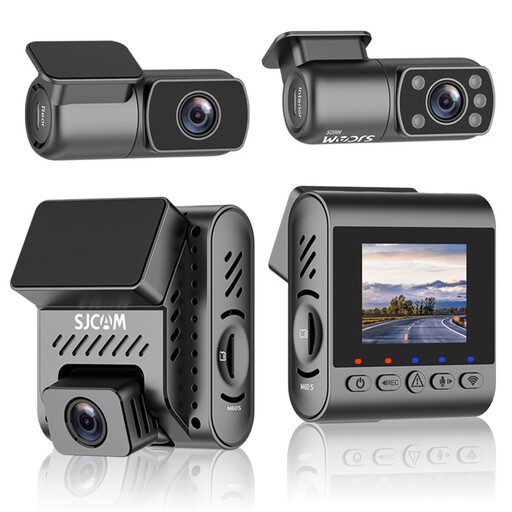
Why it stands out: With three cameras, the SJCAM M60S offers exceptionally comprehensive surveillance. In addition to the front and rear cameras, a third camera records the vehicle's interior, making it particularly interesting for professional drivers or families.
Advantages:
Who is it for? Ideal for drivers of taxis, ride-sharing services (Uber), or company vehicles who need to document not only traffic events but also the interior seamlessly. The interior camera can also be useful for parents.
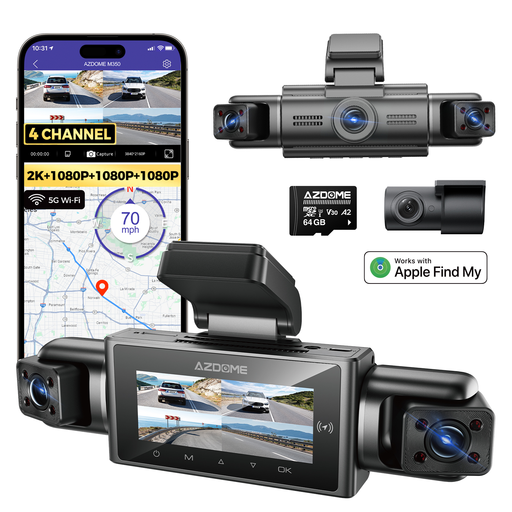
Why it stands out: According to the manufacturer, the AZDOME M350 is the first dash cam with native integration of the Apple Find My network. This allows you to locate your vehicle worldwide via Apple's "Find My" app without needing an additional SIM card or subscription. The four cameras also cover all sides of the vehicle.
Advantages:
Who is it for? This model is primarily aimed at Apple users who want seamless integration into their ecosystem and a reliable location feature for their vehicle. The 4-channel recording also provides maximum surveillance.
The models presented here cover specific use cases. If you are looking for other options or different configurations, you can find a wider selection in our assortment.
Discover more models in our wireless dash cams category.
Yes, their use is permitted under certain conditions. The crucial factor is that no permanent, indiscriminate recording takes place. Modern devices meet this requirement through the Loop Recording feature, where a sequence is only permanently saved in the event of an incident (e.g., triggered by the G-sensor). The admissibility of recordings as evidence in court is decided on a case-by-case basis but is generally possible.
Parking mode is usually implemented via a G-sensor. If it detects a vibration (e.g., a parking bump) while the car is parked, the dash cam turns on and saves a short, write-protected video sequence. Some models also use a time-lapse mode for continuous but storage-efficient surveillance. For reliable operation, a constant power supply via a hardwire kit connected directly to the car battery is necessary.
A high-performance microSD card is essential for recording 4K video. A card with a speed class of U3 (UHS Speed Class 3) and a video class of V30 is recommended to ensure smooth, error-free recording. Furthermore, "High Endurance" cards are advisable as they are designed for the constant writing and overwriting cycles in a dash cam and have a longer lifespan. Also, pay attention to the maximum supported storage capacity of the respective dash cam model.